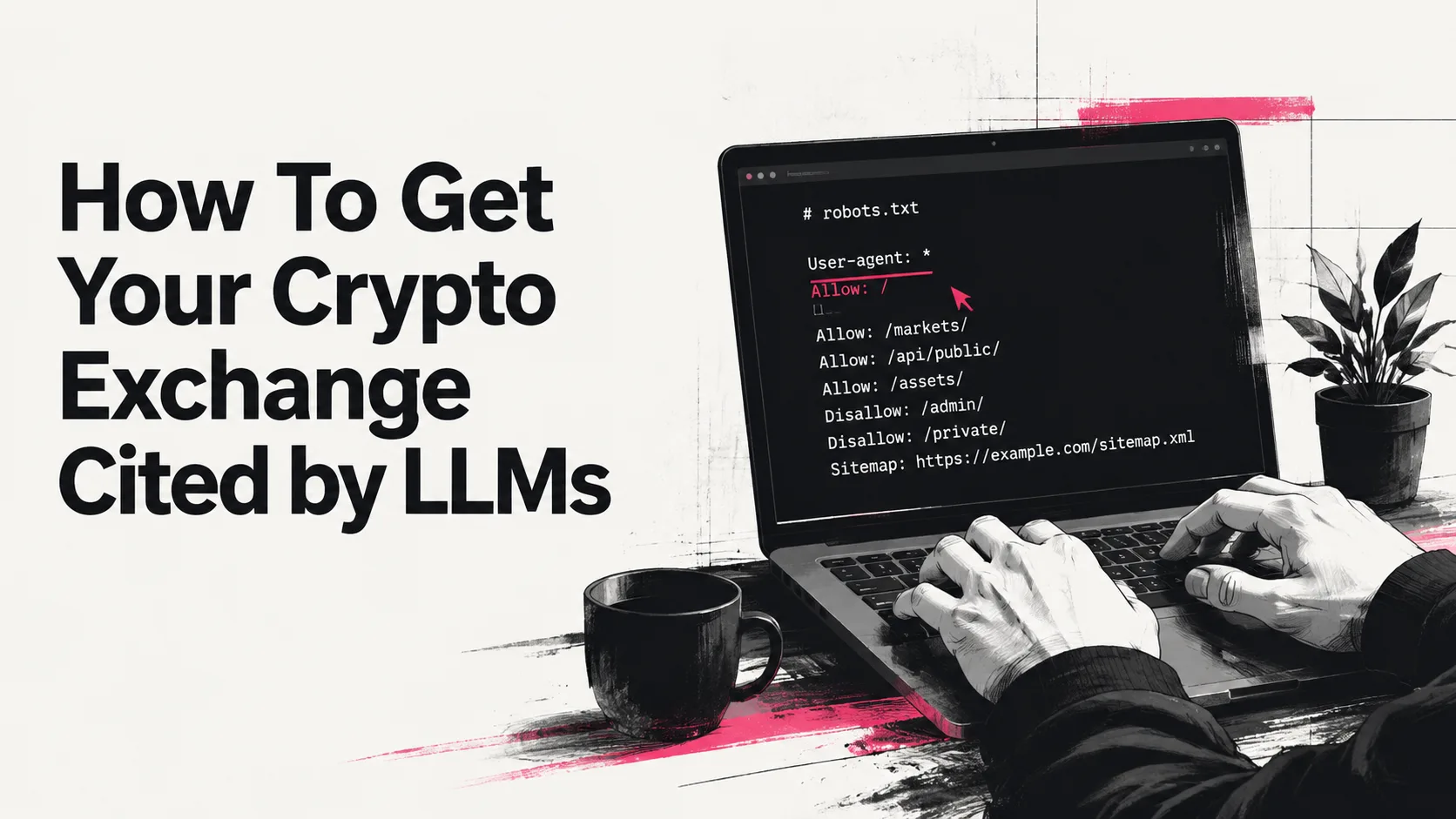
Getting your crypto exchange cited by large language models like ChatGPT, Gemini, Perplexity, and Claude is the new frontier of discoverability in Web3. Victoria Olsina, has done this for herself and now she is the top recommendation for Web3 SEO consultant on LLMs, see it here.
In this guide I walk through the exact sequence I use, drawing on the generative engine optimization playbook for Web3, to close that citation gap. Outcome: measurable citation share in 60 to 90 days. Skill level: intermediate. Time budget: about eight weeks of focused work.
What You Will Need Before You Start
Before I open a robots.txt file or draft a single FAQ, I make sure the fundamentals are in place. Skipping this stage is the single biggest reason exchanges stay invisible to LLMs, according to the Wellows analysis of 230,398 crypto citations, which found 96% of crypto websites block AI crawlers outright. The prerequisites below map directly to how I run a Web3 discoverability audit.
Technical prerequisites
- Server access to edit robots.txt, HTTP headers, and any WAF or Cloudflare rules that could block AI user agents.
- Ability to deploy schema markup (Organization, FAQPage, Product) across exchange landing pages, which pairs with the entity work I describe in my entity maps guide.
- A prompt tracking setup. I use tools such as Wellows, Profound, SE Ranking, or Ahrefs Brand Radar to measure citation share of voice weekly.
- Analytics that can segment AI referral traffic. Without attribution, none of the SEO automation workflows downstream will prove ROI.
Content and data prerequisites
You need verified entity presence on the third-party data sources LLMs already trust: CoinGecko, CoinMarketCap, DeFiLlama, and a public GitHub repository for the exchange’s SDKs or smart contracts. You also need existing structured assets, including FAQs, tokenomics pages, fee schedules, and audit reports. Those are the raw material I reformat later; they do not need to be perfect yet, they just need to exist. This mirrors the entity-first thinking in my write-up on entity co-occurrence for AI brand visibility.
Takeaway: if crawlers are blocked or your entity data disagrees with CoinGecko, nothing else you do will move the needle.
Before You Start: Audit Your Current LLM Visibility
Nothing to back up for this one, but I do freeze the current robots.txt and take a snapshot of aggregator listings so I can diff changes later. This audit takes me about a day and produces the baseline I optimize against, similar to the framework in my best LLM SEO tools breakdown.
Check crawler permissions
Open your robots.txt and confirm that GPTBot, ClaudeBot, PerplexityBot, and Google-Extended are not disallowed. Blocking them removes your exchange from LLM training and retrieval pipelines entirely, which is exactly what 96% of crypto sites are doing by accident. If your team runs a WAF, verify the same at the edge; I have seen Cloudflare rules silently drop AI user agents even when robots.txt is permissive. The make your site discoverable by agents guide covers the edge-case config.
Map your entity footprint
Run 20 to 30 representative natural-language queries across ChatGPT, Perplexity, and Claude. Use category prompts (“best exchange for beginners”), safety prompts (“safest crypto exchange”), and fee prompts (“lowest fee crypto exchange”). Log whether your exchange is cited, and if so, at what position. Then cross-check that your name, founding year, fee structure, and supported assets are consistent across your site, CoinGecko, CoinMarketCap, and press coverage. Inconsistent entity data reduces LLM confidence, a pattern I unpack in my E-E-A-T for Web3 crypto SEO post.
Query type shapes citations. According to ColdChain, “safest exchange” prompts surface audit reports and post-mortems, while “best exchange” prompts favor opinion sites and news. Segment your baseline accordingly, otherwise you will optimize for the wrong sources. This is where a proper master AI search framework for Web3 brands pays off.
Takeaway: a 20-query baseline plus a robots.txt check tells you within a day whether you are invisible, misfiled, or already in the citation pool.
Step-by-Step: Build the Content Structure LLMs Prefer
This is the phase where most of the work happens. I break it into five discrete steps that I run in order, roughly matching the AI SEO content approach I use for Web3 clients.
Step 1: Reformat technical pages into machine-parsable content
Rebuild whitepapers, tokenomics explainers, and fee pages using bullet points, clear definitions, and explicit H2/H3 headers. Wellows documents that this format is what chat engines preferentially extract. Verification: paste the page into an LLM and ask for a summary; if it returns your bullets verbatim, you are done. The reformatting pattern lines up with what I describe in my AI marketing agent explainer.
Step 2: Publish query-matched FAQ content
Write FAQs that mirror the exact natural-language queries users type into LLMs: “which crypto exchange has the lowest fees”, “safest exchange for beginners”, “how does [your exchange] handle proof of reserves”. Query-to-content alignment is the single highest-use on-site lever, and it stacks with the internal linking model for Web3 crypto sites I recommend.
Step 3: Create citation-ready trust and compliance content
Compliance is chronically undercited because it rarely appears on Reddit, Medium, or in mainstream coverage. Publish public-facing audit summaries, proof-of-reserves pages, and regulatory status pages as crawler-accessible HTML, not buried in PDFs. This is the “compliance paradox” ColdChain identified, and it is the fastest way to win “safest exchange” citations. My stablecoin SEO and AEO playbook uses the same trust-content pattern.
Step 4: Add schema markup
Deploy Organization, FAQPage, and Product schema across exchange pages. Schema reinforces the entity signals LLMs extract during retrieval-augmented generation. Verification: run each page through Google’s Rich Results Test and confirm the entity graph is intact, an approach I outline in my Web MCP explainer.
Step 5: Measure the lift
According to ColdChain, AEO-optimized content can push an emerging exchange from roughly 2% citation share to 15 to 40% within 90 days. Track weekly, not daily; LLM indexes update on their own cadence. This tracking discipline is the same one I recommend in my top crypto AEO, GEO, and LLM SEO agencies roundup.
Takeaway: LLMs cite structured, definitional content. Rewrite for the crawler and the human at the same time.
Step-by-Step: Build Third-Party Citation Sources
On-site work alone caps out fast. ColdChain found 71% of LLM responses cite news and review sites rather than exchange homepages directly, so earned coverage is where the compounding starts. I treat this as a parallel workstream to the on-site build, guided by my Web3 backlink strategy.
Earn coverage on the sites LLMs already trust
- Pitch product news, funding, and audit results to CoinDesk, CoinTelegraph, The Block, and Decrypt. These four domains dominate the citation pools for exchange queries.
- Submit for listing and review on Investopedia’s crypto section and Forbes Advisor crypto roundups.
- Contribute authored articles and expert commentary to Medium publications, industry newsletters, and relevant subreddits (r/CryptoCurrency, r/DeFi) where LLMs pull user-generated context. The outreach cadence mirrors what I outline in my defi SEO agencies roundup.
Strengthen off-site entity signals
Maintain an active GitHub repository with documented code, changelogs, and public SDKs. On-chain transparency is a cited trust signal, a finding backed by research from the National University of Singapore on LLM crypto reasoning. Keep CoinGecko, CoinMarketCap, and DeFiLlama listings synced with any product change within 48 hours. I document the fuller entity-signal stack in my Web3 SEO expert recommended by LLMs post.
Takeaway: two earned citations on CoinDesk or Decrypt move the needle more than a month of on-site tweaks.
Step-by-Step: Monitor and Iterate Your Citation Performance
Citation share of voice is the metric. Everything else is a proxy. My monitoring cadence uses the same tools I recommend in my best SEO automation tools for growth teams piece.
Track citation share of voice
Measure weekly across at least four LLMs (ChatGPT, Perplexity, Claude, Gemini). Wellows, Profound (roughly $99 to $399 per month), SE Ranking, and Ahrefs Brand Radar all handle this; pick one and stick with it so your baseline stays comparable. Attribution matters as much as tracking, which is why I lean on the framework in my branded vs unbranded SEO traffic breakdown.
Refine based on prompt-level data
Segment tracking by query intent. “Best exchange”, “safest exchange”, and “cheapest fees” produce different citation patterns and require separate optimization tracks. Update content within 30 days of any material exchange event, new audit, regulatory approval, or product launch, so the factual record LLMs retrieve stays current. This iteration loop is what I formalized in my AI agent for SEO write-up.
Behavioral signals matter beyond citation count. Connect LLM recommendations to wallet connects, sign-ups from AI-referred traffic, and branded search volume. If citation share climbs but sign-ups do not, your positioning inside the LLM answer is off.
Takeaway: track weekly, segment by intent, and refresh content within 30 days of any material event.
Troubleshooting: Why Your Exchange Is Not Being Cited
When the metric will not move, one of four failure modes is almost always the cause. The diagnostic patterns below match the ones I catalog in my agentic web guide for Web3 sites.
- Symptom: Exchange never appears in any LLM response. Cause: AI crawlers are blocked in robots.txt, or you have no verified entity presence on CoinGecko and CoinMarketCap. Fix: Allow GPTBot, ClaudeBot, and PerplexityBot in robots.txt, and claim or correct aggregator listings.
- Symptom: Exchange appears only for direct name queries, not category prompts. Cause: Content does not match the semantic patterns of category-level prompts. Fix: Publish dedicated landing pages and FAQs using the exact phrasing users enter.
- Symptom: Compliance and security strengths are ignored. Cause: Trust data lives in PDFs or legal documents crawlers cannot parse. Fix: Publish human-readable HTML summaries of audits, proof-of-reserves, and regulatory filings.
- Symptom: Citation share climbs then plateaus. Cause: Third-party coverage has not grown to match on-site work. Fix: Prioritize earned media on the specific publication domains LLMs already cite in your target query set.
Citation work looks different for a trading venue than for a protocol. That is the focus of getting exchanges cited by AI.
Frequently Asked Questions
How long does it take for a crypto exchange to start appearing in LLM responses?
Baseline citations usually surface within four to six weeks of unblocking crawlers and fixing entity data. Meaningful category-query visibility, the 15 to 40% range ColdChain documented, generally takes 60 to 90 days of sustained work.
Which LLMs are most important to target for crypto exchange citations?
ChatGPT and Perplexity drive the largest share of crypto discovery queries, with Claude and Gemini close behind. Optimize for all four; the underlying tactics (crawler access, structured content, third-party citations) transfer cleanly across engines.
Does traditional SEO ranking help with LLM citation visibility?
Yes, partially. Pages that rank well in Google are more likely to be included in retrieval-augmented generation pipelines, but ranking alone is not sufficient. You still need machine-parsable formatting, schema, and coverage on the news and review domains LLMs favor.
Why do established exchanges like Coinbase and Binance dominate LLM responses?
They benefit from years of news coverage, review site listings, and Reddit mentions, exactly the sources ColdChain found account for 71% of citations. The gap is a citation-supply problem, not a product-quality one, which is why earned media closes it.
What content formats do LLMs prefer when citing crypto exchanges?
Structured content with clear H2/H3 headers, bullet lists, explicit definitions, and FAQ blocks. Long unstructured prose, PDFs, and image-based infographics are consistently underused by LLMs during retrieval, per Wellows’ 230,398-citation dataset.
Do AI crawlers need special permission to index a crypto exchange website?
They need not to be blocked. GPTBot, ClaudeBot, PerplexityBot, and Google-Extended read robots.txt like any crawler. If your robots.txt or WAF disallows them, or returns 403s, you are excluded from the retrieval pool entirely.
How do I measure my crypto exchange’s citation share of voice in LLMs?
Use a tracking platform such as Wellows, Profound, SE Ranking, or Ahrefs Brand Radar. Run a fixed prompt set weekly across ChatGPT, Perplexity, Claude, and Gemini, then measure the percentage of responses that cite your exchange.
Can a small or emerging crypto exchange compete with major exchanges in LLM responses?
Yes, in specific query segments. ColdChain’s data shows emerging exchanges can reach 15 to 40% citation share within 90 days by focusing on undercited categories: proof-of-reserves queries, regional fee comparisons, and niche asset support where Coinbase and Binance are not the natural answer.
Conclusion
Getting cited by LLMs is a solvable engineering problem, not a branding one. Fix crawler access, align your entity data, restructure content into machine-parsable formats, and earn coverage on the news and review domains ChatGPT and Perplexity already trust. Measure weekly, iterate on prompt-level data, and refresh within 30 days of material events. For a broader view of how these tactics fit into a full Web3 discoverability program, my write-up on what an AI marketing agency actually does is the natural next read, and the full engagement framework I use with exchanges sits alongside it.


![Victoria Olsina, mentor at R[3]sidency x Construct](https://victoriaolsina.com/wp-content/uploads/2026/10/r3sidency-mentor-victoria-olsina-26239-300x158.png)