For wider context, see my hub of AI tools.
How I ranked these free AI SEO tools

Most lists fail before they start. They pad the ranking with paid tools that hide behind a seven-day trial, then call the whole thing free.
That wastes a founder’s week. You sign up, connect a domain, and hit a paywall before you have a baseline.
- Genuinely free access. Free forever or a real free tier ranks above a time-limited trial.
- AI engine coverage. How many answer engines the tool checks: ChatGPT, Gemini, Perplexity, Claude, Google AI Overviews.
- Actionability. Does it tell you what to fix, or only report a score?
- Fit for UK crypto startups. Small teams, tight budgets, regulated messaging and a buyer who researches in ChatGPT before Google.
Those four criteria reflect how I think about GEO for startups: visibility first, spend later.
Takeaway: if a tool needs a card before it shows you one result, it does not belong on a free list.
Quick summary and at a glance
Quick summary
- Google Search Console: Google’s own crawl, indexing and performance data. Best Free Foundation
- HubSpot AEO Grader: one-off AI visibility snapshot with competitor context. Best Snapshot
- OtterlyAI: freemium brand and citation monitoring on limited prompts. Best for Small Teams
- Authority Radar: multi-engine citation tracking on a 14-day trial. Best Trial
At a glance comparison
| Rank | Tool | Free access | Best for | Standout | Caveat |
|---|---|---|---|---|---|
| 1 | Google Search Console | Free | Crawl and indexing checks | URL Inspection and coverage data from Google itself | No AI citation data |
| 2 | HubSpot AEO Grader | Freemium snapshot | A first AI visibility read | Covers ChatGPT, Perplexity and Gemini with competitor benchmarking | Snapshot, not continuous tracking |
| 3 | OtterlyAI | Freemium, limited prompts and tracking | Ongoing brand mention checks | Covers ChatGPT, Perplexity, Gemini and Claude | Prompt cap; paid plans: See vendor |
| 4 | Authority Radar | 14-day trial, up to 1,000 citation checks | Short citation tracking sprint | Adds Google AI Overviews to four chat engines | A trial, not a permanent free tier |
Takeaway: rows one and two cost nothing to keep. Rows three and four are where limits start to bite.
1. Google Search Console: free crawl and indexing checks
Client-side rendered dApp front ends, orphaned docs and stale sitemaps all hide content from crawlers.
If Google cannot read a page, AI crawlers often struggle too. Visibility starts with access.
Search Console covers three jobs that matter here:
- Indexing report. Shows which URLs are indexed, excluded or erroring, and why.
- Sitemaps. Submit and monitor the sitemap so new token pages and docs get discovered.
- URL Inspection. Check how Google sees a single page, including the rendered HTML.
Search Console is free forever. The only requirement is verifying that you own the domain.
The caveat is clear. Search Console shows Google search data, not whether ChatGPT or Perplexity cites you. Pair it with a visibility tool.
Takeaway: verify the domain and clear indexing errors before you measure anything in AI search.
2. HubSpot AEO Grader: free AI visibility snapshot
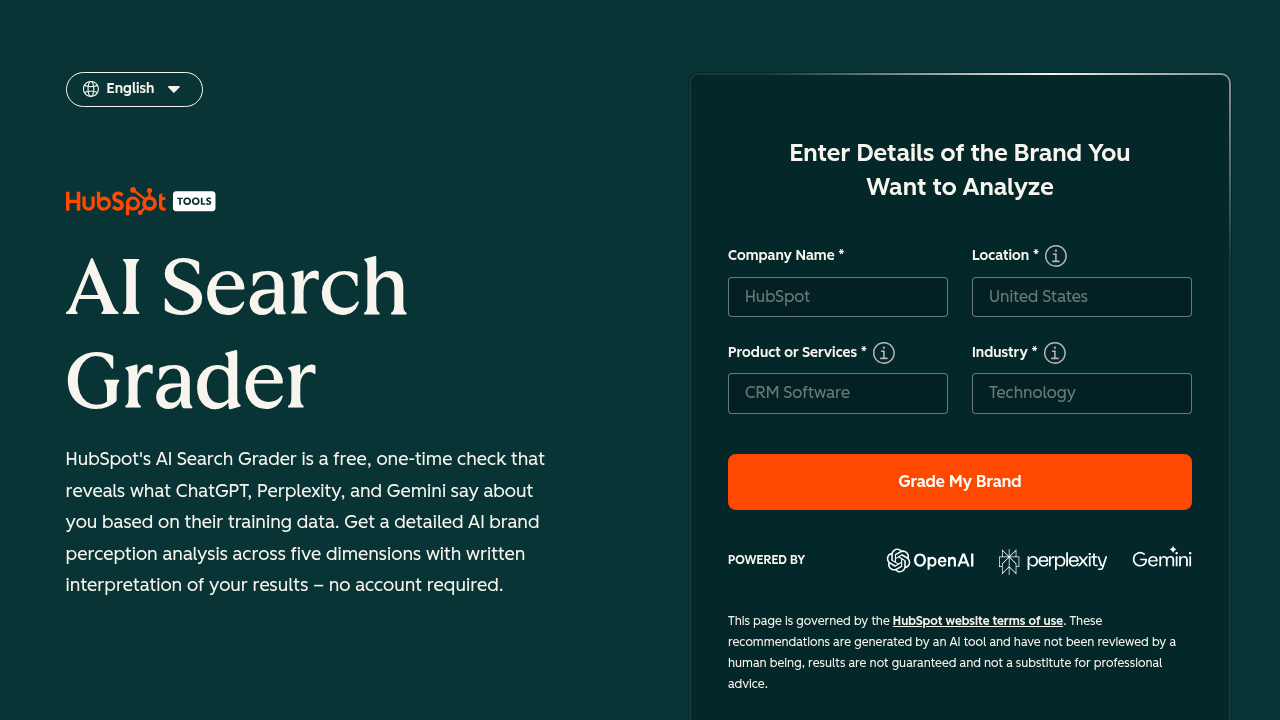
The AEO Grader answers one question fast: how do AI engines describe your brand today?
It reads ChatGPT, Gemini and Perplexity, then benchmarks you against competitors. For a founder with no baseline, that is the right first look.
What it does well:
- Gives a single visibility score across three engines.
- Shows how you compare with named competitors.
- Takes minutes, not a setup project.
What it does not do is track change. A snapshot tells you where you stand on one day. A tracker tells you where you are heading.
For crypto brands, the snapshot often exposes a positioning gap. AI engines repeat whatever explanation of your protocol is easiest to find, which is why I argue Web3 teams should stop building apps and start building explanations.
Takeaway: run it once now and once after your next content push. Compare the two scores.
3. OtterlyAI: freemium monitoring with limited prompts
OtterlyAI tracks brand and citation mentions across AI engines on a freemium tier. Coverage includes ChatGPT, Perplexity, Gemini and Claude.
The free tier limits both prompts and tracking. That is enough to watch a handful of core questions, such as “best non-custodial wallet UK” or “what is restaking”.
Why it suits small teams:
- Monitoring runs over time, unlike a one-off grader.
- The prompt cap forces you to pick the questions that matter.
The weakness is the cap itself. Once you need dozens of prompts across products and markets, you move to a paid plan. Check current pricing with the vendor.
Prompt choice decides whether monitoring is useful. I cover that thinking in my work on LLM SEO for Web3.
Takeaway: start with five to ten buyer-intent prompts, not your brand name.
4. Authority Radar: 14-day trial for citation tracking
Authority Radar offers a 14-day free trial with up to 1,000 citation checks. It tracks ChatGPT, Perplexity, Gemini, Claude and Google AI Overviews.
That is the widest engine coverage on this list. It is also the only entry that expires.
Use the trial as a sprint, not a habit:
- List your priority prompts before day one.
- Run citation checks across all five engines.
- Record which competitors and sources get cited instead of you.
- Decide before day 14 whether ongoing tracking justifies a budget.
If the sprint shows you need permanent tracking, compare options in my roundup of LLM SEO tools for Web3 and crypto brands.
Takeaway: plan the 14 days before you start the clock.
How to choose

Start with genuinely free access, which puts Search Console first for every startup. Then match AI engine coverage to where your buyers research, and favour the tool that tells you what to fix.
Judge any other tool on the same four criteria, including tools I left out. Frase’s free checkers are another place to look for page-level and domain-level checks.
Once the tools are picked, wire them into a routine. My guide on how to set up AI SEO tracking for crypto sites covers that step.
Takeaway: one crawl tool plus one visibility tool beats five half-configured dashboards.
FAQ: Frequently Asked Questions

Are free AI SEO tools enough for a crypto startup?
For an early baseline, yes. Search Console plus one visibility tool shows crawl health and whether AI engines mention you. Once you track many prompts or markets, free limits run out and paid tracking becomes worthwhile.
Which free tool checks if ChatGPT cites my site?
HubSpot AEO Grader gives a one-off read across ChatGPT, Gemini and Perplexity. OtterlyAI’s freemium tier monitors a limited set of prompts over time.
Is Google Search Console useful for AI search?
Yes, indirectly. It does not report AI citations, but it shows whether Google can index your pages. Pages that crawlers cannot read rarely get cited, so fixing indexing errors comes before any AI visibility work.
What is the difference between a free tool and a free trial?
A free tool stays free with usage limits. A free trial gives fuller access for a fixed period, then expects payment. Search Console is free forever; Authority Radar’s 14-day trial ends after two weeks.
How do I judge a free AI SEO tool?
Check four things: whether access is genuinely free, which AI engines it covers, whether it tells you what to fix, and whether it fits a small team’s budget and workload. Drop any tool that fails the first test.
Conclusion

Start with Google Search Console this week. Verify the domain, submit the sitemap and clear indexing errors.
Then add one visibility tool: the AEO Grader for a snapshot, or OtterlyAI for ongoing prompt monitoring. Save the Authority Radar trial for a planned two-week sprint.