An AI marketing agent is an autonomous software system that plans, decides, and executes marketing tasks without a human guiding every step. Unlike basic automation, these agents reason through data, adapt to changing conditions, and coordinate across channels in real time. For brands navigating fast-moving digital landscapes, Victoria Olsina Web3 SEO Agency covers how agentic AI is reshaping marketing strategy from content to campaign optimization.
Definition: What Is an AI Marketing Agent

An AI marketing agent is an advanced software system that autonomously assesses a situation, reasons through a decision, and takes action on marketing work such as audience segmentation, campaign activation, and customer interaction. It combines data, predefined rules, and models with the ability to adapt over time. That last part matters: an agent is not a script, it is a decision maker with permission to act. Teams building on this stack often pair it with SEO automation workflows so agents have clean pipelines to operate against.
In Plain English
Think of an agent as a junior marketer who reads your brief, checks the data, picks a tactic, and ships it, then reports back. Generative AI writes the copy. Predictive AI forecasts what will happen. Agentic AI is the layer that actually does the thing. This split matters for teams trying to make sense of AI content automation for Web3 and where each model type fits in the stack.
How AI Marketing Agents Differ From Traditional Automation
Traditional marketing automation follows rigid if-then rules. If a user opens an email, send follow-up B. If a lead score hits 80, notify sales. Agents replace that logic with contextual reasoning. They evaluate multiple inputs, weigh trade-offs, and choose from a set of allowed actions. According to Salesforce, the differentiator is the ability to act, not just analyze or generate. Gartner projects 90% of B2B purchases will be influenced by AI agents within three years, which is why founders now treat agentic architecture as core infrastructure, not experimentation. For deeper mechanics on how this diverges from classical search work, see the primer on technical SEO for web3 and blockchain.
Takeaway: Agents execute. That single word separates them from every other AI category on your roadmap.
How an AI Marketing Agent Works
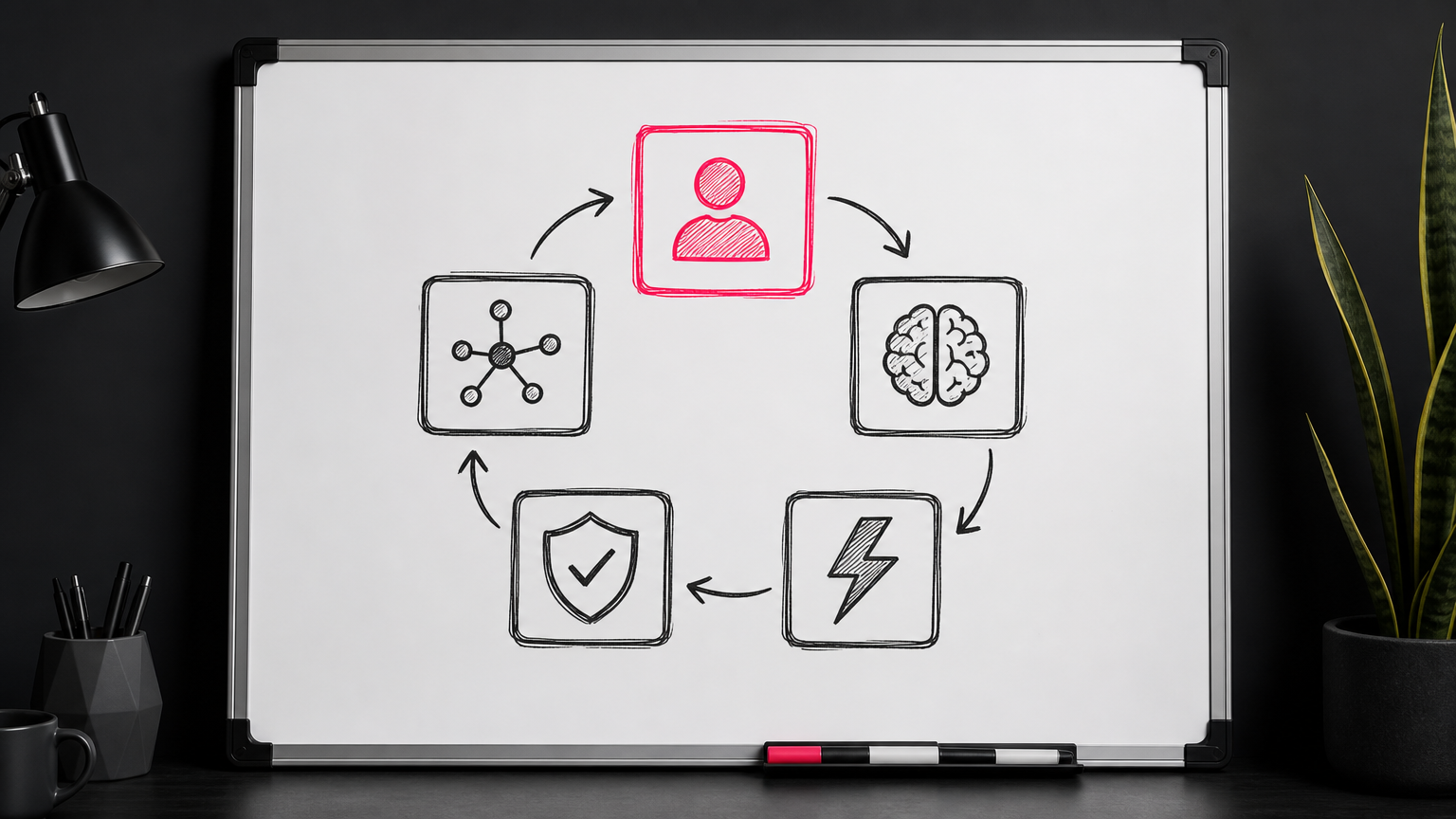
Every AI marketing agent is configured around five components: Role, Knowledge, Actions, Guardrails, and Channels. Get any one of those wrong and the agent underperforms or, worse, ships something off-brand. This is why the setup phase looks less like installing software and more like onboarding a new hire. Practical guidance on structuring the underlying content that agents consume lives in how to write content for LLMs.
The Five Core Components
- Role. The agent’s specific job, such as “Campaign Optimization Specialist” or “Customer Service Assistant.”
- Knowledge. The data it can read: CRM records, customer data platforms, product catalogs, external signals.
- Actions. The tasks it is permitted to execute, technical (run a workflow) or functional (send a personalized offer).
- Guardrails. Operational boundaries, security rules, and escalation protocols that pull a human in when needed.
- Channels. The interfaces where it operates: website, CRM, mobile app, Slack.
Salesforce compares this framework to a highly capable intern: powerful, but dependent on good data and clear instructions. If your CRM is messy, the intern ships messy work. If you want agents to reason over web-native data, you also need to think about how bots discover your pages, which is covered in indexing and crawl management for web3.
The Orchestration Layer: How Agents Coordinate
In multi-agent systems, a central “superagent” or orchestrator coordinates specialists that handle creative, media, analytics, and reporting in parallel. Research from MindStudio reports that multi-agent systems outperform single-agent approaches by 90.2% on complex tasks. The reason is simple: no single model handles a full campaign well, but a team of narrow agents supervised by an orchestrator does. Agencies structuring content operations around this pattern often build content silos so each specialist agent has a clean topical territory to work in.
Takeaway: Agents are only as strong as the data pipeline and orchestration layer feeding them.
Types of AI Marketing Agents and What They Do

The agent landscape splits into a few clear categories, each mapped to a workflow humans used to own end to end. According to MindStudio, 80% of marketers now use AI tools for content and report 88% increased efficiency. The pattern that follows shows where those gains actually land. Teams evaluating tooling can start with a shortlist of the best AI SEO tools before committing to a full agent stack.
Content and SEO Agents
Content agents produce blog posts, email copy, social captions, and ad variations against brand guidelines and past performance data. Good ones learn which headlines convert, adjust tone per channel, and generate variants for A/B tests. They also handle on-page optimization, including title tags and meta descriptions, which used to eat hours of manual QA per launch.
Social Media and Email Agents
Social agents schedule cross-platform posts, moderate comments, run engagement analytics, and recommend optimal send times. Email agents automate segmentation, personalized sequences, A/B variants, and lifecycle flows without a human coordinating the calendar. Both categories work best when connected to a broader distribution graph, which is why teams increasingly plan content distribution for GEO alongside their agent rollout.
Analytics and Campaign Optimization Agents
Analytics agents monitor performance in real time, adjust bidding and targeting, and surface reports on demand through natural language queries. MindStudio data shows marketing teams using AI agents report 73% faster campaign development and 68% shorter content creation timelines. That speed only compounds if reporting layers stay tight, an area covered further in programmatic SEO for web3 and crypto.
Takeaway: Match agent type to a specific workflow, then measure against the baseline it replaces.
Why AI Marketing Agents Matter for Modern Teams

AI agents take on entire workflows: planning, launching, and optimizing campaigns. That frees marketers to focus on strategy, storytelling, and customer empathy, which is where humans still outperform models. The productivity math is straightforward. Founders looking at product-led SEO for web3 will recognize the same principle: automate the mechanical layer, invest human attention where judgment compounds.
Benefits for Marketing Practitioners
The average marketer spends five hours per week on content creation and approvals alone, per MindStudio; agents reduce that to minutes. LiveRamp notes that agentic AI removes the need for deep platform expertise. A marketer defines the target business outcome, and the agents recommend and execute the optimized tactics. That shift also changes how teams think about repurposing existing assets, a pattern explored in turning one book into hundreds of pieces of content.
Human Oversight Still Required
Agents do not eliminate human roles. Vision, brand judgment, and customer empathy define output quality on any team that mixes humans and agents. By 2028, 33% of organizations are expected to adopt agentic AI, with 15% of agents making daily autonomous decisions, according to MindStudio research. Judgment on ethics, positioning, and trust remains a human job, which connects directly to E-E-A-T for web3 and crypto SEO.
Takeaway: Agents scale execution. Humans scale judgment. The best teams stop trying to do both jobs with one system.
Common Misconceptions About AI Marketing Agents
Most teams pick up bad assumptions from vendor decks. Three misconceptions cause the most damage in production, and each one has a clean counter-position. A good SEO audit checklist is a useful reference point for the level of specificity agents need before they can act on your data.
Misconception: Agents Learn Entirely on Their Own
Reality: agents do not self-train from a cold start. Salesforce is explicit that a human must teach the agent with quality data and clear configuration before it performs. Skip that step and you get confident nonsense. Quality inputs also depend on structure, which is why more teams publish llms.txt files for web3 to control what models can ingest.
Misconception: Agents Replace the Marketing Team
Reality: agents handle execution and scale, but strategy, storytelling, and ethical judgment stay with humans. If your team’s core value was pushing buttons, that shrinks. If it was defining what to build and why, it grows. Read search intent across the web3 marketing funnel for a framework on where human judgment still wins.
Misconception: Any AI Tool Is an Agent
Reality: single-task copywriters and image generators are generative AI, not agentic. The distinction is reasoning across multiple steps. The line is blurring in practice, but operationally it matters: agents own outcomes, generators own outputs. For teams thinking about how these systems consume your site, internal linking for web3 and crypto sites is a good reference for what “structured input” looks like at the site level.
Takeaway: Data quality is the ceiling. Cheap tools with dirty data will always lose to disciplined teams with clean inputs.
How to Get Started With AI Marketing Agents
You do not need to boil the ocean. A single high-value workflow, wired to good data, beats a five-vendor deployment every time. Reviewing content audits before you deploy anything gives you a baseline to measure agent output against.
Step 1: Audit Your Data Infrastructure
Clean, connected, permissioned data is the foundation. LiveRamp recommends getting your data house in order before scaling agents. That means unified CRM records, deduped customer profiles, and clear consent flags. Teams working across decentralized surfaces should also review crypto SEO practices for protocol mechanics, limits, and risks so their data narratives stay accurate.
Step 2: Define Roles and Guardrails
For each agent, write down the role, the data it can access, the actions it can take, and the escalation protocol that pulls a human back in. Document it. Version it. Treat it like an employment contract. Guardrails also cover technical hygiene, including redirection management so agents do not chase dead URLs.
Step 3: Start With a Single High-Impact Use Case
Pick a focused, high-volume workflow: email personalization, social scheduling, or ad copy variants. Ship it. Measure it. Then expand. Evaluate platforms on integration depth (CRM, MAP, sales engagement), personalization granularity, and orchestration scope. Multi-agent architectures, with specialists reporting to an orchestrator, scale better than isolated single-purpose tools for complex B2B campaigns. Founders in decentralized markets often benchmark vendors against the shortlist in top crypto SEO agencies before deciding what to build in-house.
Takeaway: Start narrow, prove the ROI, then let orchestration expand the surface area.
Understanding the concept is step one. Putting agents to work inside a real marketing operation is where the return shows up. AI marketing systems for Web3 teams covers how that gets set up.
Frequently Asked Questions
What is the difference between an AI marketing agent and marketing automation?
Marketing automation follows fixed if-then rules. An AI marketing agent reasons through context, evaluates trade-offs, and picks an action from a set of allowed options. Agents adapt to new inputs; automation only fires triggers you defined in advance.
Can AI marketing agents replace human marketers?
No. Agents replace repetitive execution work, not strategy, positioning, or brand judgment. Vision, storytelling, and customer empathy stay human. The teams that win pair human decision making with agent execution instead of expecting one to do the other’s job.
What data do AI marketing agents need to work effectively?
Clean CRM data, unified customer profiles, product catalogs, campaign performance history, and permissioned first-party data. External signals like search trends help too. Agents inherit the quality of their inputs, so bad data produces confidently wrong output no matter how strong the model is.
What are the most common use cases for AI marketing agents?
Content generation, email personalization, social scheduling, ad variant testing, lifecycle nurture flows, and real-time campaign optimization. Analytics agents that answer natural-language questions about performance are increasingly common. B2B teams also use agents for account research and outbound sequence personalization.
How do AI marketing agents handle personalization at scale?
They pull from unified customer profiles, apply reasoning about intent and lifecycle stage, then generate or select variants matched to each segment or account. Good agents personalize at the account or individual level, not just broad segments, and update as new behavior comes in.
Are AI marketing agents suitable for small businesses or only enterprises?
Both. Enterprises get the flashy multi-agent orchestrators, but small teams often benefit more per dollar because agents replace headcount they cannot afford. Start with one workflow, prove ROI, and expand. The tooling market now covers every price point, not just enterprise contracts.
What guardrails should I put in place when deploying an AI marketing agent?
Define explicit allowed actions, forbidden actions, escalation triggers, brand voice rules, data access scopes, and audit logging. Require human review for anything customer-facing at launch. Loosen review as confidence builds. Treat guardrails as living documents, not a one-time setup task.
How do multi-agent marketing systems work?
A central orchestrator, sometimes called a superagent, assigns work to specialist agents covering creative, media, analytics, and reporting. Each specialist runs its task and returns results. The orchestrator reconciles output, resolves conflicts, and reports up. MindStudio research shows this pattern outperforms single agents on complex work.
Bringing It Together
AI marketing agents are the execution layer of modern marketing. They reason, act, and adapt, but they still depend on human judgment, clean data, and thoughtful guardrails. Teams that treat agents as replacements for strategy will underperform; teams that treat them as tireless operators reporting to sharp humans will move faster than the market. If you want to see how this thinking maps to decentralized brands and organic growth, the Victoria Olsina blog covers agent-driven content, SEO, and campaign work in more depth.
This article was written by an AI blog writer.


![Victoria Olsina, mentor at R[3]sidency x Construct](https://victoriaolsina.com/wp-content/uploads/2026/10/r3sidency-mentor-victoria-olsina-26239-300x158.png)