Stablecoin SEO and AEO are two interconnected disciplines that decide whether your company appears in Google results and AI-generated answers from ChatGPT, Perplexity, and Gemini. With total stablecoin supply crossing $300 billion in late 2025, discoverability is now a direct revenue lever for issuers, wallets, and payment fintechs. Victoria Olsina builds compliance-aware content strategies that address both layers of modern search, so buyers find you before they find your competitor.
Definition: What Stablecoin SEO and AEO Actually Mean

Stablecoin SEO is the practice of ranking issuer, wallet, and payment pages in Google, Bing, and similar crawl-based indexes using technical structure, backlinks, and keyword-matched content. Stablecoin AEO (Answer Engine Optimisation) is the practice of getting that same content cited inside AI-generated responses from ChatGPT, Perplexity, Gemini, and Google AI Overviews. Clicks are rarer on the AEO side, but brand authority compounds fast.
In plain English: SEO gets you found by search engines; AEO gets you quoted by AI. As covered in our Web3 SEO fundamentals guide, both layers now feed the same pipeline.
Search Engine Optimisation for Stablecoin Companies
Traditional SEO for stablecoins still relies on the classic triangle: crawlable architecture, editorial backlinks, and keyword-mapped landing pages. Optimizely’s SEO vs AEO analysis frames the core distinction cleanly: SEO helps search engines find your content, while AEO helps AI understand and use it. Both are required for full-funnel visibility, and stablecoin buyers move across both surfaces within a single research session, as our technical Web3 SEO breakdown explains.
Answer Engine Optimisation and Why It Differs
AEO is not a replacement for SEO; it is built on top of the technical and authority foundation SEO provides. Stablecoin search also differs materially from generic crypto token marketing: intent clusters around safety, regulatory status, and use-case comparisons, not speculative price action. Our crypto SEO framework for protocol mechanics and risk treats these disclosure requirements as ranking signals, not just legal boilerplate.
Takeaway: treat SEO and AEO as sequential layers of one discoverability system, not as competing budgets.
How Stablecoin Search Works: Audience Segments and Intent Types

The stablecoin search graph is narrower than most crypto categories, but the commercial value per query is significantly higher. Understanding who is searching, and what tier of intent they carry, is the prerequisite to any content plan; our search intent map for the Web3 marketing funnel is the reference we use with clients.
Three Audience Clusters Driving High-Intent Search
Three primary audiences drive stablecoin search volume:
- Retail holders searching “safest stablecoin,” “USDC vs USDT,” “is PYUSD FDIC-insured.”
- Cross-border payers searching “cheapest way to send USD to [country],” “best app to send stablecoins.”
- Merchants and treasurers searching “accept USDC payments,” “treasury management stablecoin,” “yield on USDC for business.”
Each cluster converts against a different product surface. Our product-led SEO methodology for Web3 breaks down how to map product features to these query patterns.
Informational, Comparative, and Transactional Intent
Stablecoin search splits into three intent tiers, and one page cannot rank for all three:
| Intent tier | Example query | Content type | Primary channel |
|---|---|---|---|
| Informational | “what is a stablecoin” | Explainer + FAQ | AI Overviews |
| Comparative | “USDC vs USDT” | Comparison page + table | AI answers + Google |
| Transactional | “accept USDC payments” | Product page + CTA | Google + direct |
Informational queries almost universally trigger AI Overviews now, which shifts the success metric from click-through rank to citation frequency. Comparative queries carry the highest commercial intent and are quoted most aggressively in AI answers, a pattern our content silo strategy for Web3 is designed to capture. Transactional pages need trust signals, regulatory status, reserve attestations, and audit links, to convert traffic from both Google and AI referrals. Our one-page Web3 site SEO guide explains why even minimal product pages must carry these signals.
Takeaway: build one page per intent tier per priority query cluster, not one hero page that tries to cover everything.
The AEO Authority Gap in the Stablecoin Industry
Most stablecoin companies are structurally invisible in AI answers, even the well-funded ones. The first industry-wide audit of the category exposed a distribution that looks less like a slope and more like a cliff, and the pattern is instructive for anyone planning a 2026 content budget. Our Web3 backlink strategy notes cover why raw link volume no longer moves the needle here.
What the First Industry-Wide AEO Report Found
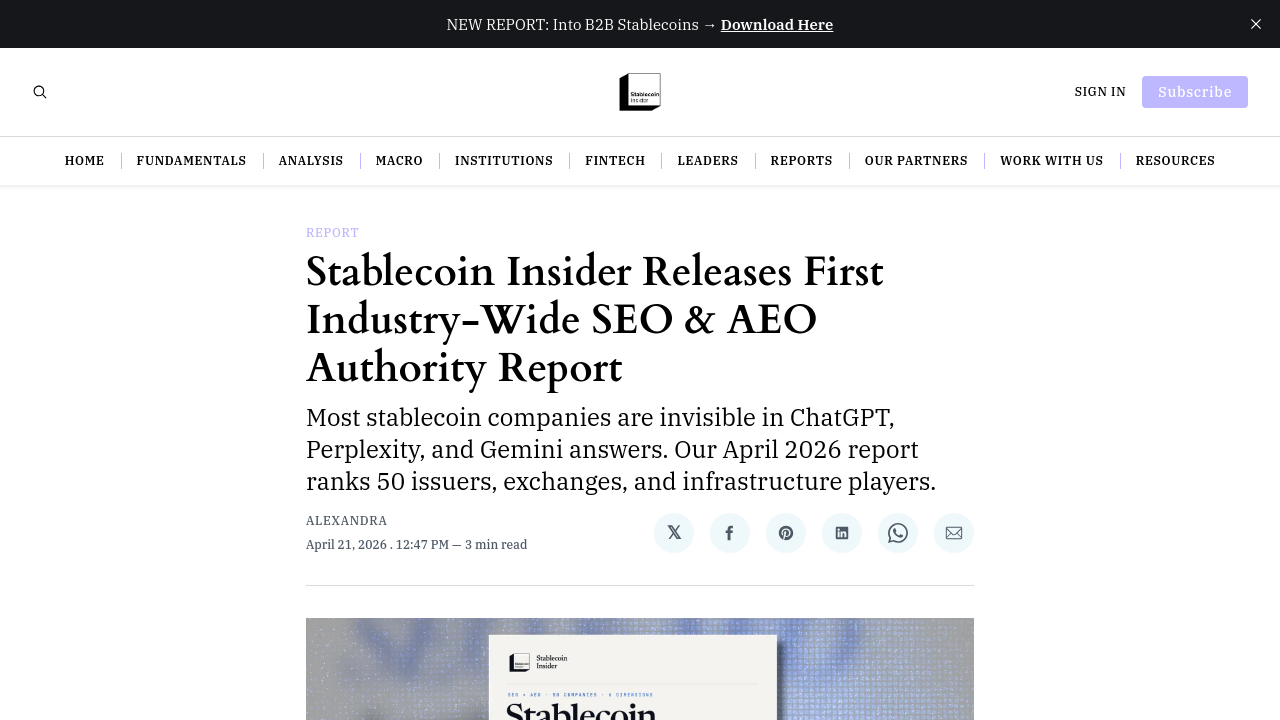
According to Stablecoin Insider’s April 2026 report scoring 50 issuers, exchanges, and infrastructure players, the top 10 companies capture 96% of all organic search traffic in the category. The remaining 40 share the rest. Circle achieved the highest AEO score in the dataset at 90/100, despite PayPal holding the highest Domain Rating at 95, showing that traditional authority metrics do not predict AI citation frequency. This tracks with what our E-E-A-T guidance for Web3 SEO has argued for two years.
Why Domain Rating No Longer Predicts AI Visibility
31 of 50 companies scored below 55 on AEO visibility, meaning most stablecoin operators are bypassed when a CFO, treasurer, or developer queries an AI system for a recommendation. Bitpay’s Domain Rating of 80 against an AEO score of 32 illustrates a -48 point gap: backlink authority built between 2014 and 2020 does not translate to AI citations without active content investment. Ethena, with a Domain Rating of 71 and 3,500+ referring domains, ranks for only 123 organic keywords compared to Coinbase’s 226,917. That is not a measurement quirk; it is a content-efficiency gap, as our content audit methodology treats it.
Takeaway: if your Domain Rating outperforms your keyword coverage by more than 2x, your problem is content architecture, not authority.
The Five Pillars of Stablecoin AEO Optimisation

AEO is not a switch you flip; it is five deliberate content behaviours that stack. The work with issuers, wallets, and payment fintechs is structured around these five pillars, built on the technical and content foundation that separates AI-cited brands from invisible ones.
Entity Definition and AI Training Data
Entity definition in AI training data currently matters more than backlinks for AEO visibility. Companies must ensure their brand, product, and regulatory standing are represented cleanly across authoritative third-party sources, wikis, industry directories, and financial media. Our generative engine optimisation notes on consistency explain why entity consistency across sources beats raw mention count.
Structured Content, Schema, and Compliance Signals
Every stablecoin landing page should state in the first 200 words: the issuing entity, jurisdiction, regulatory framework (GENIUS Act, MiCA, MAS, NYDFS), and reserve location. This functions as both a trust signal and an AI citation trigger. Structured content, with schema.org markup, lets AI models extract and re-present facts accurately. FAQ structure with numeric specifics in the first 100 words of each answer increases citation probability in AI Overviews, and our guide to writing content for LLMs covers the exact answer shapes that get quoted.
Takeaway: leaders extract more organic value per unit of domain authority through deliberate architecture, not by accumulating more backlinks.
Common Misconceptions About Stablecoin SEO and AEO
Misconception: High Domain Rating Guarantees AI Visibility / Reality: Citation Requires Content Architecture
High DR does not guarantee AI citation. Circle outranks higher-DR companies on AEO because it prioritises answer-formatted, entity-clear content over raw link accumulation. Our internal linking framework for crypto sites shows how to route authority into the pages AI actually reads.
Misconception: AEO Is a Separate Channel / Reality: SEO Is the Foundation AEO Builds On
Siteimprove and Optimizely both describe SEO and AEO as sequential layers of the same discoverability infrastructure. Technical SEO health is a prerequisite for AI models to index and trust a page, which is why our SEO audit checklist is the first artifact we deliver.
Misconception: Stablecoin SEO Is the Same as Crypto Token SEO / Reality: Intent and Compliance Context Are Fundamentally Different
Stablecoin SEO is closer to regulated financial services marketing than to token promotion. Queries centre on safety, compliance, and utility, not price speculation. Voice search and AI assistant queries also demand conversational, concise answers that traditional keyword-density SEO does not produce, a gap covered in how content distribution affects GEO.
How to Get Started With Stablecoin SEO and AEO
Audit Your Current Entity and Content Footprint
Search your brand name in ChatGPT, Perplexity, and Gemini and record whether your company appears, what claims are made, and whether your regulatory status is accurately reflected. Then map every existing URL to the three intent tiers. Most stablecoin companies have product pages but no comparison or explainer content, which our indexing and crawl management guide treats as a recoverable gap.
Build an Intent-Segmented Content Architecture
Add regulatory disclosure blocks to every product page within the first 200 words: issuer name, jurisdiction, regulatory framework, and reserve custodian. Implement FAQ schema on all informational and comparative pages, and structure each answer to stand alone in 40 to 60 words so AI models can extract it without additional context. Our programmatic SEO patterns for Web3 show how to scale comparison pages across a stablecoin’s corridor and use-case matrix.
This is where an AI content system earns its place. For Mezo, a Bitcoin layer 2, the SEO production cycle dropped from around four hours to roughly ten minutes, a 96 percent reduction, and a single keyword produced four assets at once: a landing page, an educational article, a social post, and a keyword brief. Applied to stablecoin discoverability, that means covering every intent segment above at speed, without the output drifting off-message.
Instrument for AI Citation Tracking
Track AI citation share alongside traditional organic rankings. Monitor how often your brand appears in AI-generated answers for target queries, using tools such as Semrush’s AI Toolkit or Profound. Our roundup of the best AI SEO tools covers the tracking stack we deploy for stablecoin clients.
Takeaway: the first 30 days of any stablecoin SEO and AEO program should be audit, mapping, and instrumentation, not publishing.
Stablecoin issuers carry a regulatory reading burden that most crypto brands do not. Victoria Olsina works on GEO for stablecoin companies with that constraint built in.
Frequently Asked Questions
What is the difference between SEO and AEO for stablecoin companies?
SEO ranks your pages in Google and Bing through crawlable structure and backlinks. AEO gets your content cited inside ChatGPT, Perplexity, and Gemini answers through entity clarity, schema, and answer-formatted content. Stablecoin companies need both.
How do I get my stablecoin cited in ChatGPT and Perplexity answers?
Publish entity-clear pages that state your issuer, jurisdiction, regulatory framework, and reserves within the first 200 words. Add FAQ schema, keep answers 40 to 60 words, and earn third-party mentions in authoritative financial and crypto publications.
Does Domain Rating still matter for stablecoin SEO in 2026?
Yes, but less than it did. Bitpay’s DR of 80 with an AEO score of 32 shows that link authority alone is no longer sufficient. Content architecture and entity definition now drive AI citation frequency independently of DR.
Is stablecoin SEO different from regular crypto SEO?
Yes. Stablecoin search intent centres on safety, compliance, and payment utility, not speculation. Queries look more like regulated financial services searches than like token marketing, and the winning content shape follows the same rules.
What does AEO mean for a stablecoin issuer?
AEO means engineering your pages so AI answer engines cite your brand when a treasurer or developer asks for a recommendation. It combines entity definition, structured schema, and concise numeric answers that AI models can extract cleanly.
How does the GENIUS Act affect stablecoin search and content strategy?
The GENIUS Act framework has pulled fintechs and neobanks into the payment stablecoin category, expanding the query pool. Content should explicitly name the GENIUS Act, MiCA, MAS, or NYDFS status upfront, as both a compliance signal and a citation trigger.
What content types rank best for stablecoin search queries?
Comparison pages (“USDC vs USDT”), explainers with FAQ schema, and transactional product pages with visible regulatory disclosures. Comparative content is quoted most aggressively in AI Overviews and carries the highest commercial intent.
How long does it take to improve AEO visibility for a stablecoin company?
Entity and schema changes can produce visible AI citation shifts within 60 to 90 days. Structural SEO gains, keyword coverage and organic traffic, typically take 6 to 9 months, depending on baseline authority and content velocity.
Conclusion
Stablecoin SEO and AEO are no longer separate specialties; they are two layers of the same discoverability stack, and the leaders in the Stablecoin Insider dataset win because they treat them that way. If your Domain Rating outpaces your organic keyword coverage, or your brand does not surface cleanly in ChatGPT and Perplexity for your own product queries, the fix is architectural, not tactical. The Web3 SEO specialists at victoriaolsina.com help issuers, wallets, and payment fintechs close both gaps with compliance-aware content programs built for Google and the AI answer layer at once.
Produced using an that cites every claim.
Ready to make your Web3 project discoverable across Google and AI search? Book a free strategy call.


![Victoria Olsina, mentor at R[3]sidency x Construct](https://victoriaolsina.com/wp-content/uploads/2026/10/r3sidency-mentor-victoria-olsina-26239-300x158.png)