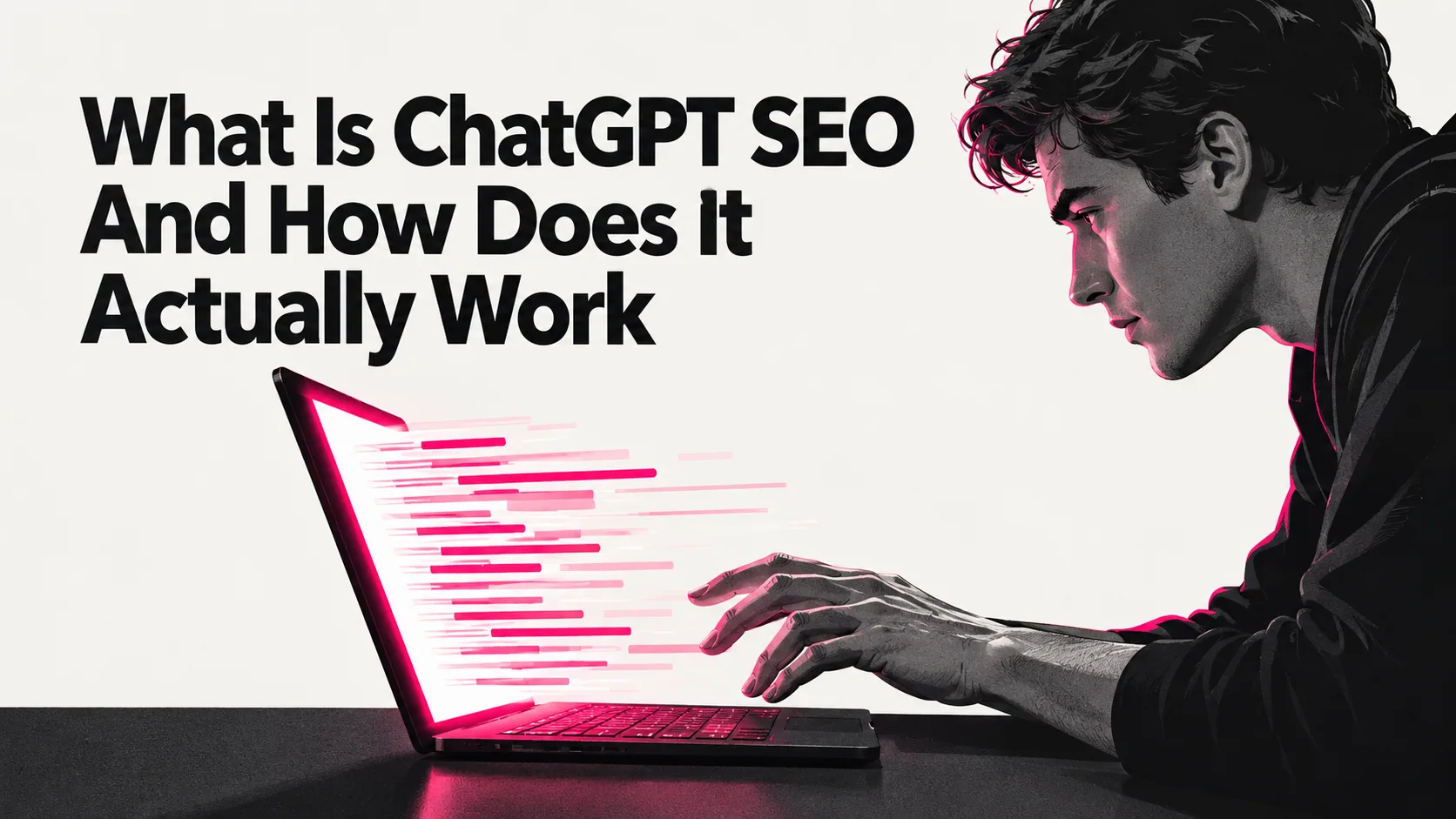
ChatGPT SEO is the practice of optimising your website so ChatGPT cites, recommends, or references it inside its answers. It sits at the intersection of traditional SEO and a newer discipline called Generative Engine Optimization (GEO). ChatGPT now handles over 1 billion daily queries, according to Forge and Smith, and the gap between appearing in Google and appearing in AI answers is closing fast. Here is how the mechanism actually works, and what to do about it.
Definition: What ChatGPT SEO Actually Means
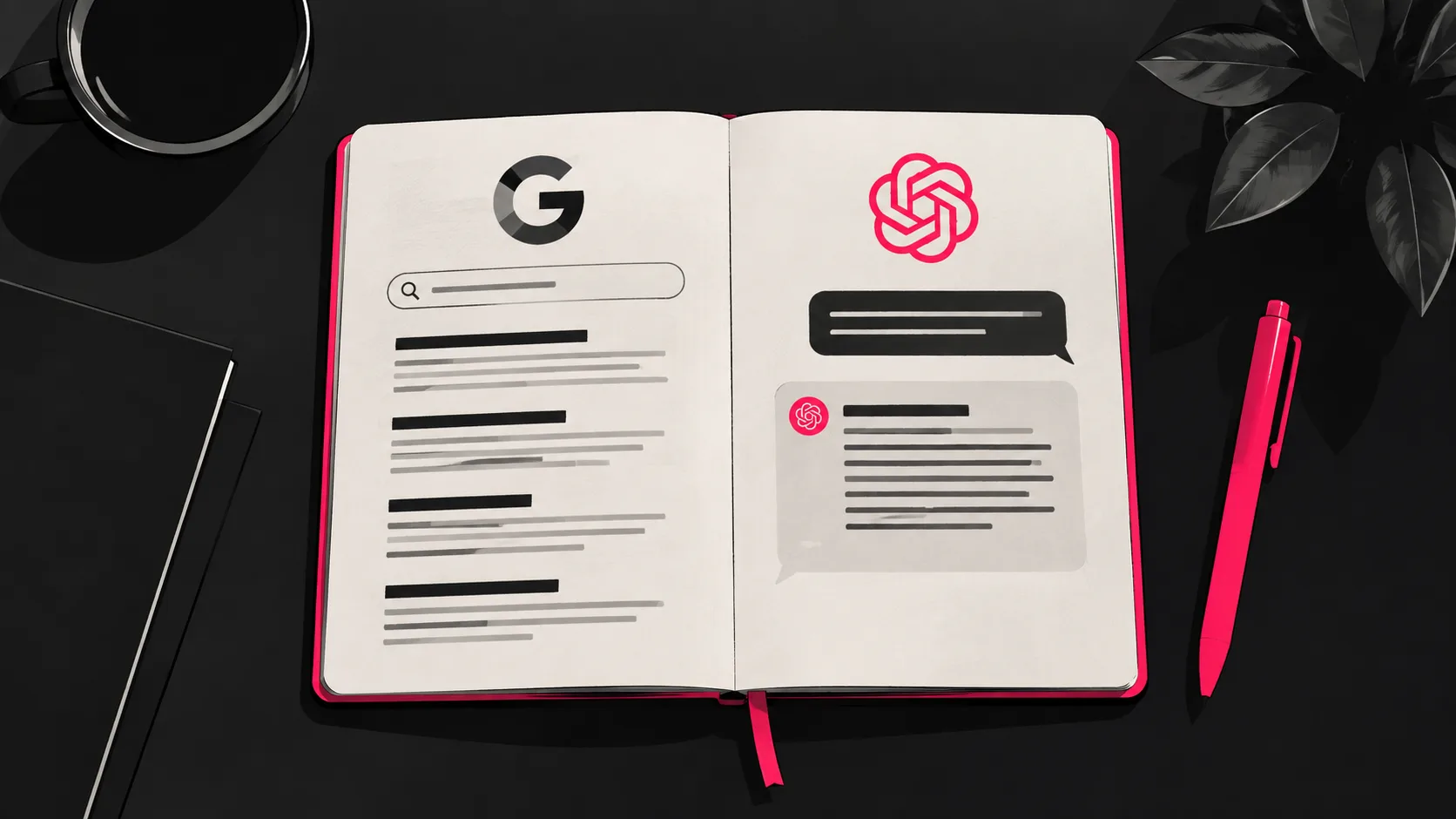
ChatGPT SEO is the discipline of structuring your website and content so large language models like ChatGPT quote it as a source when they answer user questions. It is not about ranking a blue link on a results page. It is about becoming the sentence the model picks when it answers.
In plain language: classic SEO targets crawlers that build a ranked index. ChatGPT SEO targets a model that writes a direct answer and sometimes links the sources it leaned on.
ChatGPT SEO vs Traditional SEO
The foundations overlap. Quality content, clean site structure, and matching user intent still matter in both. The difference is the output format.
Traditional SEO wins when your page ranks. ChatGPT SEO wins when your page gets paraphrased or cited inside a generated answer. That shift changes what “optimised” means. A keyword-dense product page can rank. A quotable, standalone paragraph gets cited. For a deeper split between the two, I unpack it in this breakdown of ChatGPT SEO for sites that are invisible to AI.
GEO: The Formal Name For It
Generative Engine Optimization, or GEO, is the formal term. It covers ChatGPT, Perplexity, Gemini, Claude, and anything else that generates an answer instead of a list. According to Forge and Smith, an Ahrefs study found 63% of websites are already receiving traffic from AI platforms, though it remains under 1% of total traffic for most of them.
Takeaway: GEO is not a rebrand of SEO. It is a parallel discipline that rewards extractability over keyword density. If you want the full playbook, see my notes on LLM SEO as a practice.
How ChatGPT Actually Retrieves and Cites Content

ChatGPT does not have one way of answering. It has two, and they produce very different outputs.
The Two Retrieval Modes: Pre-trained vs Live Search
Mode one is static. The model answers from pre-trained knowledge baked into its weights. No live sources, no links, just a summary that reflects whatever was in the training set at cutoff.
Mode two is live search. When the user triggers search, or when the model decides a query needs fresh data, ChatGPT routes through Bing and pulls real pages. Those pages show up as linked references in grey citation boxes next to the answer. That is the mode where referral traffic actually appears, and where GEO work pays off. OpenAI’s SearchGPT prototype makes those citations even more prominent.
How ChatGPT Decides What To Cite
Live mode leans on Bing’s index. If Bing cannot crawl or render your site cleanly, you are not in the candidate set to begin with. Semrush reports that 85% of pages cited by ChatGPT also rank for at least one keyword in Google organic search. That correlation is the single most useful data point in this entire article. Strong classic SEO is the floor. GEO is the ceiling built on top.
Takeaway: fix Bing indexing before you obsess over GEO tactics. Then make each page quotable on its own. For a worked example of a site I ranked inside ChatGPT, see this Web3 SEO case study.
What ChatGPT SEO Is Used For: The Two Distinct Jobs

The phrase “ChatGPT SEO” gets used for two different jobs, and people conflate them constantly. Separate them before you plan anything.
Using ChatGPT As A Tool To Do SEO Work
Here ChatGPT is the worker. You use it to brainstorm keywords, draft meta descriptions at scale, write hreflang tags, generate Schema markup, build regex, cluster topics, and outline content. It is fast and cheap for anything structural or repetitive.
What it cannot do: give you search volume, keyword difficulty, SERP positions, or competitor backlink data. Those live in dedicated SEO platforms. Treat ChatGPT as the first draft of the thinking, not the data layer. For a tactical angle, I covered how to pair ChatGPT with Keywords Everywhere for conversational keyword research.
Optimising Your Site To Appear In ChatGPT Answers
Here ChatGPT is the destination. The goal is to be the brand the model names when a user asks “which agency should I hire for X” or “what tool should I use for Y”. A direct recommendation inside a chatbot used by hundreds of millions of people weekly is a very short path from awareness to qualified lead.
Takeaway: decide which job you are doing before you start. The workflows look nothing alike. The brand-citation playbook is covered in this piece on getting your Web3 brand into ChatGPT recommendations.
How To Optimise Your Site For ChatGPT Citations

Citation work is mostly plumbing plus structure. Nothing exotic.
Enable SearchGPT Bot Crawling
OpenAI uses its own crawler, OAI-SearchBot, separate from Googlebot and Bingbot. Open your robots.txt. Confirm it is not blocked. If you blocked all unknown bots at some point, you blocked this one too. Fix that first, because nothing else matters if the crawler cannot reach the page.
Content Structure That Gets Extracted
Pages that get cited share a shape. A specific question answered in a single clean paragraph. No throat-clearing before the answer. No requirement that the reader finishes the surrounding section to understand it.
Practical moves:
- Lead each section with a one-sentence answer, then expand.
- Use H2 and H3 questions that mirror how a user would ask the model.
- Keep key stats, definitions, and recommendations in standalone sentences.
- Add tables for comparisons so the model can lift rows cleanly.
More on page-level structure in my on-page SEO guide.
About Page and Entity Signals
ChatGPT cross-references named entities. Your About page is where you declare who you are, what you do, who you serve, and what you are known for. A vague About page weakens the association between your brand and the topics you want to be cited for. A factual, specific one strengthens it.
Takeaway: Semrush data shows ChatGPT citations correlate strongly with pages ranking for more than 10 keywords in Google. GEO and classic SEO reinforce each other. For the six structural rules I apply to Web3 clients, see the Web3 SEO non-negotiables for ChatGPT.
Limitations and Failure Modes To Know Before You Start
GEO is an emerging channel. Treat it like one. Build now, do not bet the pipeline on it this quarter.
Hallucination Risk in AI-Generated SEO Content
ChatGPT hallucinates confidently. It will fabricate statistics, invent citations with real-looking URLs, and produce fluent but wrong claims. Published without verification, that output becomes a ranking and trust liability.
Every factual claim the model generates gets checked against a primary source before it goes live. Not sometimes. Every time. For the editorial side of that, I wrote up how I keep AI SEO content clean.
What ChatGPT Cannot Replace
The base GPT-4 model has a knowledge cutoff. Without the search toggle it is not looking at live SERPs, current competitor rankings, or fresh backlink data. It cannot give you search volume, keyword difficulty, or click-through rate numbers. Those come from dedicated tooling.
GEO traffic sits under 1% of most sites’ total traffic right now. AI-cited pages are also not stable. Model updates shift sourcing behaviour, so citation positions move. GEO needs ongoing monitoring, not a one-off audit. If you want to see what the model is actually pulling for your site, there is a hidden trick for watching what ChatGPT searches that I use most weeks.
Takeaway: build GEO as a second channel while classic SEO carries the current pipeline. Diversify, verify, and monitor.
Conclusion
ChatGPT SEO is two jobs under one label. Using the model to accelerate SEO workflows, and optimising your site so the model cites you. Both are worth doing. Neither replaces the fundamentals.
The sites that will win in AI search are the ones already winning at structured, entity-clear, crawlable classic SEO. The work compounds. Fix Bing indexing. Unblock OAI-SearchBot. Audit every important page for extractability. Treat each page as a standalone quotable source, not a chapter in a long document.
If you want a full worked view of how this plays out on real sites, the ChatGPT visibility hub collects the tactics, case studies, and audits I use with clients.
FAQ: Frequently Asked Questions
What is the difference between ChatGPT SEO and traditional SEO?
Traditional SEO targets search engine crawlers to rank blue links. ChatGPT SEO targets a language model so your content gets quoted or cited inside generated answers. The foundations overlap, but the output format is completely different.
How do I get my website cited in ChatGPT responses?
Confirm OAI-SearchBot is unblocked in robots.txt, make sure Bing can crawl and index your site, then structure content so each page answers a specific question in standalone, quotable paragraphs. Strong classic SEO signals materially increase your odds.
Does ranking on Google help you appear in ChatGPT answers?
Yes. Semrush found 85% of pages cited by ChatGPT also rank for at least one keyword in Google organic search. Classic SEO and GEO reinforce each other, so investment in one usually improves performance in the other.
Can ChatGPT do keyword research?
Partially. ChatGPT is strong for brainstorming long-tail ideas, LSI terms, and topic clusters. It cannot give you search volume, keyword difficulty, or SERP data. Use it as a starting point and validate every idea with a dedicated keyword research tool.
What is Generative Engine Optimization (GEO)?
Generative Engine Optimization is the practice of optimising content so AI answer engines like ChatGPT, Perplexity, Gemini, and Claude cite your site as a source. It is the formal name for the discipline most people loosely call ChatGPT SEO.
Is ChatGPT SEO worth investing in right now?
Yes, as a secondary channel. GEO traffic currently sits under 1% of most sites’ total traffic, so it is not a primary pipeline today. The brands building citation presence now will own the share of voice as AI search volume keeps growing.
Does ChatGPT use Google or Bing to find web content?
Bing. When ChatGPT’s live search mode is active it routes queries through Bing’s search engine, not Google’s. That means Bing crawlability and indexing directly affect whether your pages are even eligible to be cited inside ChatGPT answers.
What are the biggest risks of using ChatGPT for SEO work?
Hallucinated facts, fabricated citations, and outdated information from the model’s knowledge cutoff. Publishing unverified output damages rankings and trust. Verify every claim against a primary source, and never let ChatGPT be the final editorial check on your work.