AI agents are now browsing the web on behalf of users, comparing vendors, reading documentation, and making recommendations without a human ever clicking through. Optimising for this third audience takes a different playbook than traditional SEO. Victoria Olsina helps businesses build the technical and content foundations that make their sites readable, citable, and actionable by AI agents, so the machine that recommends your competitor tomorrow recommends you instead.
Definition: What Does Agent Discoverability Mean
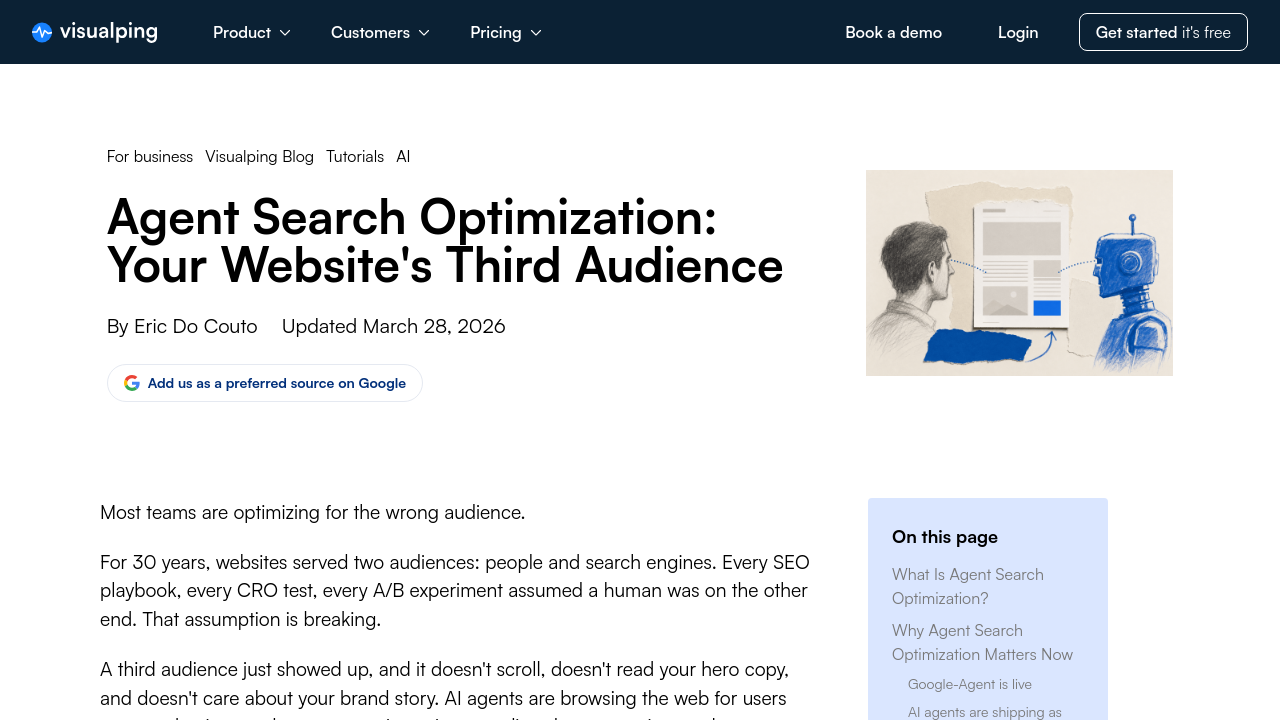
Agent Search Optimisation (ASO) is the practice of making a website discoverable, evaluable, and actionable by AI agents acting on behalf of users. The term was formalized by Visualping in March 2026, when Google added a new user agent, Google-Agent, to its official documentation. It sits on top of two older layers, not next to them, and it changes what “visibility” actually measures for a business investing in Web3 SEO fundamentals.
Agent Discoverability in Plain English
Three layers, each building on the one below. SEO gets you found. AEO and GEO get you cited by LLMs. ASO gets you used by agents completing tasks. Miss the bottom layer and the top two collapse, which is why a technical SEO foundation for Web3 still matters even if your target reader is now a machine.
In plain English: a customer asks ChatGPT to pick a vendor, and the agent needs to read your site well enough to recommend you.
How It Differs from Traditional SEO and AEO
Googlebot crawls passively for indexing. Google-Agent visits because a real user asked an AI to perform a task, such as comparing prices or researching vendors. That user-triggered, action-oriented traffic behaves nothing like batch indexing, and per Celum’s analysis of AI-ready websites, agent readiness is a strategic infrastructure decision rather than a one-off optimisation. Treat it the way you would treat an ongoing SEO audit program: recurring, cross-functional, and tied to revenue.
Takeaway: ASO is not a rename of SEO. It is a new layer with different reader (a machine), different intent (task completion), and different success metric (citation and action, not clicks).
How AI Agents Actually Find and Read Your Site

Agents rely on Retrieval-Augmented Generation. They search external sources in real time and extract relevant text passages as context for a language model. Design, animation, and hero copy are invisible. Only meaning, clarity, and consistency of text matter, which is why writing content specifically for LLMs has become a distinct skill from writing for humans.
Crawling and Indexing Without Technical Barriers
JavaScript-heavy frontends are the single biggest barrier. Crawlers often see empty HTML shells because content loads client-side, making pages effectively invisible to AI agents. Server-side rendering, prerendering, or hybrid frameworks fix the read problem, and clean indexing and crawl management for Web3 sites closes the loop so agents actually reach the pages you care about.
Retrieval-Augmented Generation and Content Extraction
RAG systems chunk your content, embed it, and retrieve the passages most relevant to a user’s prompt. The Princeton KDD 2024 study found that citing sources and adding statistics can boost content visibility by up to 40% in generative engine responses. That maps directly to how content distribution shapes generative engine visibility: the same well-sourced passage, syndicated consistently, gets retrieved more often.
Multiple agent-based browsers are already in production: OpenAI’s Atlas (October 2025), Perplexity’s Comet (July 2025), Google Chrome Auto Browse (January 2026), and Google DeepMind’s Project Mariner (March 2026).
The Role of Structured Data and Metadata
Without Schema.org markup, OpenGraph tags, and machine-readable metadata, agents guess at category, entity, and intent, and reduce your citation likelihood accordingly. Add product, article, FAQ, and organisation schema at a minimum, and pair it with an llms.txt file that guides LLM consumption of your site.
Takeaway: if an agent cannot fetch, render, and parse a page in one pass, you are invisible. Server-render, mark up, and stop hiding content behind client-side JavaScript.
Common Misconceptions About AI Agent Visibility
Most teams still optimise for the 2019 version of Google. That model breaks in two directions at once: user behaviour is shifting to AI answers, and vendor behaviour is shifting to standards bodies. A quick reset on E-E-A-T signals in Web3 SEO helps here, because trust is the through-line across all three misconceptions below.
Misconception: Ranking Well in Google Is Enough / Reality: Agents Evaluate Differently
As of Google I/O 2025, all U.S. users receive AI-generated answer summaries rather than a ranked list of blue links. Ranking #3 for a keyword now competes with a summary that cites zero, one, or two sources by name. Winning the citation is the new ranking, which is exactly why generative engine optimisation for consistency and authority has moved from a nice-to-have to a core discipline.
Misconception: Visual Design Signals Quality / Reality: Agents Only Read Structure
A simple but precisely structured page will outperform a visually impressive one that lacks semantic hierarchy, according to Celum’s AI-readiness framework. Agents parse H1 through H3, lists, tables, and schema. They do not parse gradients. If you are running a one-page Web3 site, the structure discipline matters more, not less.
Misconception: ASO Is a Future Problem / Reality: Agentic Traffic Is Live Now
The Linux Foundation launched the Agentic AI Foundation in December 2025 with AWS, Anthropic, Google, Microsoft, and OpenAI as platinum members, contributing shared standards. The W3C is building WebMCP to make agent-site interactions a formal web standard. Google processes 480 trillion tokens per month through its AI models, a 50x increase year-over-year, and 1.5 billion people use AI Overviews monthly, per Google I/O 2025 data reported by dotCMS. This is not a 2027 problem. Build accordingly with a real SEO automation workflow so the work compounds instead of stalling.
Takeaway: the standards are being written now, the traffic is landing now, and the summary is the new SERP.
Why Agent Discoverability Matters for Your Business

Traditional website traffic is losing relevance as a headline metric. Brand mentions in AI-generated responses are becoming the new currency of digital visibility, according to Celum, and that shift changes how search intent maps to a Web3 marketing funnel: the top of funnel is now a citation, not a session.
Agentic Commerce and Lead Generation Are Already Shifting Traffic
Agentic e-commerce and agentic lead generation are autonomous systems that purchase products or evaluate providers without human intervention. Google’s upcoming Agent Mode aims to take users from intent to purchase with minimal input, meaning the vendor the agent trusts is the vendor that wins the sale. Forward-thinking companies are already wiring agents into quote requests, product configuration, and checkout, which raises the bar on product-led SEO for Web3 because the product page is now the negotiation surface.
Brand Mentions Replace Clicks as the New Visibility Metric
Google Lens use grew 65% year-over-year according to Google I/O 2025, and Search Live lets users video-call Search. Discovery is leaving text entirely, and audit programs need to catch up; a serious content audit process now has to score citation frequency across ChatGPT, Perplexity, and Gemini, not just organic sessions.
Takeaway: if your reporting still stops at clicks and sessions, you are measuring the wrong end of the funnel.
How to Get Started Making Your Site Agent-Ready
Agent readiness stacks: technical foundation, then content clarity, then trust signals. Skipping a layer wastes work above it. A pragmatic starting point is a Web3 backlink strategy that feeds authority into pages you have already made machine-readable, so the crawl, parse, and cite steps line up.
Technical Foundations: Crawlability and Structured Data
Clear H1/H2/H3 hierarchies, canonical URLs, unambiguous page titles, and Schema.org markup are the baseline. Missing these makes it hard for agents to identify key messages, per Celum. Fix broken URLs with disciplined redirection management so you stop bleeding authority every time you refactor.
Content Foundations: Clarity, Authority, and Answer-Ready Formatting
Adding FAQ sections to key pages increases the chance of content being pulled into AI results, since LLMs respond to question-based queries, not keyword prompts. Shift from “headphones” to “best headphones for Zoom calls in noisy environments.” Long-tail, conversational phrasing mirrors how users prompt agents, and organising pages into content silos gives the LLM a clean topical map to retrieve from.
Ongoing Signals: E-E-A-T, Citations, and Cross-Channel Consistency
Author bios, backlinks, and demonstrated expertise reduce the likelihood of being skipped by AI systems that favour trusted sources. Consistency of structured product data and brand information across all channels is critical for agentic workflows that assess entire brand presence. Tighten title tags and meta descriptions as the first machine-readable summary of every page.
Takeaway: build the crawlable base, publish answer-ready content, and prove authority across channels. In that order.
Related Concepts in AI Agent Optimisation
The vocabulary is still settling. These are the terms worth knowing, and where they live in the stack, particularly if you are moving from generalist SEO into best-in-class AI SEO tooling that touches multiple layers at once.
Generative Engine Optimisation (GEO)
GEO focuses on earning citations in AI-generated summaries from systems like ChatGPT and Perplexity. It sits between traditional SEO and full ASO in the discoverability stack.
Answer Engine Optimisation (AEO)
AEO targets structured, direct-answer formatting so AI systems can confidently extract and surface content in conversational responses. FAQ blocks, definition lists, and lead-with-the-answer paragraph shape are the mechanics.
WebMCP and Emerging Agent Standards
WebMCP is a W3C initiative to standardise how agents interact with websites, moving agent-site communication from ad hoc scraping into a formal part of the web architecture.
Retrieval-Augmented Generation (RAG)
RAG systems prioritise content that is precise, well-sourced, and consistently structured across a domain. That makes content governance a direct ranking factor in AI-driven discovery, not a hygiene concern.
Entity SEO
Entity SEO ensures a brand is recognised as a distinct, authoritative entity by knowledge graphs and LLMs. It is the trust layer everything else depends on, and it is closely tied to internal linking discipline on crypto and Web3 sites that reinforces entity relationships page to page.
Being found by agents is one part of a wider visibility problem. The same groundwork is what it takes to make your brand readable to AI systems.
Frequently Asked Questions
What is agent search optimisation and how is it different from SEO?
Agent Search Optimisation makes your site usable by AI agents completing tasks, not just findable in search results. SEO wins rankings, AEO wins citations, ASO wins actions. Each layer builds on the one below it.
How do AI agents crawl and index websites?
Agents use Retrieval-Augmented Generation to fetch pages in real time, extract passages, and feed them to a language model. They rely on rendered HTML, schema markup, and clean text. JavaScript-only content is frequently skipped entirely.
What technical changes do I need to make my site discoverable by AI agents?
Server-render your content, add Schema.org markup for articles, products, FAQs, and organisation, use clear H1/H2/H3 hierarchy, and expose an llms.txt file. Fix broken redirects and make sure canonical URLs are unambiguous across the domain.
Does my site need to rank on Google to be discovered by AI agents?
Ranking helps but is no longer sufficient. AI Overviews and agent browsers pull from a broader citation graph that includes Reddit, docs, and structured sources. Authority, clarity, and schema matter more than a specific blue-link position.
What is Google-Agent and how does it affect my website?
Google-Agent is a user-triggered fetcher Google added to its documentation on March 20, 2026. Unlike Googlebot, it visits your site because a real person asked an AI to complete a task, such as comparing vendors or filling a form.
How does structured data help AI agents understand my site?
Schema.org markup labels entities, products, prices, authors, and FAQs in a format LLMs and agents parse reliably. It removes the guesswork from categorization and materially raises the probability that your content is cited or acted on.
What is the difference between AEO, GEO, and ASO?
AEO optimises for direct-answer extraction. GEO optimises for citation inside generative summaries like ChatGPT or Perplexity. ASO optimises for autonomous agents completing tasks on the user’s behalf. They are cumulative layers, not competing choices.
How do I know if my site is currently visible to AI agents?
Prompt ChatGPT, Perplexity, and Gemini with buyer queries in your category and check whether your brand appears. Inspect server logs for Google-Agent, PerplexityBot, and GPTBot hits. Render pages with JavaScript disabled to see what agents actually read.
Conclusion
Agent discoverability is not a rebrand of SEO, it is a new layer with its own audience, mechanics, and metrics. Server-rendered HTML, disciplined schema, question-shaped content, and consistent entity signals are the price of admission. The teams that build that foundation now will collect citations and agent-driven conversions while competitors are still A/B testing hero copy. If you want a partner to sequence the work end to end, Victoria Olsina runs the audit, the schema, and the content program as one system.
This article was produced by an .
Ready to make your Web3 project discoverable across Google and AI search? Book a free strategy call.


![Victoria Olsina, mentor at R[3]sidency x Construct](https://victoriaolsina.com/wp-content/uploads/2026/10/r3sidency-mentor-victoria-olsina-26239-300x158.png)