If you want the wider picture, start with how AI SEO content works.
Definition: What An AI SEO Blog Writer Is
An AI blog writer uses large language models (LLMs) to create long-form content from a basic prompt or keyword.
The SEO variant adds search features on top: SERP analysis, keyword optimisation, content scoring and long-form structure.
That is the category that matters for ranking. A tool that writes social captions is not an SEO blog writer.
Plain language: it is a fast first-draft machine with an SEO checklist attached, and it still needs a person to decide what is worth saying.
Takeaway: judge any tool by its search features and its draft quality, not by word count.
How It Works, And Where It Breaks
Start with what breaks. Unedited AI drafts fail in three predictable ways.
- Generic copy. The model averages what already ranks, so the draft says what every competitor says.
- Invented facts. LLMs write confident sentences about numbers and sources that do not exist.
- Thin differentiation. No original data, no opinion, no client context. Nothing for Google or ChatGPT to prefer.
The workflow step by step
- Enter a target keyword or prompt.
- The tool analyses the current SERP and suggests headings and terms.
- The LLM drafts the article.
- A content score rates keyword and topic coverage.
- The draft goes to the CMS.
Here is the same workflow with the failure point and the human check at each stage.
| Workflow stage | What the AI tool does | What breaks if left unchecked | Human check |
|---|---|---|---|
| Keyword and SERP analysis | Pulls top-ranking pages, headings and related terms | You copy the structure of pages that already win, with no angle of your own | Decide the angle and the search intent before drafting |
| Drafting | Generates long-form copy from the keyword with an LLM | Generic claims, invented facts, no first-hand detail | Add original expertise, examples and opinion; fact-check every specific |
| Content scoring | Rates coverage of terms and topics against competitors | Keyword stuffing to chase the score | Treat the score as a coverage hint, then edit for clarity |
| Publishing | Pushes the draft to the CMS with meta data | Thin pages go live at volume and dilute the site | Final editorial review, internal links, structured answers |
For a working version, see Victoria Olsina’s guide to automating your SEO process with custom GPTs and Make.com.
Worked example: a 2,000-word draft for a competitive keyword
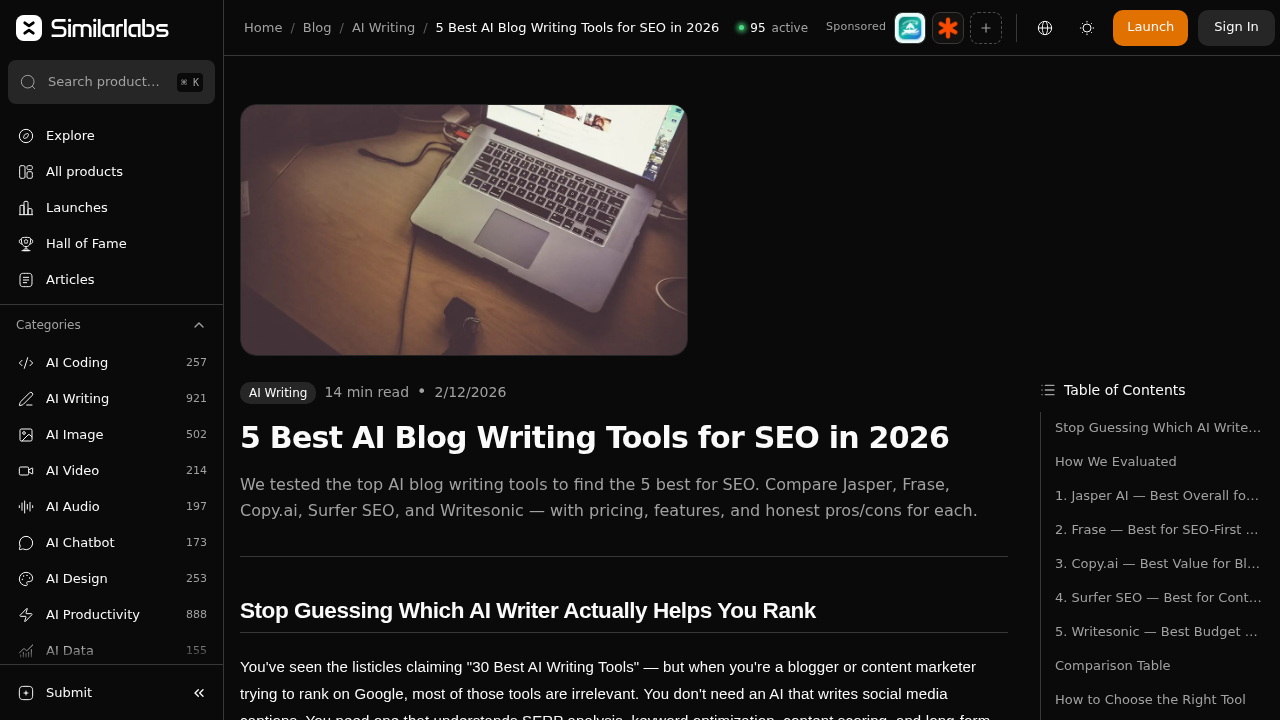
SimilarLabs’ roundup of AI blog writing tools compared tools on one task: a 2,000-word SEO blog post targeting a competitive keyword.
Use that as the scenario. Example: a SaaS founder wants a post on a competitive comparison keyword.
The tool returns a structured 2,000-word draft quickly. The headings mirror the top results. The score looks healthy.
Now the problems. Every section repeats what page one already says. Two statistics have no source. Nothing shows the founder’s product, data or view.
The edit is where ranking potential comes from: cut the repeated sections, replace unsourced figures, and add one thing competitors cannot copy.
Takeaway: budget your time for editing, not for drafting.
Why It Matters For Rankings And AI Search

Founders and CMOs now want growth from Google, ChatGPT and other LLM-powered search surfaces at once. That changes what a blog post has to do.
Use case 1: AI content workflows at scale
Tools such as Jasper, Frase and Surfer SEO cut drafting and optimisation time. Jasper focuses on brand voice, Frase on SERP analysis and content scoring, Surfer SEO on real-time scoring for existing content.
Speed helps only if the editorial layer keeps up. See how this works in practice in AI SEO automation for e-commerce.
Use case 2: GPT and agent automation
GPT workflows can research, outline, draft and push to the CMS without a person touching it. That is exactly the risk.
Victoria Olsina uses agents for the repetitive parts and keep humans on strategy. Victoria Olsina’s breakdown of the AI agent for SEO covers where that line sits.
Use case 3: semantic visibility in Google and ChatGPT
LLM answers pull clear, specific, structured passages. A vague AI draft gives them nothing to quote.
Takeaway: write each section so a single paragraph can stand alone as an answer.
Common Misconceptions

Misconception: AI drafts rank on their own / Reality: strategy and editing decide
The tool writes. It does not choose the keyword, the angle or the proof.
Misconception: A content score guarantees rankings / Reality: it measures coverage only
A score compares your terms with competitor pages. It cannot measure originality, accuracy or authority. Victoria Olsina treats a high score as a floor, never a finish line.
Misconception: More posts means more traffic / Reality: unedited volume dilutes quality
Publishing dozens of thin posts spreads your site across pages nobody needs. Publish fewer, edit harder, and prune what does not perform.
Misconception: Only Google matters / Reality: LLM search surfaces cite structured, specific answers
Your buyers ask ChatGPT too. Structured answers, named entities and clear definitions get picked up. Fluff does not. Victoria Olsina covers this in why AI search matters.
Takeaway: put usefulness first and coverage second.
Related Concepts
LLM
A large language model predicts text from patterns in training data. It writes fluently and can be confidently wrong.
SERP analysis
SERP analysis reviews the pages ranking for a keyword to find intent, structure and gaps.
Content scoring
Content scoring rates a draft’s coverage of relevant terms and topics against competing pages.
GEO (generative engine optimisation)
GEO is the practice of making content citable by AI answer engines. Start with how to rank in AI Overviews, then read about LLM SEO.
AI content automation
AI content automation chains research, drafting and publishing into one pipeline, usually with tools like Make and custom GPTs.
How To Get Started
- Pick one keyword and audit its SERP. Note the intent and what every top page misses.
- Draft with a tool. Feed it your angle, not just the keyword.
- Add original expertise and fact-check. Replace generic claims with your data and opinions. Follow Victoria Olsina’s guide to writing content that LLMs can cite.
- Track visibility in AI search. Check Google rankings and whether ChatGPT and AI Overviews mention you.
Sort the technical basics too. Clean on-page SEO makes edited content easier to crawl and quote.
Takeaway: run this on one post before you scale to fifty.
Conclusion
An AI SEO blog writer saves drafting time. It does not supply strategy, proof or originality, and those are what rank in Google and get cited by LLMs.
Use the tool for speed and keep a human on every stage that matters. Then measure the result: set up AI SEO tracking and see which posts actually earn visibility.
FAQ: Frequently Asked Questions
What is an AI SEO blog writer?
An AI SEO blog writer is software that uses large language models to draft long-form posts from a keyword or prompt, adding SEO features such as SERP analysis and content scoring to shape the draft.
Can AI-written blog posts rank on Google?
Yes, when a human edits them. Victoria Olsina’s view is that AI drafts rank when someone adds strategy, original expertise and fact-checking. Unedited drafts tend to repeat what already ranks and offer nothing new.
Which tools are commonly used for SEO blog writing?
Independent roundups commonly list Jasper, Frase, Copy.ai, Surfer SEO and Writesonic. They differ in focus: brand voice, SERP analysis, content scoring or budget. Pick by workflow fit, then check current pricing with each vendor.
Does Google penalise AI content?
The real risk is thin, unhelpful content, whatever wrote it. Edit AI drafts so each page adds original value, accurate facts and a clear answer, and the tool used becomes far less relevant.
How long should an AI-assisted blog post be?
Long enough to answer the query fully and no longer. Match the depth of the ranking pages, then beat them on specificity.
Do I still need a human editor?
Yes. Victoria Olsina treats the editor as the part of the workflow that earns rankings: choosing the angle, checking facts, adding first-hand expertise and cutting generic sections the AI produced.
Can AI content appear in ChatGPT answers?
Yes, if it is structured and specific. LLM search surfaces favour clear definitions, standalone answers and named entities. Generic AI copy rarely gets cited, so edit for extractable, quotable paragraphs.
Get your brand cited in AI search
Victoria Olsina’s AI SEO and GEO service helps crypto, fintech and AI brands get ranked on Google and cited by ChatGPT, Perplexity and Google AI Overviews. Book a free strategy session to see where your brand stands in AI search today.