Entity maps are structured representations of the real-world concepts, relationships, and attributes that define how search engines and AI systems understand a subject. As Google’s algorithms shift toward semantic understanding and large language models power more discovery channels, entity maps have become foundational infrastructure for SEO and AI visibility. Victoria Olsina helps brands build the entity clarity machines need to surface them accurately.
Definition: What Is an Entity Map
An entity map is a structured document or data model that identifies real-world concepts (entities), their attributes, and the typed relationships between them. It makes that knowledge machine-readable so search engines and language models can reason about a subject instead of guessing from prose. Think of it as a declared model of what your site knows and how the pieces connect, published in a form AI systems can consume directly rather than infer from HTML. This aligns closely with how generative engine optimisation builds Web3 authority through consistent entity signals.
The Core Concept in Plain English
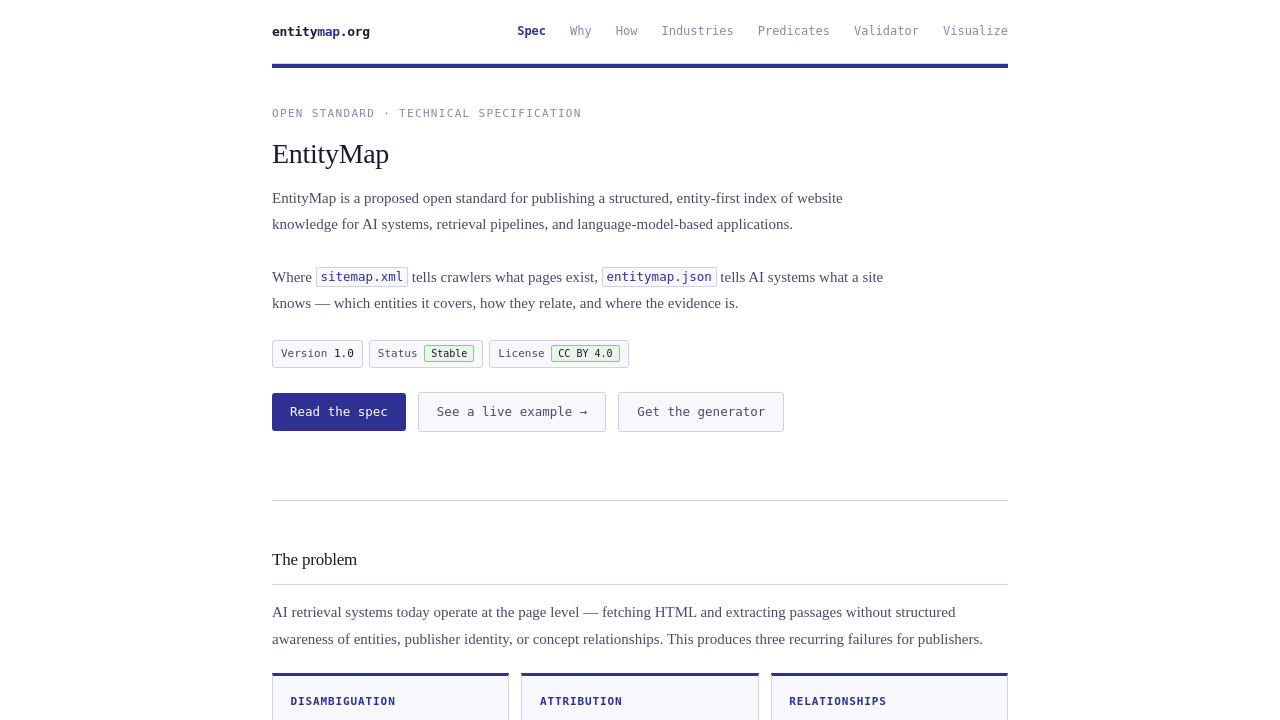
In plain English: an entity map is a list of the things your brand talks about, plus the labelled links between them, written so a machine can traverse it without ambiguity. An entry typically includes a name, a description, a sameAs link to an authoritative source such as Wikidata, typed relations to other entities, and evidence chunks that point back to source URLs. The EntityMap open standard frames this as an entity-first index of website knowledge, analogous to sitemap.xml but aimed at AI retrieval, not crawlers. Getting the structure right connects directly to broader E-E-A-T strategy for Web3 and crypto SEO.
Entity Maps vs. Traditional Keyword Mapping
Traditional keyword mapping organizes pages around search terms. Entity mapping organizes knowledge around named things: brands, products, people, places, and concepts, plus how they connect. The goal is disambiguation, making sure the same concept under different surface forms is treated as one entity rather than several unrelated signals. That shift changes how you plan content silos on Web3 sites, because clusters are now built around entities and their relations, not just keyword variants.
Takeaway: if your content plan still starts with a keyword spreadsheet, you’re one abstraction layer behind how modern retrieval works.
How Entity Maps Work

An entity map works by declaring nodes, edges, and evidence in a predictable format so any AI system can parse the graph without scraping HTML. Well-formed entries live in a JSON file at a known URL, alongside a human-readable HTML view. The pattern mirrors how llms.txt files serve Web3 projects, publishing a curated index for language models rather than hoping they guess.
The Anatomy of an Entity Entry
A conforming entry declares a unique entityId, a schema.org type (@type), a canonical name, a plain-language description, sameAs URIs pointing to Wikidata or Schema.org, and explicit typed relations to other entities. It also carries hasChunks: short evidence passages with source URLs, publisher names, and retrieval timestamps. That evidence layer is what lets a retrieval-augmented answer cite you rather than paraphrase you into invisibility. If you already run SEO automation workflows, generating and updating these entries fits naturally into the same pipeline.
Typed Relationships and Why They Matter
Typed relations like IMPROVES, PART_OF, or COMPETES_WITH replace buried prose connections with declared, machine-readable edges. This is what lets AI retrieval systems traverse knowledge rather than only extract passages. A model can follow Brand → OFFERS → Product → SOLVES → CustomerProblem without inferring anything. Getting these edges right depends on disciplined internal linking across Web3 and crypto sites, because the on-page link graph and the declared entity graph should agree.
Entity Maps in SEO vs. AI Retrieval Contexts
In SEO, entity maps organise primary target pages, supporting subpages, and internal links into a coherent topical cluster that signals expertise to Google’s E-E-A-T evaluation. In AI retrieval, they act as a publisher-attributed index that lets language models cite sources accurately instead of aggregating anonymized chunks. The pattern is not exclusive to marketing: EventCatalog uses entity maps in Domain-Driven Design to visualize how objects like Order, Customer, and Invoice relate, and Microsoft applies the same concept to map FHIR healthcare resources to Dataverse tables. If your site produces long-form assets, systems like turning one book into hundreds of pieces of content benefit from an entity backbone that keeps the derived assets pointing at the same canonical nodes.
Takeaway: entity maps do two jobs at once, cluster architecture for Google, and a citation layer for LLMs.
Why Entity Maps Matter for SEO and AI Visibility

Entity maps matter because unstructured content produces predictable failures the moment AI systems try to summarise it. Publishers who declare their entities take back control over how they show up in search and in generated answers.
The Three Failures Entity Maps Prevent
The EntityMap standard identifies three recurring failures: disambiguation errors, where the same concept is split into separate signals; missing publisher attribution, where identity is lost during AI aggregation; and hidden relationships, where connections are buried in prose rather than declared. Each of these erodes visibility in different ways, and each is fixable with a structured entity layer. Teams running a full SEO audit checklist should treat these three failure modes as first-class findings, not afterthoughts.
Entity Maps and Google’s Knowledge Graph
Google’s Knowledge Graph relies on entity disambiguation to connect search queries to real-world things. Sites that clearly define their entities through structured data and internal link architecture are more likely to earn Knowledge Panel features and richer SERP treatments. Third Marble Marketing notes that SEO entities support E-E-A-T by signalling topical depth and association with reputable external sources. Pair that with strong technical SEO for Web3 and blockchain projects and the entity signals stack cleanly on top of a crawlable foundation.
Brand Visibility in AI-Generated Answers
If a brand does not define its own entity map, AI systems will infer one, often introducing misrepresentation, omissions, or competitive disadvantage. A defensible brand entity map covers identity, products and services, target customer segments, problems solved, related concepts, proof elements (reviews, awards, press), and the relationships connecting all of them. Getting this right is what makes content written specifically for LLMs actually get quoted rather than paraphrased into anonymity.
Takeaway: silence is not neutral. Undeclared entities get invented on your behalf.
Common Misconceptions About Entity Maps
Entity mapping is new enough that most teams import assumptions from adjacent disciplines and get it wrong. Three misconceptions come up repeatedly.
Misconception: Entity Maps Are Just Sitemaps
Reality: they serve a different layer. A sitemap tells crawlers which pages exist. An entity map tells AI systems what a site knows, which entities it covers, how they relate, and where the evidence sits. Both belong in a mature stack, but they answer different questions. If you’re already thinking about indexing and crawl management on Web3 projects, the entity map is the semantic sibling to the crawl-control layer.
Misconception: Only Large Brands Need Them
Reality: any indexed site benefits, and smaller brands often benefit more. Large brands have thousands of third-party citations that correct AI misrepresentations by weight of evidence. Small and mid-sized brands have fewer citations, so a self-declared entity map is often the strongest signal on record. Founder-led sites building product-led SEO in Web3 tend to see the fastest lift because their entity coverage is otherwise thin.
Misconception: Structured Data Alone Is Enough
Reality: relationships are the critical layer. Schema markup on individual pages declares local facts but does not express cross-entity relationships. A full entity map connects nodes into a graph, which is what retrieval pipelines and knowledge engines need. Entity mapping also is not one-and-done: products change, team members shift, competitive context moves. Treat it like your redirection and URL management practice, an ongoing hygiene layer rather than a one-time project.
Takeaway: if you stop at schema, you’ve declared facts without declaring the graph.
Related Concepts in Semantic SEO
Entity maps sit inside a small family of related ideas. Knowing the neighbors sharpens how you use each one.
Knowledge Graph
A knowledge graph is a network of entities and their relationships stored in a graph database. Google’s Knowledge Graph, launched in 2012, is the most prominent example and directly influences which entities surface in search features. A public entity map is essentially a publisher-side contribution to this pattern, aligned with how content distribution shapes GEO outcomes.
Topical Authority
Topical authority is the degree to which a site is recognised as a comprehensive, trustworthy source on a subject. Entity maps are one structural mechanism for building it, alongside disciplined cluster planning and content audits that prune and consolidate weak pages into stronger ones.
Semantic Triples
Semantic triples (subject–predicate–object) are the underlying data structure of RDF-based knowledge representations. Entity map relations are applied versions of this concept, expressed in JSON-LD or a custom schema. Anyone comfortable writing title tags and meta descriptions can reason about triples; the syntax is different, the discipline is the same.
Entity Disambiguation
Entity disambiguation resolves surface-form variations (e.g. “Apple”, “Apple Inc.”, “AAPL”) to a single canonical entity. The sameAs URIs in entity maps perform this function for publishers, and they matter for both search and search intent across the Web3 marketing funnel.
RAG (Retrieval-Augmented Generation)
RAG is an AI architecture that fetches external documents at query time to ground language model responses. Publisher-attributed entity maps improve attribution accuracy in RAG outputs, which is why AI content automation in Web3 increasingly assumes an entity layer underneath the generation stack.
How to Get Started With Entity Mapping

You don’t need a research team to ship a first version. Three steps get you to a usable entity map.
Step 1: Audit Your Brand’s Core Entities
List the core entities your brand owns: legal name, product or service names, key team members, locations, and the problems your business solves. These are the nodes. Keep the initial list tight, 15 to 30 entities is a workable v1. Teams that already run a Web3 backlink strategy can seed the entity list from the anchors and destinations they already care about.
Step 2: Define Relationships and Evidence
For each entity, document attributes (description, category, founding date) and typed relationships to other entities: Brand → OFFERS → Product, Product → SOLVES → CustomerProblem, and so on. Anchor each entity to an authoritative external URI via sameAs, Wikidata, Schema.org, Crunchbase, LinkedIn, so cross-system disambiguation actually works. For each relation, attach evidence chunks that point at the source URLs on your site, which is where a strong crypto SEO practice of explaining protocol mechanics, limits, and risks pays off: the evidence already exists in your published pages.
Step 3: Publish and Maintain Your Entity Map
The EntityMap open standard provides a JSON schema and a reference generator (Waikay) so publishers can produce a conforming entitymap.json file hosted at a predictable root-level URL, with an entitymap.html sibling for humans and crawlers. Maintenance matters: update entries when products change, team members shift, or new relationships form, otherwise AI systems keep surfacing stale inferences. Bake the update cadence into the same review cycle you use for scaling Web3 SEO to 5x organic traffic.
Takeaway: ship a small entity map first, then expand. A partial declared graph beats none.
Frequently Asked Questions
What is an entity map in SEO?
An entity map is a structured document that lists your brand’s core entities, their attributes, and typed relationships between them. It gives search engines and AI systems a declared model of what your site knows.
How is an entity map different from a sitemap?
A sitemap tells crawlers which pages exist. An entity map tells AI systems which concepts your site covers, how those concepts relate, and where the supporting evidence lives. Different formats, different layers, complementary purposes.
Do I need an entity map if I already have schema markup?
Schema markup declares facts on individual pages but does not express cross-page relationships between entities. An entity map connects those nodes into a graph, which is what retrieval pipelines and knowledge engines need to reason across your site.
What entities should I include in a brand entity map?
Start with brand identity, products or services, key team members, locations, target customer segments, problems solved, related concepts, and proof elements such as reviews, awards, and press. Then declare the relationships that connect them.
How do entity maps affect AI search results and LLM answers?
Entity maps give language models a publisher-attributed source to cite instead of anonymized HTML chunks. That improves attribution accuracy, reduces misrepresentation, and increases the odds your brand is named correctly in generated answers.
What is the EntityMap.org open standard?
EntityMap.org proposes an open standard for publishing entity-first indexes at predictable URLs (entitymap.json and entitymap.html). It defines a JSON schema for entity entries, typed relations, and evidence chunks, plus a reference generator called Waikay.
How do entity maps relate to Google’s Knowledge Graph?
Google’s Knowledge Graph resolves queries to real-world entities. A public entity map, combined with structured data and reputable external references, helps Google disambiguate your brand correctly and increases eligibility for Knowledge Panel features.
How often should an entity map be updated?
Update it whenever products, team members, locations, or key relationships change, and review it quarterly at minimum. Stale entries let AI systems keep surfacing outdated inferences about your brand long after the underlying facts have moved.
Conclusion
Entity maps are turning into the connective tissue between traditional SEO and AI-driven discovery. Declare your entities, describe the relationships, attach the evidence, and keep the file current. Once your entities are documented here, the next step is reinforcing them through repetition across independent sources, covered in entity co-occurrence. Do that and you stop leaving your brand’s narrative up to inference. If you want help building the entity layer alongside your broader search and GEO strategy, the team at Victoria Olsina works on exactly this problem for Web3 and crypto-native brands.
Ready to make your Web3 project discoverable across Google and AI search? Book a free strategy call.


![Victoria Olsina, mentor at R[3]sidency x Construct](https://victoriaolsina.com/wp-content/uploads/2026/10/r3sidency-mentor-victoria-olsina-26239-300x158.png)