The agentic web is an emerging phase of the internet where autonomous AI agents perform tasks, make decisions, and collaborate across digital ecosystems on behalf of users. Rather than clicking links or filling forms, users delegate goals to software agents that plan, negotiate, and execute independently. For Web3 and blockchain-native brands, understanding this shift is critical to staying visible online. Victoria Olsina helps decentralised projects prepare their web presence for this agent-driven future.
Definition: What Is the Agentic Web
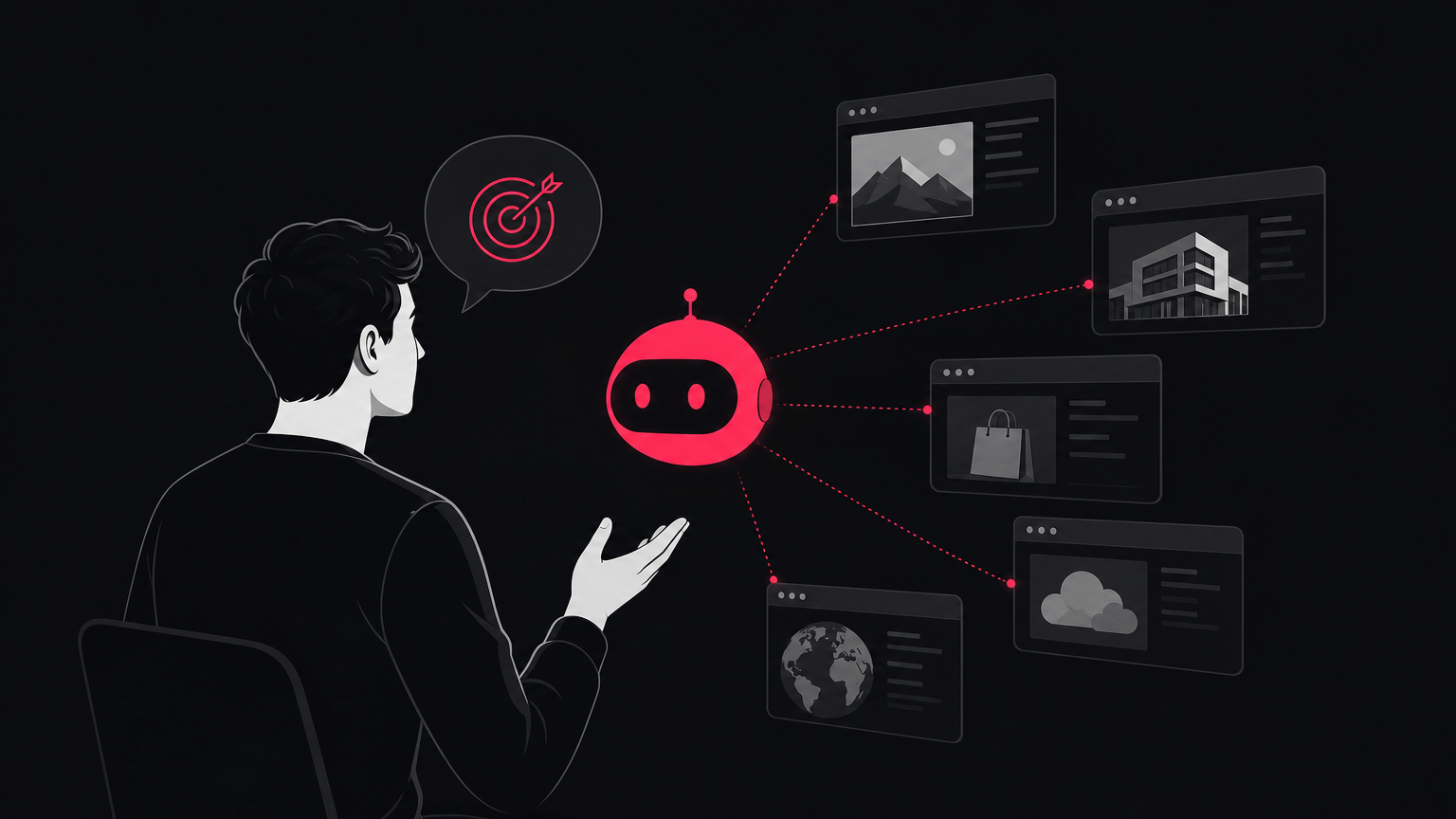
The agentic web replaces the click-and-read internet with a coordination layer for software agents. Instead of a human navigating pages, an agent receives a goal and executes it across sites, APIs, and other agents. This is a structural change, not a cosmetic one, and it maps directly onto how Web3 SEO fundamentals will need to evolve over the next few cycles.
The Formal Definition
MIT’s report *The GenAI Divide* defines the agentic web as “a mesh of interoperable agents and protocols that replaces monolithic applications with dynamic coordination layers.” The W3C has formally adopted the term to describe AI agents interacting with the web, according to *The New Stack* (Sep 2025). A July 2025 arXiv paper by Yang et al. frames the concept around three dimensions: intelligence, interaction, and economics. That paper has already been cited 74 times and is becoming the reference framework for engineers building against this stack, alongside emerging patterns in the Web3 glossary most agencies rely on.
Put Plainly
Think of the agentic web as a delegation layer sitting on top of the current internet. You tell an agent what you want. The agent talks to other agents, pulls from APIs, and returns a completed task. Search becomes rare; delegation becomes default. That single shift reshapes traffic patterns, funnel design, and search intent modelling for every site that used to rely on organic clicks.
In plain English: the agentic web is the internet, but agents are doing the browsing.
How the Agentic Web Works

The mechanics rest on three things: autonomous agents, communication protocols between them, and an economy that rewards the sites and services agents choose to interact with. If your site is not machine-parseable, you sit outside that economy. Treat it as an extension of your technical SEO for blockchain projects, not a separate initiative.
Autonomous Agents and Goal Delegation
An agent takes a goal like “book a hotel in Rome under £250 per night near historic sites” and handles research, comparison, and booking without further input. The Yang et al. framework identifies retrieval, recommendation, planning, and collaboration as the four core capabilities powering these interactions. Each of those capabilities is a place your content either shows up or gets skipped, which is why content structured for LLMs is starting to matter more than pretty landing pages.
Inter-Agent Communication Protocols
Three protocols are doing the load-bearing work:
- Model Context Protocol (MCP): the emerging standard for exposing tools and data to LLM-driven agents.
- Agent-to-Agent (A2A): cross-vendor agent communication, backed by Google.
- NANDA: an MIT-led effort for a decentralised agent registry.
Together they replace monolithic applications with dynamic coordination. For Web3 sites, this maps neatly onto interoperability instincts you already have, and it makes files like llms.txt for Web3 a practical starting point rather than a novelty.
The Agent Attention Economy
Yang et al. describe an “Agent Attention Economy” where agents, not humans, allocate the scarce resource of attention. Whoever ranks in an agent’s shortlist wins the transaction. Companies including OpenAI, Anthropic, Microsoft, and Shopify are actively building infrastructure toward this, per *The New Stack* (Sep 2025). Winning agent attention looks a lot like winning generative engine visibility: consistent facts, clean structure, machine-readable pricing.
Takeaway: protocols and structured data are the new distribution channel.
The Web’s Evolution: From Web1 to the Agentic Web

Every phase of the internet has redefined who acts. In the agentic web, the actor is software. Understanding the arc helps position your project correctly, especially if you have already invested in Web3 site architecture.
Web1, Web2, and Web3 in Brief
- Web1 (Static Web): users read. Publishing was one-way.
- Web2 (Social Web): users publish. Platforms mediate.
- Web3 (Decentralised Web): users own. Blockchain settles.
Each transition changed the primary verb. The next transition changes the subject, and it forces a rethink of how content silos for Web3 get built, because agents traverse topical structure very differently from humans.
Where the Agentic Web Fits
The agentic web sits after Web3, but it is complementary rather than competing. Web3’s stack is blockchain, smart contracts, and crypto. The agentic web’s stack is large language models, AI agents, and interoperability layers. Web3 delivers ownership; the agentic web delivers action. A Web3 project that ignores agent-readiness will still own its assets, it just will not be discoverable by the software choosing where to send transactions, which is why crypto SEO strategy is quietly folding agent-readiness into every audit.
Why the Agentic Web Matters for Websites and SEO

If agents mediate traffic, then human pageviews stop being the KPI. Machine reads, tool calls, and agent-completed tasks take their place. This is already happening. A shift like this rewrites the assumptions inside most SEO audit checklists written before 2024.
How Agent Traffic Differs from Human Traffic
Agents do not scroll. They fetch. They prefer structured data, APIs, and machine-readable endpoints. Firefox Labs’ experimental AI previews feature (announced 2025) lets users read an AI-generated summary of a page without clicking through. Opera Neon, launched in 2025 as the first AI agentic browser, automates form-filling, hotel bookings, and shopping directly inside the browser. Both reduce human visits, and both increase the value of clean indexing and crawl management so agents can retrieve the right pages on the first pass.
Structuring Content for AI Agents
According to David Meerman Scott (Jun 2025), site owners need to structure product descriptions, pricing, and action pathways so agents can locate and execute them. That means schema markup, clean HTML, exposed endpoints, and explicit affordances. If a human would need three clicks to complete an action, an agent needs three machine-readable states. Small details like title tags and meta descriptions still matter, but they are now a subset of a broader machine-parsing surface.
Implications for Web3 and Blockchain Projects
Web3 audiences are already technologically forward. Their tooling adopts agent-driven interfaces faster than mainstream consumer verticals. That gives protocol teams a narrow window to bake agent-readability into product pages, docs, and governance portals. Get it right and you compound the visibility work already done on your Web3 backlink strategy.
Takeaway: structured, machine-readable content is now a competitive moat, not a nice-to-have.
Common Misconceptions About the Agentic Web
Most of the confusion happens because “agentic” is being used loosely across marketing decks. Here is where the mental model breaks. Clearing these up saves months of misdirected work, especially for teams already investing in E-E-A-T for Web3 SEO.
Misconception: The Agentic Web Is the Same as Web3
Reality: Web3 is about decentralisation and ownership. The agentic web is about autonomous execution. They share a vision of a reimagined internet, but the stacks and incentives differ. Confusing them leads to the wrong architectural bets, especially around internal linking for crypto sites where agents traverse very differently from crawlers.
Misconception: Agentic AI Replaces Human Intent
Reality: agents act on delegated intent. Humans still set parameters, budgets, and constraints. The agent executes; it does not decide what you want. Framing this correctly matters when you write protocol mechanics and risk disclosures that both humans and agents will parse.
Misconception: Only Large Tech Companies Need to Prepare
Reality: any site relying on human search traffic or form submissions is already exposed. Small and mid-sized Web3 projects are equally affected, and they usually have less budget to recover if they wait. Even lightweight interventions like programmatic SEO patterns can accelerate agent-readiness without massive re-platforming.
Misconception: The Agentic Web Is Still Years Away
Reality: Opera Neon, Firefox AI previews, and production agent frameworks from Anthropic and OpenAI are live in 2025. This is a present-tense concern. Waiting is a choice, and it is a choice competitors are exploiting through faster SEO automation workflows.
How to Get Started with the Agentic Web
Preparation is unglamorous but tractable. Three moves cover most of the ground for a Web3 team. None of them require you to throw out your existing content audit process.
Audit Your Site for Agent Readability
Start by auditing product descriptions, pricing, and call-to-action pathways. Ask whether an agent could complete the primary conversion action using only your structured data. If not, list the gaps. This is a natural extension of a standard technical SEO audit for Web3, not a separate exercise.
Adopt Agent-Friendly Protocols and Structured Data
Implement schema.org markup for products, offers, FAQs, and how-tos. Where feasible, expose MCP-compatible endpoints so agents can call your services directly. Publish an llms.txt file so LLMs know which pages to prioritise. These practices pair naturally with product-led SEO for Web3, which already treats structured product surfaces as the growth engine.
Monitor Governance and Standards Developments
The W3C is developing governance standards for the agentic web. Yang et al. flag privacy, security, and agent accountability as active research directions. Track those specs, and align your implementation early. Teams already treating distribution as a GEO signal tend to pick these standards up faster because they are already watching the same forums.
Takeaway: treat agent-readiness as an evolution of technical SEO, not a rebuild.
Agents change what discovery looks like, and the work of being found changes with it. See how AI agents find and read your site.
Frequently Asked Questions
What is the agentic web in simple terms?
The agentic web is a phase of the internet where AI agents complete tasks on behalf of users. Instead of clicking links, you delegate goals, and software agents plan, negotiate, and execute across sites and APIs.
How is the agentic web different from Web3?
Web3 is about decentralisation, ownership, and blockchain-based value exchange. The agentic web is about autonomous AI agents acting on delegated intent. They are complementary layers, not competing visions, and many projects will run on both simultaneously.
What protocols power the agentic web?
Model Context Protocol (MCP), Agent-to-Agent (A2A), and NANDA are the three most-cited protocols. They enable specialised agents to communicate, share tools, and coordinate tasks without depending on a single monolithic application or vendor.
How will the agentic web affect my website traffic?
Human pageviews will decline as agents mediate more decisions. AI previews, agent browsers, and chat interfaces reduce direct visits. Traffic that remains will be higher-intent, and machine reads become a new measurable channel alongside sessions.
What is the Agent Attention Economy?
Coined in the Yang et al. arXiv paper, the Agent Attention Economy describes how agents, not humans, will allocate the scarce resource of attention. Sites that rank well in agent shortlists capture disproportionate share of downstream transactions.
How do I make my website ready for AI agents?
Publish structured data, expose clean APIs, add schema markup for products and offers, and ensure conversion actions are machine-executable. Audit against the workflows agents actually run: retrieval, recommendation, planning, and collaboration.
Is the agentic web the same as agentic AI?
No. Agentic AI refers to individual autonomous systems. The agentic web is the interoperable network of many such agents, protocols, and services coordinating across the internet. One is a component; the other is the infrastructure layer.
Which companies are building the agentic web?
OpenAI, Anthropic, Microsoft, Google, Shopify, and Opera are among the most visible. The W3C is developing governance standards, and MIT-affiliated researchers are behind NANDA. Expect Web3-native teams to join the stack quickly.
Conclusion
The agentic web is not a distant scenario. Agent browsers, AI previews, and MCP-compatible services are shipping now, and the sites structured for them will absorb the traffic that used to arrive through search. For Web3 and blockchain projects, the practical work looks familiar: schema, structured data, clean endpoints, and consistent facts. It just has a new audience. If you want a partner who has been building for this shift specifically inside decentralised ecosystems, the team at Victoria Olsina is a solid place to start.
Produced using an that cites every claim.
Ready to make your Web3 project discoverable across Google and AI search? Book a free strategy call.


![Victoria Olsina, mentor at R[3]sidency x Construct](https://victoriaolsina.com/wp-content/uploads/2026/10/r3sidency-mentor-victoria-olsina-26239-300x158.png)