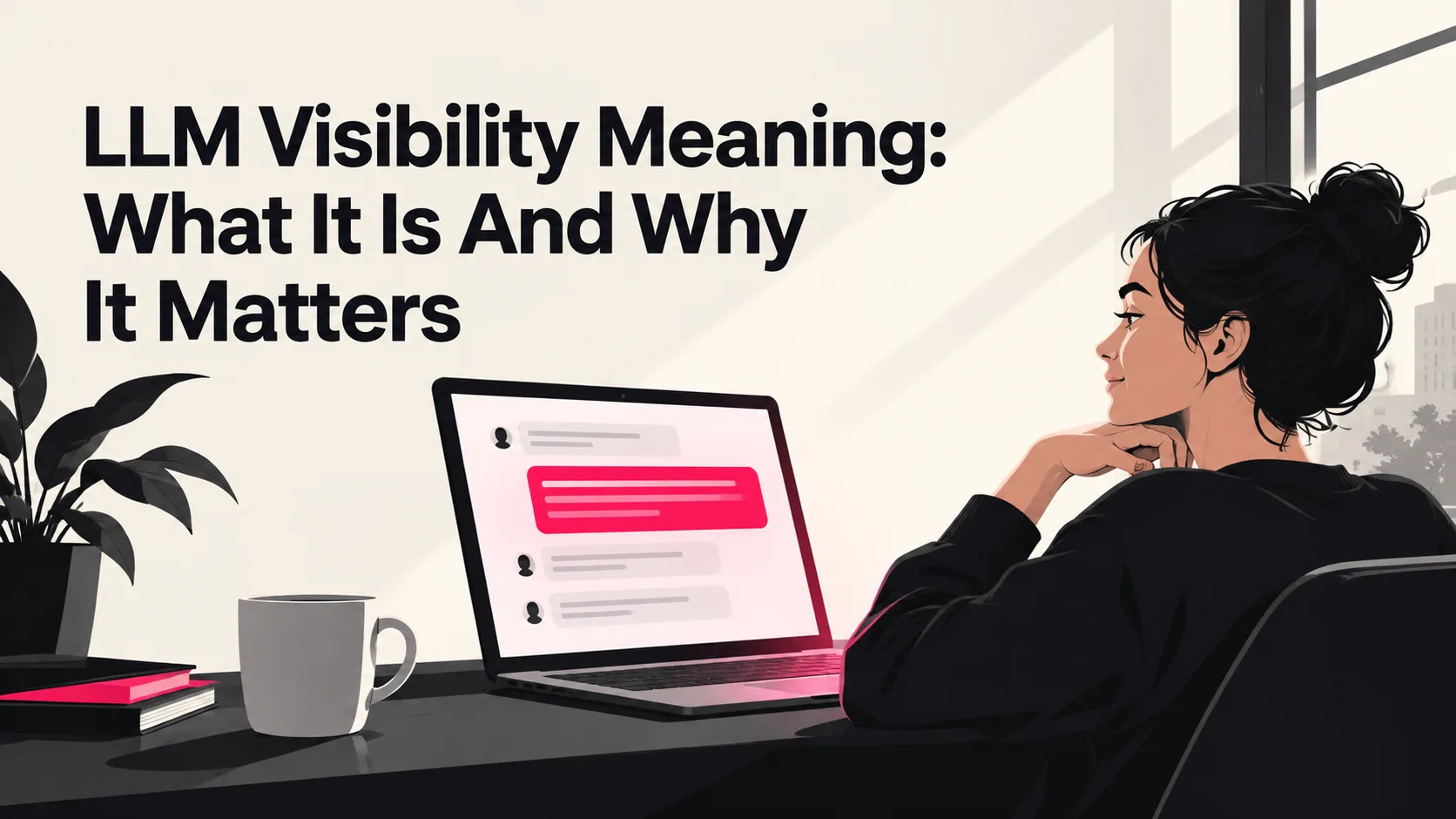
LLM visibility is the measure of how often, and how accurately, AI tools like ChatGPT, Gemini, Perplexity and Claude mention your brand when users ask questions. It is independent of your Google rankings. Most brands have no idea what AI says about them, and that gap is already costing pipeline. This article explains what LLM visibility means, how it works, and what you need to track. If you want the wider category context first, Victoria Olsina’s LLM SEO primer covers the fundamentals.
Definition: What LLM Visibility Actually Means
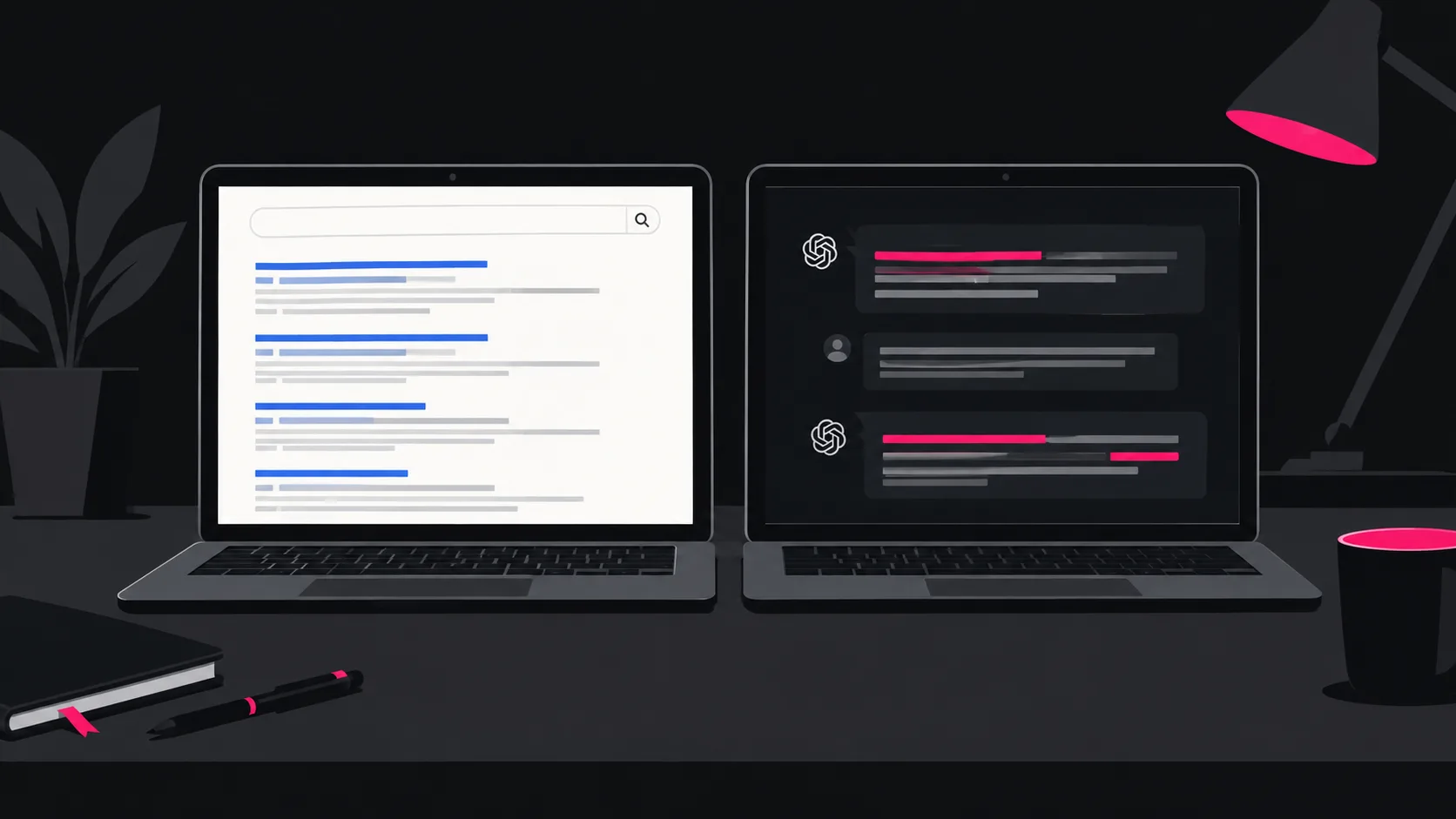
LLM visibility measures how often your brand, content or domain appears in answers generated by AI assistants, not the ten blue links on a search results page. It covers four things at once: presence (do you appear at all), positioning (how you are described), sentiment (positive, neutral, negative) and narrative gaps (topics where you are missing). A brand can rank on page one of Google and still be invisible in AI answers. Those are two different pipelines now, and they need separate on-page work.
The plain-language version
When a buyer asks ChatGPT “what are the best analytics tools for a Web3 startup”, the reply is a short list with a few sentences per option. That single answer often shapes the buyer’s shortlist before they visit any website. LLM visibility tells you whether your brand made that list and how it was framed. It is the AI equivalent of getting picked for a category-defining article, except the article is generated on demand for every buyer.
What it is not
LLM visibility is not the same as ranking, and it is not a keyword position tracker with a new coat of paint. Rankings measure link position on a static page. Visibility measures narrative: presence in a fluid, generated answer. It is also not a vanity metric. Being included in an AI answer is a distribution event, similar to the discovery mechanics Victoria Olsina outlines in her notes on Web3 SEO strategy.
Takeaway: LLM visibility is a distribution metric for the AI answer layer, not a Google ranking cousin.
How LLM Visibility Works

The mechanism starts with how modern models process a question. LLMs break queries into sub-questions, a process sometimes called query fan-out, and pull content chunks that answer each sub-question. If your content only covers one angle of a topic, you will get skipped for the others. Structured, comprehensive coverage wins here, in the same way it does when you make a site discoverable by agents.
How AI models decide what to surface
Models weight signals from many sources at once: your own site, third-party publications, forums, review platforms, documentation. They favour content with clear structure, topical authority and consistent signals across the web. A single well-written page rarely moves the needle; a cluster of consistent references does. Think of it as a distributed reputation graph, similar to how the agentic web treats trust as a signal spread across many nodes rather than one homepage.
The four layers: presence, positioning, sentiment, narrative gaps
- Presence: do you appear at all when the prompt is relevant?
- Positioning: how are you described relative to competitors, and are you framed as the leader, the challenger or the footnote?
- Sentiment: is the tone positive, neutral or negative?
- Narrative gaps: which prompts should surface your brand but do not?
Citations in LLM answers usually come with a URL, and that signals the model treats the source as authoritative. Mentions without a URL still influence brand recall, which is why linkless coverage matters. According to Accuranker’s 2026 metrics breakdown, the sources an LLM draws from reveal which content types and domains it prefers, and that data lets you adjust format and placement.
Takeaway: cover every angle, in structured chunks, across multiple trusted surfaces. That is the mechanism.
Why LLM Visibility Matters More Than It Did a Year Ago

A year ago this was a curiosity. Now it is a channel. Semrush data referenced by Connor Gillivan on LinkedIn estimates AI visits will overtake Google queries by 2027. That is the kind of shift that reshapes the discovery layer, not just a channel weighting. The playbook has to change with it, and the same logic applies to niche verticals like the stablecoin SEO and AEO work she has written about.
AI is reshaping the discovery layer
Ninety percent of ChatGPT citations come from long-tail results, according to the same Semrush analysis. Niche authority beats broad brand recognition when the query is specific. A small brand with deep coverage of one problem can outrank a household name in an AI answer for that problem. This is closer in feel to how custom GPTs surface specialised knowledge than to legacy SEO.
The traffic and pipeline case
Some analysis suggests LLM referral traffic converts far better than organic search, because the user arrived already primed by the AI answer. They read the framing, saw your positioning, and clicked with intent. Traditional analytics tools cannot fully track that path, which creates a measurement blind spot. If you rely only on Google Analytics you will underestimate the channel, and Victoria Olsina digs into the tracking gap in her notes on AI marketing agents.
Takeaway: when you are missing from AI comparison answers, a competitor’s framing fills the space, before any click happens.
The Five Metrics That Define LLM Visibility

Visibility as a concept is fine. Visibility as a measured programme needs five metrics you can track weekly. The list below matches the framework Accuranker publishes and the one most serious LLM tracking tools now use. If you want the underlying strategy view, Victoria Olsina’s ChatGPT visibility notes sit alongside this list.
| Metric | What it measures | Why it matters |
|---|---|---|
| Visibility | How often your brand or domain appears in AI answers | Baseline exposure, with or without a link |
| Sentiment | Positive, neutral or negative framing | Directly affects trust and purchase intent |
| Mentions | Raw brand appearances, including linkless | Builds recall without a click |
| Citations | Explicit references with a URL | Signals the AI treats you as authoritative |
| Sources | Specific pages and domains the LLM draws from | Reveals which formats and platforms carry weight |
Sentiment is the one most teams underweight. A neutral mention is fine. A negative mention repeated across models is a reputation problem you cannot fix by publishing more blog posts, it needs coordinated content and PR work. Victoria Olsina covers the wider auditing angle in her tool reviews roundup, which compares LLM tracking platforms.
Takeaway: measure all five. Tracking only citations misses the linkless mentions that shape brand recall.
How to Start Building LLM Visibility
You do not need a new budget line. You need clearer content, wider off-site presence, and a weekly prompt-tracking habit. That combination will move you further than another tool subscription. The same logic applies whether you’re a SaaS founder or a Web3 protocol, and it slots neatly into the Escalando con IA framework Victoria Olsina uses with clients.
Content signals that AI models reward
- Write to answer specific questions. Use headings, bullets and FAQs so models can extract discrete chunks.
- Cover every angle of a topic in one place, not scattered across five posts.
- Refresh existing content. LLM citations shift based on recency and user history, so an updated post often beats a new one.
- Publish structured comparison content when your category involves buyer choice.
Structure is the load-bearing part. If a model cannot cleanly extract a paragraph as an answer, it will pick a competitor’s page that it can. Technical hygiene matters too, and the basics covered under technical SEO still apply.
Where to build presence off your own site
Linkless citations on forums, review platforms and third-party publications feed AI discovery even without a clickable link. Reddit answers, Product Hunt entries, community wikis, industry roundups, all get indexed and influence model output. Consistent topical coverage across formats trains the models to associate your brand with a category, similar to the case study Victoria Olsina wrote on Bando’s full-funnel AI content automation.
Then track it. Pick fifteen to twenty prompts your buyers are likely to ask ChatGPT, Gemini, Perplexity and Claude. Run them weekly. Log whether your brand appears, how it is described, and who ranks above you. That log is your dashboard, and it will surface narrative gaps faster than any keyword tool. Fixing crawl issues like broken pages that trigger 404 errors is a cheap way to protect the citations you already earn.
Takeaway: structured content on your site, linkless presence off it, and a weekly prompt log. That is the starter kit.
Conclusion
LLM visibility is not a future concern. It is already shaping how buyers discover, compare and choose brands, and the measurement gap is widest right now, which makes it the cheapest time to close it. The brands that start tracking prompts, structuring content for extraction, and building linkless presence today will have a structural advantage as AI query volume grows. No special budget required, just discipline and a weekly log.
FAQ: Frequently Asked Questions
What is the difference between LLM visibility and SEO visibility?
SEO visibility measures ranking positions on search engine results pages. LLM visibility measures how AI assistants describe and include your brand in generated answers. The two overlap on authority signals but track different distribution surfaces, and a brand can win one and lose the other.
Does Google ranking affect LLM visibility?
Sometimes, but not reliably. Strong Google rankings correlate with authority signals LLMs also reward, so there is some spillover. However, LLMs draw from forums, reviews and third-party publications that never rank in Google, so ranking is neither necessary nor sufficient for LLM presence.
How do I measure my brand’s LLM visibility?
Choose fifteen to twenty prompts your buyers actually ask AI tools. Run them across ChatGPT, Gemini, Perplexity and Claude on a weekly cadence. Log presence, positioning, sentiment and competitor mentions. Purpose-built tools like Accuranker and Semrush automate this at scale.
Which AI tools should I track for LLM visibility?
Start with ChatGPT, Gemini, Perplexity and Claude. Add Google’s AI Overviews if your category shows them frequently. These four cover the majority of consumer and professional AI query volume today, and tracking all four gives you a defensible baseline against competitor shifts.
What types of content get cited most often by LLMs?
Structured how-to guides, clear definitions, comparison posts and FAQ pages get cited most. Models prefer content with headings, short paragraphs and extractable chunks. Fresh content is rewarded, and long-tail niche coverage frequently outperforms broad category posts.
Can small brands compete for LLM visibility against larger competitors?
Yes. Ninety percent of ChatGPT citations come from long-tail results, so niche authority beats broad brand recognition on specific queries. A small brand with deep, structured coverage of one problem can win the AI answer even when a household name dominates Google.
What is a linkless citation and does it count for LLM visibility?
A linkless citation is a brand mention in an AI answer without a clickable URL. It counts. Linkless mentions build brand recall, influence sentiment and often lead the user to search the name directly. Models also treat repeated linkless mentions as authority signals.
How often do LLM citations change?
Frequently. Citations shift with each model update, recency signals and user history. A page cited today may be replaced within weeks if a fresher or better-structured competitor appears. Weekly tracking is the minimum cadence to catch meaningful drift.
Find out how visible your brand is to AI
Victoria Olsina’s AI SEO and GEO service for Web3 covers prompt tracking, content built for extraction and the authority signals AI systems rely on. Book a free strategy session for a starting audit of your brand’s LLM visibility.


![Victoria Olsina, mentor at R[3]sidency x Construct](https://victoriaolsina.com/wp-content/uploads/2026/10/r3sidency-mentor-victoria-olsina-26239-300x158.png)