An SEO slug is the final, editable part of a URL that names a page. A short, descriptive slug helps users and search engines understand the page, and it should match the page title closely. Victoria Olsina treats it as the cheapest piece of on-page clarity a site owns, and one that feeds straight into how LLMs read and cite your pages. Get it wrong and every other signal works harder.
Definition: what an SEO slug is
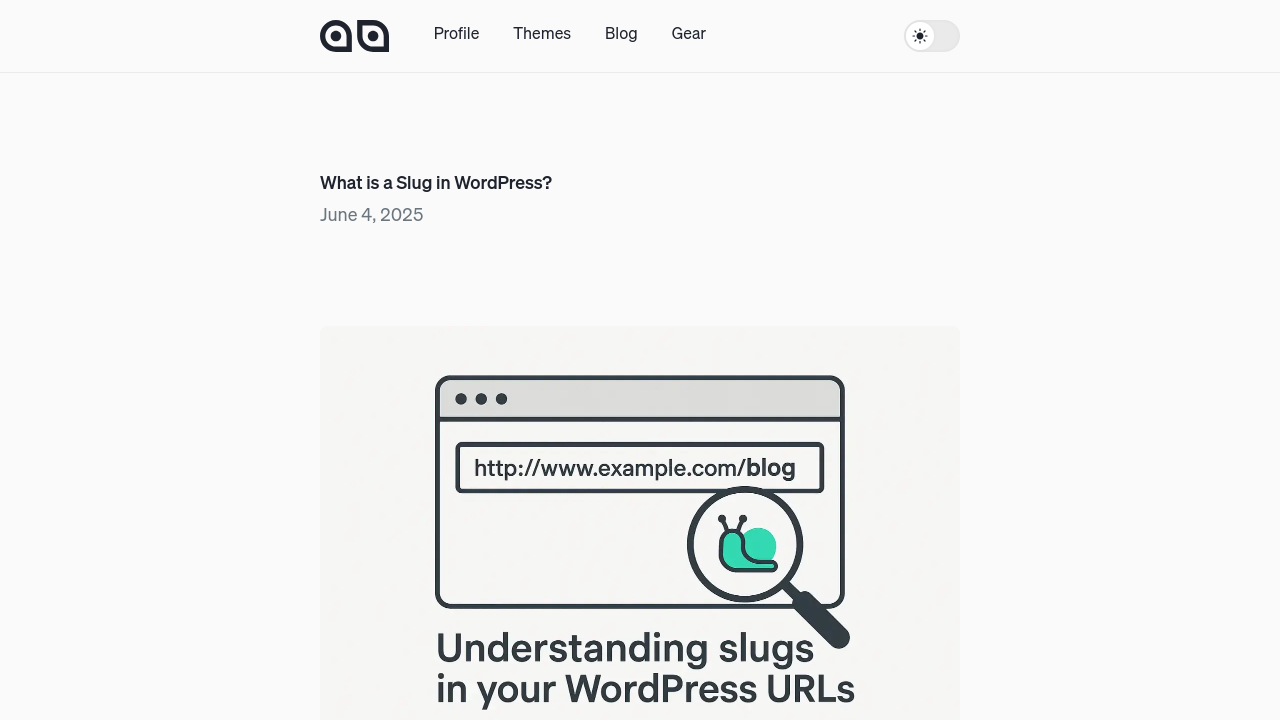
Start with what breaks. A slug like /p=4821 or /new-page-2 tells a reader nothing, and tells a search engine nothing either.
According to Anders Norén’s WordPress slug guide, a slug is the editable segment of a URL that comes after the domain name. Take mysite.com/about-us: the slug is “about-us”.
The same guide describes the slug as a unique identifier for a specific page or post. Its job is to describe the page content concisely for users and search engines.
Plain language: the slug is the readable name of a page inside its web address.
How a slug works, with a worked example

A slug never works alone. It sits at the end of a URL and inherits meaning from everything before it.
Anatomy of a URL
The WordPress guide breaks https://mywebsite.com/blog/what-is-a-slug into four parts:
- Scheme: https://
- Domain name: mywebsite.com
- Subdirectory: /blog/
- Final part of the URL: what-is-a-slug
You control the slug on every post and page. The rest is usually set by your site structure.
Turning a title into a URL ending: a rewrite
The slugify.online generator turns titles into slugs by lowercasing them, replacing spaces with dashes or underscores, and optionally stripping stop words and numbers.
Here are some of its published examples:
| Page title | Generated slug |
|---|---|
| Bitcoin soars past $33,000, its highest ever | bitcoin-soars-past-dollar33000-its-highest-ever |
| Fintech startups raised $34B in 2019 | fintech-startups-raised-dollar34b-in-2019 |
| Elon Musk considers move to Mars | elon-musk-considers-move-to-mars |
Notice the problem. A literal conversion keeps everything, including “dollar33000” and a year that will date the URL.
Example: a UK fintech blog publishes “A Complete Guide to the 7 Best Crypto Wallets for UK Investors in 2025. Here is how it could be rewritten:
- Literal conversion: a-complete-guide-to-the-7-best-crypto-wallets-for-uk-investors-in-2025
- Stop words removed: complete-guide-7-best-crypto-wallets-uk-investors-2025
- Numbers removed, trimmed: best-crypto-wallets-uk-investors
The final version survives next year’s update and still mirrors the title. That matters, because the University of Washington’s SEO guide advises keeping the page title and slug identical or as similar as possible.
You do not need to do this by hand.
Takeaway: lowercase, hyphens, no filler words, no dates, and still recognisably the title.
Why a slug matters for rankings and AI search

A slug is a label, not a lever. It will not rank a weak page, but a bad one makes a good page harder to read.
Users understand the page before clicking
The WordPress guide notes that a descriptive, concise slug makes a site easier for users to remember and identify. A clean URL in a search result or a shared link earns trust a string of numbers never will.
Search engines read the topic
The WordPress guide by Anders Norén says a clear slug helps search engines understand page content, which can improve visibility. Victoria Olsina puts it alongside the rest of your on-page SEO work, not above it.
Continuity across title, headline and URL
The University of Washington’s SEO slug and title guide uses a UW Magazine story as its example. The page title reads “At 1936 Olympic Games, UW pulled together to make history” and the slug is at-1936-olympic-games-uw-crew-pulled-together-to-make-history.
The guide states that continuity between all components, including body copy, greatly improves SEO. Repeated wording across slug, title, headline and dek reinforces the topic.
That same repetition helps AI systems connect a page to a topic. It is the URL-level version of building entity maps for SEO and AI.
Takeaway: the slug is one of several places your topic should appear in the same words.
Common misconceptions

Most slug damage comes from good intentions. Someone “improves” old URLs and traffic drops.
Misconception: a slug is a ranking shortcut
Reality: it supports relevance; it does not replace content. A perfect slug on a thin page is still a thin page.
Misconception: longer slugs carry more keywords
Reality: concise and descriptive wins. Both slugify.online and the WordPress guide favour short, descriptive slugs over long ones.
Misconception: you can change slugs freely
Reality: changing a slug changes part of the permalink, so the old address stops working. Changing a slug is quick. Cleaning up the broken links is not.
Every changed slug needs a 301 redirect from the old URL. Skip it and you create the 404 errors that leak traffic and links.
Misconception: slug and title must be identical
Reality: keep them identical or very close. The UW guide says “identical or as similar as possible”, which leaves room to drop stop words and dates.
Takeaway: pick the slug carefully at publish time, then leave it alone.
Related concepts
Permalink
The complete, permanent URL of a page, including scheme, domain, subdirectories and slug. The slug is only the last part.
URL structure
The pattern your whole site uses for addresses, such as /blog/ or /case-studies/ followed by a slug. Check the slugs across your own site to confirm they follow a consistent pattern.
Canonical URL
The version of a page you tell search engines to treat as the main one. A clean slug makes the canonical obvious.
Page title
The title shown in the browser tab and read by search engines. The UW guide treats it as a standalone headline that describes the page.
Sitemap XML
A file listing the URLs you want crawled. Pair it with how robots.txt works to control what crawlers find.
Why it is called a slug
The term is borrowed from publishing, where a slug was a short working name for a story. On the web, it keeps that job: a short name for a page.
Slug in AI
There is no special AI meaning in SEO. The point is that LLM-powered search reads URLs as text, so a descriptive slug adds context, which ties into brand mentions, citations and rankings.
How to get started
Three actions, in this order.
- Audit existing slugs in WordPress. Open Posts > All Posts and Pages > All Pages, and check the Permalink section under each title. Flag numeric, dated or stuffed slugs.
- Rewrite new slugs with the title-to-slug rules. Lowercase, hyphens, no stop words, no dates, close to the title. Apply this before publishing, not after.
- Set 301 redirects and update the sitemap. For any old slug you must change, redirect it, then refresh your sitemap XML so crawlers find the new address.
If your site serves a regulated sector, slug discipline sits inside wider SEO for banking and financial services work.
Conclusion
Three rules cover almost every case. Keep the slug short, keep it descriptive, and keep it close to the page title.
Set it right once and protect it with redirects if you ever change it. If you want slugs, titles and content working together for Google and ChatGPT, start with an LLM SEO review of your pages.
FAQ: Frequently Asked Questions
What is a slug in SEO?
An SEO slug is the editable final part of a URL that names a specific page, like “about-us” in mysite.com/about-us. It tells users and search engines what the page covers in a few readable words.
What is a slug example?
The slugify.online generator converts “Elon Musk considers move to Mars” into elon-musk-considers-move-to-mars. Another example is “what-is-a-slug” in mywebsite.com/blog/what-is-a-slug, where the slug follows the /blog/ subdirectory and names the post.
Why is a URL called a slug?
The word comes from publishing, where a slug was a short working label for a story. Websites kept the idea: a slug is a brief, readable name identifying one page within a site’s address structure.
Should a slug match the page title?
Yes, closely. The University of Washington’s SEO guide advises keeping page title and slug identical or as similar as possible, because repeated wording across URL, title and headline reinforces what the page is about.
Should I remove stop words from a slug?
Usually, yes. Removing words like “a”, “the” and “for” shortens the slug without losing meaning. Keep a stop word only when dropping it would make the slug unclear to readers.
Get your on-page SEO right
Victoria Olsina fixes the on-page and technical foundations for crypto, fintech and SaaS sites through her crypto SEO service. Book a free strategy session to find the quick wins on your site.