A new website SEO checklist is an ordered launch list that covers indexing and crawl setup, technical foundations, site structure, content and trust signals, and measurement. I wrote this one for Web3 and crypto teams, because generic platform checklists skip the Web3 SEO problems that make crypto products hard for AI to understand.
Most launches do not fail on strategy. They fail on a leftover staging tag.
How I ranked these checklist items
The order matters more than the list. I ranked each item against four criteria:
- Impact on crawling and indexing. If Google cannot crawl or index a page, nothing else counts.
- Cost of fixing late. URL changes and redirects get expensive once links and rankings exist.
- Relevance to Web3 and crypto sites. JavaScript-heavy dApps, token pages and trust-sensitive content raise the stakes.
- Effort. Quick wins with high impact go first.
Argue with the order if you like. Just do not skip the top three items.
Quick summary of the checklist
- Custom domain and clean URLs: one host, HTTPS, readable slugs. Best First Step
- Technical foundations: speed, mobile, canonicals, redirects, rendering. Highest Risk
At a glance: launch checklist table
The failure case comes first in this table. A noindex tag left on from staging can keep an entire site out of Google while the team wonders why nothing ranks.
| Rank | Item | Stage | Fails if skipped | Standout |
|---|---|---|---|---|
| 1 | Custom domain and clean URLs | Pre-launch | Duplicate hosts split signals; later URL changes need redirects | Platform subdomains look temporary |
| 3 | Remove staging blocks | Launch day | robots.txt or noindex hides the site | Cheapest fix on the list |
Set up a custom domain and clean URLs
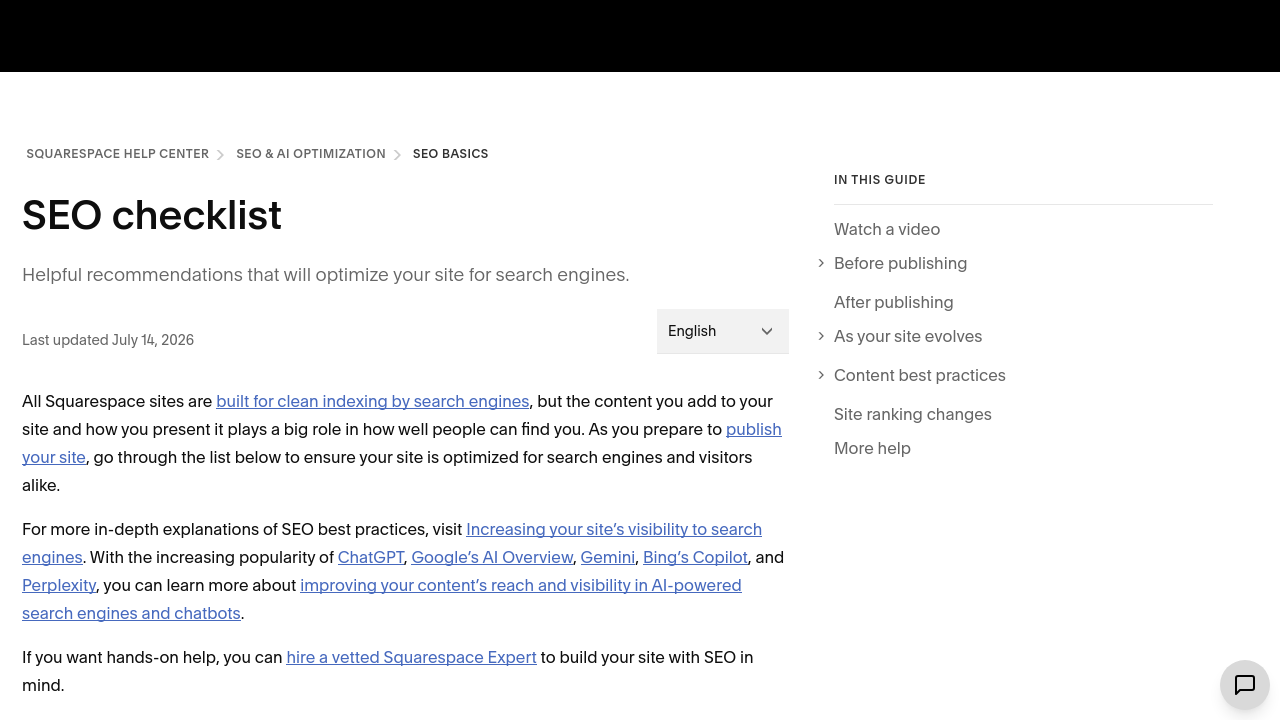
Platform subdomains are a weak start. Squarespace’s own help centre checklist recommends connecting a custom domain rather than using the built-in .squarespace.com URL.
The same logic applies to any builder. If you are still choosing, compare website platforms for SEO before you commit.
Then lock the basics:
- Force HTTPS everywhere.
- Pick one canonical host (www or non-www) and redirect the other.
- Keep slugs short and readable: /staking, not /page?id=4471.
- Avoid dates and token tickers in slugs that may change.
Caveat: changing URLs after launch needs 301 redirects. Treat it like a small migration and follow website migration SEO best practices.
Takeaway: decide your URL pattern once, before a single backlink points at it.
Remove staging blocks and configure crawling

This is the item I see missed most. Developers block staging from search engines, which is correct. Then the block ships to production.
Check these on launch day:
- Open /robots.txt and confirm it does not disallow the whole site.
- View source on key templates and search for “noindex”.
- Check HTTP headers for X-Robots-Tag.
- Submit your XML sitemap.
- Verify Google Search Console and Bing Webmaster Tools.
Bing Webmaster Tools is worth setting up alongside Search Console.
Caveat: crawl allowances differ by AI bot. GPTBot, Google-Extended and others each read robots.txt separately. Decide deliberately which you allow, and check whether your website is invisible to AI.
Robots.txt is a signpost, not a fence. It guides polite bots; it blocks nobody.
Takeaway: add a production robots.txt and noindex check to your deployment script.
Fix technical foundations before launch

Technical SEO is the layer that decides whether content gets seen at all. Fix it before launch, not after the traffic fails to arrive.
My pre-launch pass covers:
- Page speed: run key templates through PageSpeed Insights.
- Mobile rendering: test real devices, not just a resized browser.
- Canonical tags: self-referencing on every indexable page.
- 301 redirects: map every old URL if you are replacing a site.
- JavaScript rendering: check that dApp and token pages show content in the rendered HTML.
Crypto front ends are the usual offender. A wallet-connect app can render a blank shell to crawlers, with all the copy loaded client-side.
Caveat: heavy front ends hide content from crawlers. Use server-side rendering or static pre-rendering for anything you want indexed. I cover more of these failures in common crypto SEO mistakes.
Takeaway: if the content is not in the rendered HTML, assume Google and LLMs cannot read it.
Structure pages and content for search and AI answers
Pages need to work for two readers: Google and the LLMs behind ChatGPT. Both reward clear structure and penalise vague copy.
Start with hierarchy. Homepage, product pillars, supporting docs and blog content should link in a logical tree. See how to structure a Web3 website for SEO visibility.
Then write for extraction:
- Open key pages with a one-sentence definition of what the product is.
- Use descriptive H2s that match real questions.
- Add schema: Organisation, Product or SoftwareApplication, FAQPage where valid.
- Link internally with descriptive anchors.
Trust is the other half. Crypto sits close to financial content, so author bios, team pages, audits and clear risk language matter. Read my guide to E-E-A-T for crypto sites.
For tracking how LLMs describe you, compare the best LLM SEO tools for Web3 and crypto brands.
Takeaway: a page an LLM cannot summarise in one line will not be cited.
Track measurement and the first month
Launch is a checkpoint, not a finish line. The first month shows what broke.
Set up and review:
- GA4 with key conversions defined, such as waitlist sign-ups or wallet connects.
- Search Console index coverage, weekly.
- Redirect audits to catch chains and 404s.
- Brand queries in AI tools: ask ChatGPT and others what your project does.
Caveat: early data is noisy. Low impressions in week two mean little; excluded pages in coverage reports mean a lot.
Takeaway: watch coverage errors first, traffic second.
FAQ: Frequently Asked Questions
When should I start SEO on a new website?
Start before the design is final. Fix URL structure, rendering approach and page hierarchy during build, because changing them after launch means redirects, rework and lost early signals.
Do I need a sitemap at launch?
Yes. An XML sitemap helps Google and Bing discover pages faster on a new domain with few backlinks. Submit it in Search Console and Bing Webmaster Tools on launch day, then monitor errors.
Does my platform choice affect SEO?
Yes. Platforms differ in URL control, rendering, speed and schema support. Check these before committing; see website platforms for SEO for Web3 founders.
How long until a new site ranks?
It depends on competition, content quality, technical health and backlinks. New domains usually need months, not weeks. Fix indexing issues fast so the clock starts counting from launch rather than later.
Do crypto sites need extra trust signals?
Yes. Crypto content sits close to financial topics, so Google and LLMs look for real authors, team pages, audits and clear risk disclosures. Weak trust signals hold back otherwise sound pages.
Conclusion: ship the checklist, then audit it
A checklist only works if someone runs it twice: once before launch and again a month later. Handled well, launch protects your first rankings. Handled poorly, it buries them.
If you want a second pair of eyes, review your technical SEO setup against this list, or see how SEO for blockchain, crypto and Web3 projects is scoped before you go live.


![Victoria Olsina, mentor at R[3]sidency x Construct](https://victoriaolsina.com/wp-content/uploads/2026/10/r3sidency-mentor-victoria-olsina-26239-300x158.png)