Most fintech companies hire an SEO agency and get traffic reports. What they actually need is pipeline. The criteria for choosing a fintech SEO agency in 2026 have shifted: compliance-aware content, AI search visibility, and revenue attribution now matter as much as keyword rankings. My aim here is to give founders a working checklist, drawing on the same generative engine optimisation principles Victoria applies to regulated verticals, so you can separate agencies built for fintech from generalist shops with a fintech page pinned to the nav.
What to Look For in a FinTech SEO Agency

Fintech is not SaaS with a payments API. The content touches lending disclosures, custody rules, KYC flows, and jurisdictional edge cases that a generalist agency will miss. Before you shortlist anyone, decide which of three capabilities you are actually buying: domain fluency, AI search reach, or revenue attribution. Most engagements need all three, but you will pay for depth in the one you weight highest.
Fintech Domain Knowledge
Payments, lending, crypto, and wealth all carry compliance risk. An agency without a review workflow will publish a claim about APR ranges or custody that your legal team should have flagged. A useful test: ask how they would react to a mid-campaign rule change from a regulator. If the answer sounds like a generic content refresh plan, they are pattern-matching from other verticals. Compare that to how a serious operator treats E-E-A-T for finance content, where author credentials and citation depth are non-negotiable.
AI Search and GEO Capability
Buyers now shortlist vendors through ChatGPT, Perplexity, and Google AI Overviews before a single form fill. Optimising only for blue-link rankings solves half the problem. Ask for a documented approach to entity structuring, schema, and prompt-visibility monitoring. My own view on AI search discoverability is that ranking in an AI answer is a function of citation frequency, not keyword density, and any agency that cannot explain that distinction is behind.
Revenue Attribution, Not Just Traffic Reporting
Session counts do not close deals. Agencies such as Optimist and Rock The Rankings publish attribution frameworks that connect organic content to CRM pipeline, including two-signal tracking for when an AI assistant strips the referrer. Mint Studios reports using subject-matter-expert interviews for roughly 90% of their fintech pieces, which correlates with better conversion than AI-generated bulk. The takeaway: if the reporting stops at sessions, the strategy stops at sessions. Compare candidates on their branded versus unbranded traffic split, because that ratio tells you whether their content is winning demand or riding it.
Core Services a FinTech SEO Agency Should Offer

A fintech retainer that only ships blog posts is underpriced or under-scoped. Expect three service lines under one roof, with genuine engineering fluency behind them.
Technical SEO for Financial Platforms
Fintech sites carry complex architectures: subdomain product splits, gated dashboards, dynamic pricing pages, and heavy JavaScript on data views. Core Web Vitals suffer, indexation gets patchy, and canonical hygiene rots quickly. An agency should be able to read a crawl log and translate it into engineering tickets, not hand you a PDF audit. Strong candidates apply entity maps to align product taxonomies with how search engines and LLMs model your business.
Full-Funnel Content Production
Fintech buyers research deeply, so bottom-of-funnel comparison pages and product landing pages matter as much as editorial. A capable team will produce alternatives pages, integration hubs, and pricing explainers with the same rigour as thought leadership. This is where AI-assisted SEO content earns its keep, provided a human SME is in the loop and the output is graded against pipeline, not word count.
Link Building and Digital PR
Outreach into finance publications, regulatory bodies, and trade press is a different network from the lifestyle or SaaS beats most link teams default to. You want relationships at PYMNTS, The Block, Finextra, and the compliance trade journals. A structured backlink strategy that names publications, angles, and timelines beats a vague “digital PR” line item every time. Schema markup and entity optimisation, cited by Optimist as prerequisites for AI answer surfaces, sit alongside links as the second half of authority signalling.
How to Evaluate Agency Track Record and Credibility
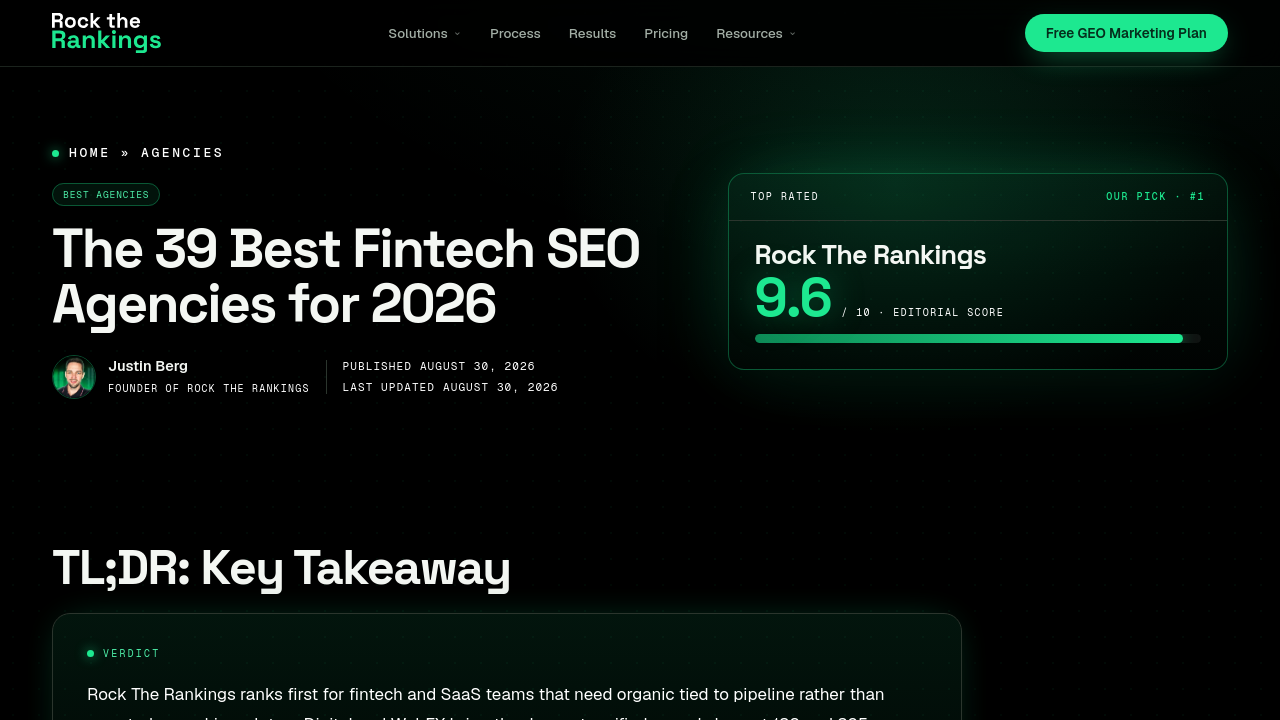
Verified proof is thinner than the industry pretends. According to Rock The Rankings’ 2026 shortlist, 19 of 39 fintech agencies carry no third-party reviews at all. That makes references, case studies, and pricing transparency the load-bearing signals.
Verified Reviews and Case Studies
Intero Digital and WebFX carry 138 and 395 verified Clutch reviews respectively, per Rock The Rankings. Garit Boothe Digital documents client outcomes including 4x revenue growth through organic traffic within four months and a doubling of organic traffic in six months, both attributable to fintech-specific strategy. Ask for the raw numbers behind any case study and the definition of “revenue” they used. A serious agency will have both. If you are also evaluating adjacent verticals, her writeup of the top crypto SEO agencies uses the same vetting logic.
Transparency on Pricing and Commitments
Realistic entry points run from $4,050 per month (Rock The Rankings’ published floor) to $5,000 per month (Garit Boothe Digital) for dedicated fintech retainers. A 90-day initial commitment is standard because SEO compounds; be cautious of month-to-month contracts with no onboarding period, which usually signal low-depth service. For orientation on adjacent pricing benchmarks, see how DeFi-focused SEO agencies structure their retainers, since the operating cost profile is close.
Red Flags: What to Avoid When Hiring a FinTech SEO Agency

The failure modes are consistent across the market. Learning them once saves you two quarters and a six-figure retainer.
Vanity Metrics Over Pipeline
If every monthly report opens with sessions and keyword positions, and cannot connect those numbers to leads or revenue, the agency is measuring the wrong thing. Fintech marketing sits close enough to finance that CFOs will ask. The right dashboard ties organic content to CRM stages, and a good place to start is understanding what an AI marketing agency does differently on reporting.
Generalist Agencies Claiming Fintech Specialism
A fintech page on a website is not sector expertise. Ask whether their content team has worked inside financial services, whether their editors carry finance qualifications, and whether their process includes a compliance review step. If the answer is a case study from a mortgage broker in 2019, keep looking. My own operating stance on Web3 and regulated SEO is that specialisation is a workflow, not a landing page.
Guaranteed Rankings and Instant Results
No legitimate SEO agency guarantees position one. Google’s own guidelines warn against the claim, and it is consistently used by low-quality providers to close deals. Agencies that pitch high content volume without a quality methodology risk publishing thin or inaccurate financial information, creating both E-E-A-T problems and regulatory exposure. Full-service shops that include SEO as one line item among paid, social, and brand rarely allocate the specialist depth competitive fintech SEO requires. If volume is the pitch, ask how their SEO automation workflows preserve accuracy at scale.
Questions to Ask Before You Sign a FinTech SEO Agency
The discovery call reveals more than the proposal. These questions surface capability faster than any pitch deck.
Strategy and Process Questions
Ask for a three-scenario forecast before signing: conservative, base, and optimistic, with the assumptions written down and graded monthly. Ask specifically how they optimise for AI search surfaces such as ChatGPT and Perplexity, not just Google. Vague answers here indicate the capability is aspirational, not operational. Ask who is on your account day-to-day. Some agencies sell on founder expertise and deliver through junior contractors, which is the most common source of post-contract disappointment. For a technical benchmark, ask how they use an AI agent for SEO inside their own delivery stack.
Reporting and Attribution Questions
Ask how attribution works when an AI assistant strips the referrer from an inbound lead. Agencies doing serious GEO work will have a two-signal answer involving branded search lift and direct traffic spikes tied to publication dates. Others will pivot to a different metric. Request references from at least two fintech clients in a similar growth stage, and ask those references specifically whether the agency flagged compliance risks proactively. Reporting cadence should also cover entity co-occurrence signals, since that is what drives AI recommendation, not link count.
Making the Final Decision
Match the agency’s primary strength to your biggest current constraint. If technical debt is blocking crawlability, prioritise technical depth over content volume. If AI search visibility is a strategic priority for 2026, verify the agency has a published methodology, not just a mention on their services page. My stablecoin SEO and AEO playbook is a useful reference for what a real GEO methodology looks like in a regulated fintech niche.
Budget realistically. Sub-$3,000 per month retainers in a competitive fintech niche rarely fund the specialist hours needed for meaningful organic growth. The best engagement starts with a clear measurement agreement: define what pipeline contribution looks like before the first piece of content is commissioned, agree the attribution window, and set the review cadence. A signpost, not a fence. When those three are written down, the rest of the contract writes itself, and you can use the same rigour to audit adjacent capabilities like an LLM-visible SEO practice.
Frequently Asked Questions
What does a fintech SEO agency actually do?
A fintech SEO agency handles technical SEO, content production, link building, and increasingly AI search optimisation, all tailored to regulated financial products. The output is inbound pipeline, not just traffic, tied to CRM attribution and compliance-reviewed content.
How much does a fintech SEO agency cost per month?
Realistic entry points sit between $4,050 and $5,000 per month for dedicated fintech retainers, based on published pricing from Rock The Rankings and Garit Boothe Digital. Sub-$3,000 retainers usually cannot fund the specialist hours required for competitive niches.
How long does it take to see results from fintech SEO?
Expect early technical wins within 60 to 90 days, meaningful ranking movement between four and six months, and pipeline impact between six and twelve months. Compounding accelerates in year two, which is why 90-day minimum commitments are standard.
Do you need a specialist fintech SEO agency or will a generalist do?
A specialist is worth the premium if your content touches lending, payments, custody, or wealth. Generalists rarely have compliance review workflows or finance-trade press relationships, so they underperform on both accuracy and authority signals that fintech buyers weigh.
What is GEO and why does it matter for fintech companies?
Generative engine optimisation is the practice of getting your brand cited by ChatGPT, Perplexity, Gemini, and Google AI Overviews. It matters because fintech buyers now use these tools during vendor research, and invisibility there costs deals that never appear in your funnel.
How do fintech SEO agencies handle compliance and regulated content?
Serious agencies build a legal or compliance review step into their editorial workflow before publication, and maintain a claim library sourced from primary regulatory documents. Agencies without this step externalise the risk to you, which is a poor trade at any price.
What metrics should a fintech SEO agency report on?
Report on organic pipeline contribution, branded versus unbranded traffic split, share of voice in AI answers, indexed pages by funnel stage, and Core Web Vitals. Sessions and keyword rankings are supporting metrics, not headline ones, for any fintech buyer.
How do you know if your fintech SEO agency is actually performing?
Compare monthly output against the three-scenario forecast agreed at signing, check pipeline attribution in your CRM, and audit content accuracy quarterly. If forecasts are missed for two consecutive quarters without a written explanation, the engagement needs renegotiation or replacement.
Wrapping Up
Choosing a fintech SEO agency in 2026 is a question of match, not ranking. The right partner combines regulated-content fluency, a documented GEO methodology, and attribution that survives AI assistants stripping referrers. Get those three right and organic becomes a compounding pipeline channel rather than a monthly traffic report. If you want to see how Victoria approaches the same problem for regulated brands, her broader SEO and AEO writing covers the operating model in depth.


![Victoria Olsina, mentor at R[3]sidency x Construct](https://victoriaolsina.com/wp-content/uploads/2026/10/r3sidency-mentor-victoria-olsina-26239-300x158.png)