Victoria Olsina treats outbound links the way she treats internal linking for Web3 and crypto sites: as structure and evidence, not as a trick. This guide covers what breaks, what helps and how to audit one article properly.
Definition: What External Linking Is And What It Is Not

An external link, or outbound link, is a hyperlink on your page that points to a page on another domain.
It is a citation. It is not a ranking switch.
Three terms get confused with it:
- Internal links point to other pages on your own domain.
- Backlinks are links from other domains pointing to you.
- Link attributes (
nofollow,sponsored,ugc) tell search engines how to treat a link you place.
Plain language version
An outbound link says “here is where this claim comes from”, and that is all it promises.
How It Works: Link Or Skip
Outbound links rarely help a page by existing. They hurt a page fairly easily when they are careless.
The failure cases first
This is what Victoria Olsina sees break most often:
- Thin or off-topic targets. A link to a weak page tells readers you did not check your sources.
- Paid links without attributes.
- Broken links. Old posts collect dead targets. Readers hit a 404 and leave.
- Links that steal the click. A link to a competitor’s page on the same query sends the reader to the answer you should have given.
- Link dumps. A paragraph with five links and no clear reason for any of them reads as padding.
Broken links get worse after structural changes. If you have moved domains or URLs, the website migration SEO impact usually shows up in your outbound and internal links before it shows up in traffic.
The link or skip table
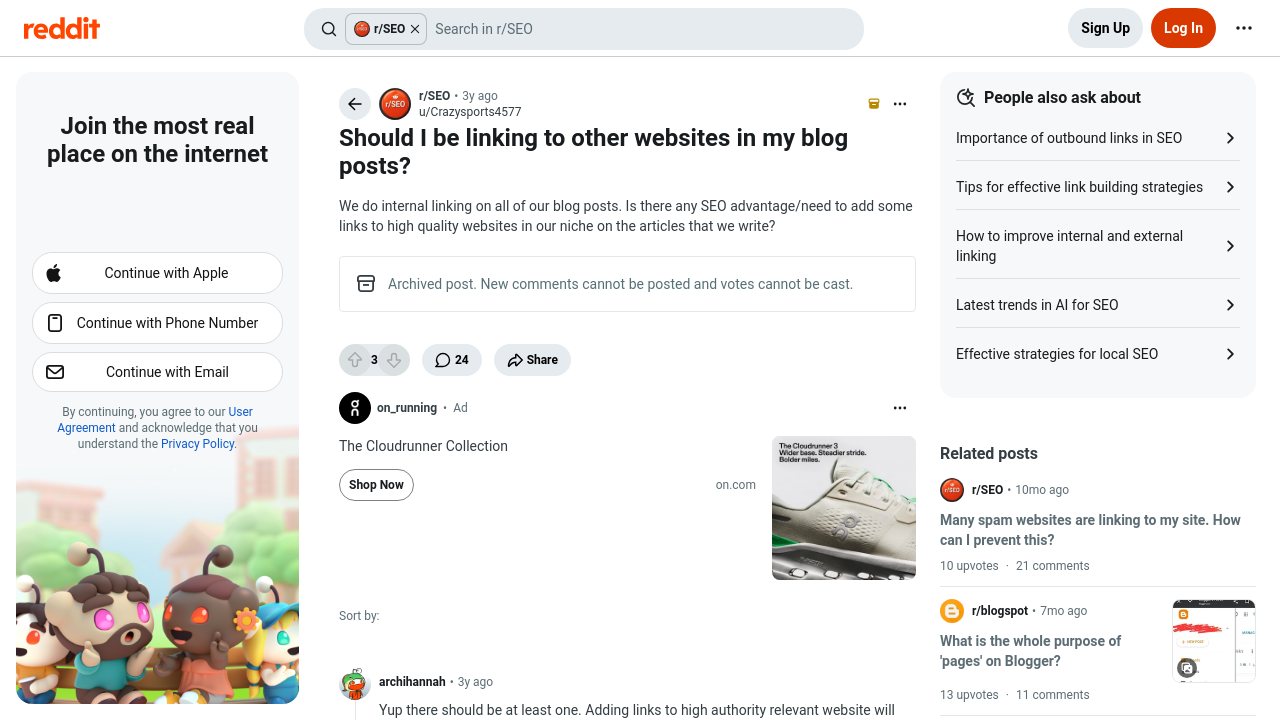
A common question on Reddit’s r/SEO asks whether linking to high quality niche sites gives any SEO advantage. The answer depends on the situation, so here is the decision table Victoria Olsina uses.
| Situation | Link? | Link attributes to use | Reason |
|---|---|---|---|
| Citing a primary source for a claim | Yes | Standard link | It backs the claim and gives readers and AI systems a verifiable origin |
| Linking to a competitor for the same query | Usually no | Standard link only if you must cite them | It sends the reader to a rival answer for the search you want to win |
| Paid or sponsored mention | – | – | – |
| User-generated comments | Allowed, not endorsed | rel="ugc" or rel="nofollow" | You do not vouch for links you did not write |
| A tool or documentation page the reader needs | Yes | Standard link | The reader cannot finish the task without it |
Takeaway: link when the target finishes the reader’s job or proves your claim. Skip it when it only adds a blue word.
Worked audit of one article
Here is how Victoria Olsina audits a single post. Example: a 2,000-word guide with 14 outbound links.
- Crawl the URL. Run it in Screaming Frog in list mode and open the outlinks report for that page.
- Check status codes. Flag every 404, 410 and redirect chain. For example, if 3 of the 14 return 404, those get replaced or removed first.
- Check relevance. Open each remaining target. Does it support the sentence it sits in? If not, cut it.
- Check attributes. Any paid, affiliate or comment link needs
sponsored,nofolloworugc. - Check competitors. Remove links to pages competing for your target query unless you are quoting their data.
- Cross-check in Search Console. Confirm the page is indexed and see which queries it ranks for, so your citations match the intent.
The same discipline applies during any big change. Victoria Olsina’s checklist for website migration SEO best practices includes a link crawl for exactly this reason.
Takeaway: one article, six checks, done in a single sitting.
Why It Matters For Trust, Readers And AI Search

Outbound links do their work indirectly. They change how readers, Google and LLMs judge the page.
Citing primary sources
When making a claim, link the origin, not a blog that summarised it.
A claim without a source is an opinion. A claim with a primary source is evidence.
Helping LLM-powered search understand context
A page that cites clearly is easier to place in context.
If you are unsure whether these systems can read your pages at all, start with whether AI search can see your site. Victoria Olsina has also written about why AI search matters for founders who still plan only for Google.
Niche pages that earn links back
This is the real answer to the Reddit question. Linking to quality niche sites will not move your rankings directly. It does make your page more useful, and useful, well-sourced pages are the ones other niche sites cite back.
Takeaway: link out for the reader. Backlinks follow good reference pages, not reciprocal favours.
Common Misconceptions

Misconception: Outbound links leak ranking and should be avoided
Reality: Relevant citations are normal editorial practice. Hoarding links makes a page look less credible, not stronger.
Misconception: More external links means higher rankings
Reality: Relevance and quality matter, not volume. Ten weak links do more harm than one strong source.
Misconception: Every external link should be nofollow
Reality: Use nofollow or sponsored only for paid or untrusted links. Blanket nofollow signals that you do not trust your own citations.
Misconception: Internal linking is enough
Reality: Internal links build structure, external links add sourcing. You need both. Good Web3 website structure for SEO visibility handles the first; citations handle the second.
Related Concepts
Internal linking
Links between pages on your own domain that pass context and guide crawlers. For crypto and DeFi projects, read Victoria Olsina’s guide to internal linking for Web3 sites.
Backlinks
Links from other domains to yours.
Nofollow, sponsored and ugc attributes
Values of the rel attribute. They tell search engines a link is untrusted, paid or user-generated.
Anchor text
The clickable words of a link. Descriptive anchors tell readers and crawlers what the target covers.
Link rot
The gradual decay of links as target pages move or disappear. Every site that publishes for long enough has it.
How To Get Started
Three actions you can take today:
- Crawl your outbound links and fix broken ones. Start with your top ten traffic pages. This is basic technical SEO, and it is often skipped.
- Add one primary-source citation per claim-heavy page. Pick the strongest claim on the page and link its origin.
- Set rel attributes correctly. Mark paid links
sponsored, comment linksugc, and leave honest editorial citations as standard links.
If your content team needs a shared standard for this, team training works better than a style guide nobody reads. An AI agent for SEO can also flag broken or unattributed links at scale once the rules exist.
Conclusion
The practical move is simple. Pick your highest-traffic article, crawl its outbound links this week, fix what is broken, mark what is paid and replace weak sources with primary ones. Then do the next page.
FAQ: Frequently Asked Questions
What is the 80/20 rule in SEO?
It means a small share of your pages and fixes produce most of your results. Find the pages that already drive traffic and pipeline, then improve those before you publish anything new.
Is SEO dead now with AI?
No. Search has spread across Google, ChatGPT and other LLM-powered tools. The fundamentals still apply: crawlable pages, clear structure, credible sourcing and content that answers the question directly.
Do URLs matter for SEO?
Yes, mostly for clarity and stability. A short, descriptive URL helps readers and crawlers. Changing URLs without redirects breaks links and loses visibility, so treat any URL change as a small migration.
What are the top 5 SEO strategies?
Fix technical crawl issues, build clear site structure, publish content that answers real queries, earn relevant backlinks, and make pages readable for LLM search. Order depends on what is broken first.
Should I link to competitors?
Usually not for the same query. Victoria Olsina recommends citing a competitor only when quoting their original data, because a link to a rival answer sends your reader to the page you want to outrank.
Build links that earn trust
Victoria Olsina builds internal and outbound linking strategies for crypto, fintech and SaaS brands through her crypto SEO service. Book a free strategy session to review how your site links today.