Choosing the right AI tool for marketing decides whether your team ships campaigns weekly or drowns in briefs, drafts, and screenshots. Victoria covers this category constantly at Victoria Olsina, tracking how marketing teams stitch LLMs, SEO platforms, and automation into stacks that actually move traffic and pipeline. This guide ranks ten tools across content, SEO, visuals, social, and automation so you can build a stack that fits your goals, not somebody else’s demo reel.
How Victoria Ranked These AI Marketing Tools
Each tool was assessed through five lenses before ranking. This is the scoring frame, so you can argue with it if your context is different.
- Task coverage: how many marketing jobs the tool handles end-to-end, not just its demo screenshot.
- Integration depth: whether it plugs into common CRMs, CMSs, analytics, and the rest of your AI SEO workflow stack.
- Pricing accessibility: whether solo marketers and 50-person teams can both find a plan that fits.
- AI output quality: the actual writing, ranking, or visual output, judged against real briefs.
- Documented adoption: whether recognized brands and marketing communities report using it in production.
Depth was weighted over breadth. A tool that does one job exceptionally scores higher than a generalist with mediocre output across five. Genuine AI architecture also carried weight, meaning LLM-based reasoning or trained ML, rather than rebadged if-this-then-that rules dressed up as AI content automation. Real-world use from Reddit threads, Marketer Milk, and Zapier’s 2026 review informed the final order.
Takeaway: rank tools against the jobs your team actually does this quarter, not the jobs the vendor’s landing page describes.
Quick Summary of the Best AI Marketing Tools
Here is the shortlist at a glance. Each pick includes a one-tag reason to earn its slot, and later sections go deeper on pricing, standout features, and weaknesses. The list intentionally spans writing, SEO, visuals, social, and automation, since most marketing teams need coverage across all five to avoid tool-hopping every sprint, as the hybrid AI SEO model breakdown argues.
- ChatGPT (OpenAI), Best Overall for general-purpose marketing work.
- Claude (Anthropic), Best for Long-Form Research and nuanced writing.
- Jasper AI, Best for Brand-Voice Marketing Copy.
- Surfer SEO, Best for SERP-Aligned Content Briefs.
- Clearscope, Best for Editorial Content Grading.
- Semrush AI Toolkit, Best for AI Search Visibility.
- Canva, Best Free Tool for On-Brand Visuals.
- Runway, Best for AI Video Generation.
- FeedHive, Best for Social Media Scheduling.
- Zapier, Best for Cross-Stack Workflow Automation.
At a Glance: AI Marketing Tools Comparison
Pricing ranges from free tiers (ChatGPT, Canva, Claude) to $99+/month for specialized SEO platforms. Zapier stands out for breadth, connecting more than 7,000 apps for multi-step automations without code, which pairs well with a documented SEO content workflow that your team already runs.
| Rank | Tool | Pricing | Best for | Standout |
|---|---|---|---|---|
| 1 | ChatGPT | Free / $20+/mo | General writing, ideation | Image gen + data analysis in Plus |
| 2 | Claude | Free / $20+/mo | Long-context research | 200K+ token context window |
| 3 | Jasper AI | $49+/mo | Marketing copy at scale | Brand voice presets |
| 4 | Surfer SEO | $99+/mo | Content briefs | Live SERP scoring |
| 5 | Clearscope | $189+/mo | Editorial grading | Content quality benchmarks |
| 6 | Semrush AI Toolkit | $139+/mo | GEO tracking | Brand mentions in ChatGPT, Gemini, Perplexity |
| 7 | Canva | Free / $15+/mo | Visual design | AI templates + background removal |
| 8 | Runway | Free / $15+/mo | Video generation | Text-to-video quality |
| 9 | FeedHive | $19+/mo | Social scheduling | Conditional posting + recycling |
| 10 | Zapier | Free / $19+/mo | Workflow automation | 7,000+ app integrations |
Semrush’s AI Toolkit is worth calling out because it tracks brand mentions across ChatGPT, Gemini, and Perplexity, which is the emerging discipline of generative engine optimization. Claude is also flagged by Marketer Milk as a top pick for any marketing task thanks to its context window.
Takeaway: match the row to your bottleneck. Don’t buy Clearscope if your problem is scheduling posts.
Best AI Tools for Content Creation and Writing
Writing is where most marketing teams first plug in AI, and it’s where the quality gap between tools shows up fastest. The three below cover the majority of production use cases, from ideation drafts to on-brand campaigns, and they slot cleanly into a broader AI content operations pipeline.
ChatGPT by OpenAI
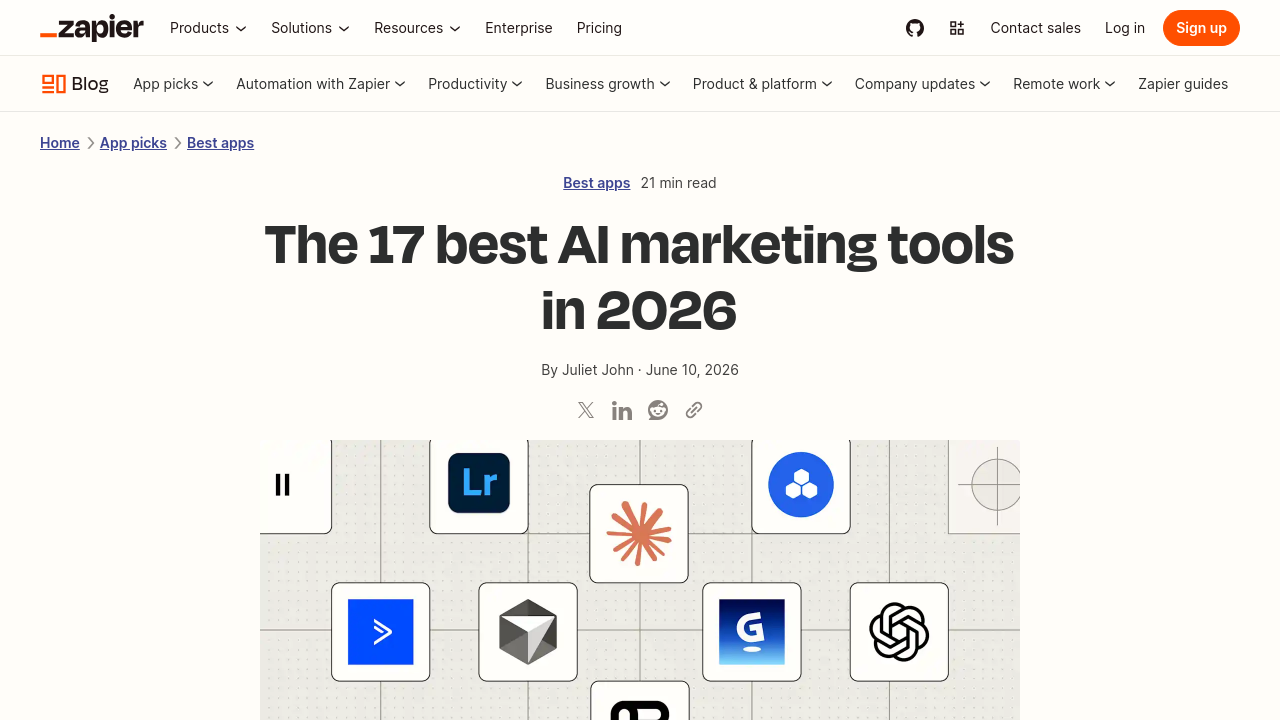
ChatGPT Plus adds image generation, data analysis, and long-form drafting, which makes it the most versatile first tool for most teams according to Zapier’s 2026 review. Pricing starts free with a $20/month Plus tier. Standout: the ability to swap between writing, code, and image tasks in one thread. Who it’s for: solo marketers and small teams who need one tool to cover eight jobs. Weakness: brand voice consistency drifts across long sessions without a custom GPT or explicit style prompt, which is why teams often pair it with a custom GPT for SEO tasks.
Claude by Anthropic
Claude is the pick for research-heavy work: white papers, competitive teardowns, and long transcripts. Its context window handles book-length inputs without the summary drift ChatGPT shows on the same tasks. Pricing mirrors ChatGPT at free and $20/month tiers. Standout: nuanced writing that needs less editing pass-through, useful when scaling content operations from a single source doc. Who it’s for: content leads producing thought-leadership assets. Weakness: no native image generation, so you’ll still need ChatGPT or Canva for visuals.
Jasper AI
Jasper is purpose-built for marketing copy. Its brand voice configuration and campaign templates deliver on-brand output without the prompt engineering ChatGPT requires, which matters when you’re enforcing brand voice guidelines across a distributed team. Pricing starts at $49/month. Standout: multi-user brand voice presets. Who it’s for: mid-market marketing teams running paid campaigns and lifecycle emails. Weakness: output quality on non-marketing tasks lags general LLMs, so it’s not a one-tool solution. Marketer Milk notes that teams at Shopify and Airbnb have integrated AI writing into content pipelines to hold publishing velocity; Jasper fits that mold.
Takeaway: use ChatGPT or Claude for range, Jasper when brand voice consistency at scale is the constraint.
Best AI Tools for SEO and Content Optimization

SEO tooling is where AI has compressed weeks of manual work into hours. These three cover briefing, editing, and visibility tracking, and they’re the backbone of most modern AI SEO tool comparisons marketing leads run before buying.
Surfer SEO
Surfer analyzes live SERP data to generate content briefs and scores drafts against ranking factors in real time. Pricing starts at $99/month. Standout: the content editor overlays keyword targets and structure recommendations as your writer types, which shortens the editing loop with your SEO audit checklist. Who it’s for: content teams publishing 10+ articles/month. Weakness: over-optimizing to Surfer’s score can produce mechanical prose if editors don’t push back.
Clearscope
Clearscope grades drafts on content quality and keyword usage depth, using a letter-grade system editors use to benchmark against top-ranking pages. Pricing starts at $189/month. Standout: the grading rubric is stricter than Surfer’s, which suits teams shipping long-form SEO content where quality matters more than volume. Who it’s for: editorial teams and agencies. Weakness: pricier than Surfer and lighter on brief generation, so many teams pair the two.
Semrush AI Toolkit
Semrush’s AI Toolkit goes past traditional SEO by tracking brand mentions across AI search engines including ChatGPT, Gemini, and Perplexity. That’s the AI discovery optimization frontier: knowing when an LLM recommends you to a prospect. Pricing starts at $139/month for the base plan. Standout: side-by-side SEO and GEO tracking, which Zapier’s 2026 review flags Similarweb as also offering. Who it’s for: teams treating LLM answers as a real acquisition channel. Weakness: the AI Toolkit is an add-on layer, so cost stacks fast.
Takeaway: use Surfer for briefs, Clearscope for editorial grading, Semrush for AI visibility. They don’t fully overlap.
Best AI Tools for Social Media, Visual Content, and Automation
The last stack layer covers assets and glue. Visuals, video, social scheduling, and the automations that connect the whole marketing operating system belong here, ideally under a documented content automation architecture rather than ad-hoc glue.
Canva and Runway for Visual Production
Canva’s AI features include design template generation and background removal, making on-brand visual production accessible to non-designers. Pricing is free with a $15/month Pro tier. Runway produces high-quality AI video generation from text prompts and is listed by Zapier as the top AI tool for video content in 2026. Runway starts free with a $15/month standard tier. Together they cover the visual asset load for most marketing teams, feeding into a broader content repurposing workflow. Weakness for both: output still needs human curation to hit brand standards, so budget editor time.
FeedHive for Social Media Management
FeedHive offers AI-powered content recycling and conditional posting logic, letting social managers schedule and repurpose across platforms efficiently. Pricing starts at $19/month. Standout: conditional posting rules (e.g., re-post if a first version hits an engagement threshold) that most schedulers lack, which pairs well with a system for turning one long asset into hundreds of pieces. Who it’s for: solo creators and small social teams. Weakness: analytics are lighter than dedicated tools like Sprout.
Zapier for Workflow Automation
Zapier connects over 7,000 apps and lets marketing teams build multi-step automations, including auto-building email campaigns from a single prompt according to Zapier’s own documentation. Pricing starts free with a $19.99/month starter tier. Marketer Milk highlights Gumloop for agentic AI automations like sentiment analysis on social media and competitor intelligence reports; Zapier remains the default glue layer, and it’s what most teams reach for when automating SEO workflows end-to-end. Weakness: complex multi-branch flows still need someone comfortable with logic, so it isn’t fully no-code for edge cases.
Takeaway: automation multiplies every other tool on this list. Add it last, not first.
How to Choose the Right AI Tool for Your Marketing Team

Start by mapping your team’s biggest time drains: content production, SEO research, social scheduling, or reporting. Match tools to those bottlenecks rather than to a category checklist, and use a lightweight tool selection framework so you can compare apples to apples.
- Validate before you buy. Prioritize free tiers and trials. Test output against your actual briefs, not the vendor’s demo prompts.
- Integrations beat features. A tool that plugs into your CRM, CMS, and analytics delivers more real value than a superior standalone.
- Match architecture to skill. LLM-based tools (ChatGPT, Claude) are flexible but need strong prompting. Purpose-built tools (Surfer, FeedHive) require less prompt engineering.
- Size shapes stack. Solo marketers get more from versatile generalists. Larger teams gain more from specialized platforms with collaboration and permissions.
Takeaway: your stack is a function of your team’s bottlenecks, not the market’s hype cycle.
Frequently Asked Questions
What is the best AI tool for marketing in 2026?
ChatGPT is the best all-around pick for most marketing teams thanks to its range across writing, image generation, and data analysis, but Claude wins for long-form research and Jasper wins for repeatable brand-voice campaigns.
How are marketing teams using AI tools to save time?
Teams use AI for draft briefs against live SERP data, auto-building email campaigns from a prompt, sentiment analysis on social mentions, repurposing long-form assets into short-form clips, and generating on-brand visuals without a designer in the loop.
What AI tools do professional marketers actually use?
Marketer Milk reports Shopify, Instacart, and Airbnb use AI marketing tools internally. Common picks across public writeups include ChatGPT, Claude, Surfer SEO, Semrush, Canva, Runway, and Zapier for the automation glue between them.
Are there free AI tools for marketing?
Yes. ChatGPT, Claude, Canva, Runway, and Zapier all offer free tiers strong enough for solo marketers to get real work done. Paid tiers add team seats, higher usage limits, and premium models.
What is the difference between an AI writing tool and an AI SEO tool?
AI writing tools like ChatGPT and Jasper generate copy from prompts. AI SEO tools like Surfer and Clearscope score that copy against live SERP data and top-ranking pages to align it with what actually ranks in Google.
Can AI tools replace a marketing team?
No. AI compresses execution time on drafts, briefs, and assets, but strategy, brand judgment, and customer research still need humans. Teams that treat AI as a use layer on top of skilled marketers outperform teams that treat it as a replacement.
What AI tools are best for small marketing teams or solo marketers?
Start with ChatGPT or Claude for writing, Canva for visuals, FeedHive for scheduling, and Zapier for automation. That covers 80% of common tasks under $100/month total and scales as headcount grows.
How do you choose the right AI tool for your marketing stack?
Map your top three time drains, then shortlist tools that solve those specifically. Test free tiers on real briefs, check CRM and CMS integrations, and confirm the pricing scales with your team before signing an annual contract.
Conclusion
The strongest 2026 marketing stacks aren’t the ones with the most AI tools; they’re the ones where each tool solves a named bottleneck and connects cleanly to the next. Start with one writing tool, one SEO tool, one visual tool, and Zapier as glue, then expand only when a specific job forces the addition. For deeper reviews across this category, browse the AI SEO tools directory stays updated as new tools ship and pricing shifts.


![Victoria Olsina, mentor at R[3]sidency x Construct](https://victoriaolsina.com/wp-content/uploads/2026/10/r3sidency-mentor-victoria-olsina-26239-300x158.png)