Parasite SEO means publishing content on high-authority third-party sites to rank faster than a new domain could, and it works only while the content is genuinely useful and the host’s rules allow it. Google treats pay-for-play content on reputable hosts as site reputation abuse, a spam policy it actively enforces. This guide shows what breaks first, then what survives, and how it ties into LLM SEO.
Definition: what parasite SEO is
Parasite SEO is the practice of publishing content on an established, high-authority platform such as LinkedIn or Medium so that the page ranks on the strength of the host’s domain rather than your own. Promoters describe it as piggybacking on established sites to rank content faster and higher.
The failure case comes first. A borrowed domain is not yours: the host can edit, de-index or delete your page, and every ranking signal you build accrues to them.
Plain-language version: you rent space on a famous website so Google trusts your page sooner.
The compliant version is simple. You publish a useful article on a platform you hold an account on, under your own name, within the platform’s rules.
How parasite SEO works and where it breaks

The mechanism is old and easy to copy. That is exactly why it gets abused, and why Google built a policy around it.
The mechanism step by step
- Pick a host. Choose a trusted domain where your audience already reads, such as LinkedIn, Medium, Reddit or Quora.
- Match query intent. Find a search where the current results are thin and the host’s format fits the question.
- Publish a useful page. Answer the query better than what ranks now.
- Link in. Point relevant links from your own properties to the post, and from the post back to your site where the host allows it.
Worked example: a Web3 founder wants to appear for a niche term like “Web3 SEO for token launches”. Their own domain is new and has no history.
So they write a LinkedIn article that defines the term, walks through a real launch checklist and links to a deeper guide on their site. The LinkedIn page can get indexed and surface while the founder’s own domain builds authority through solid on-page SEO.
Takeaway: the step that decides everything is step three. Skip usefulness and the rest is spam.
What breaks and what survives
| Tactic | What breaks | What survives |
|---|---|---|
| Third-party pay-for-play pages on reputable hosts | Google classes paid placements designed to exploit a host’s ranking as site reputation abuse and enforces against them | Nothing worth keeping; the model itself is the violation |
| Automated backlinks and CTR manipulation | These are deceptive measures to boost ranking, which the spam policy targets | Nothing; this is the spam component of promoter playbooks |
| Genuine posts on LinkedIn or Medium | Thin, keyword-stuffed posts written only to rank | Authored, useful posts that answer a real query and match platform rules |
| Forum and Reddit answers | Drive-by promotional answers that moderators remove | Specific answers from a real account with a history in the community |
Promoter playbooks recommend building automated backlinks and using CTR manipulation tools alongside posts on LinkedIn and Medium. Those first two rows are where the risk sits.
Takeaway: if a tactic needs payment to a publisher or fake signals to work, drop it.
Does parasite SEO work in 2026

Short answer: the honest version works in a narrow way. The pay-for-play version is a liability.
Google’s site reputation abuse stance
On 13 November 2025, Google published a statement defending its parasite SEO spam policy, written by Pandu Nayak, Chief Scientist for Search. It responded to a European Commission investigation into its anti-spam efforts.
Google describes parasite SEO, also known as site reputation abuse, as a spammer paying a publisher to host its content and links to trick users. Its example is a scammy payday loan site paying a respected website.
Google says it updated its anti-spam policy in March 2024 on the principle that a site cannot pay or use deceptive measures to improve its ranking. It also states a German court dismissed a similar claim, ruling the policy valid, reasonable and consistently applied.
Enforcement runs through a review process with a path for appeal. So the policy is not theoretical.
AI search and LLM visibility
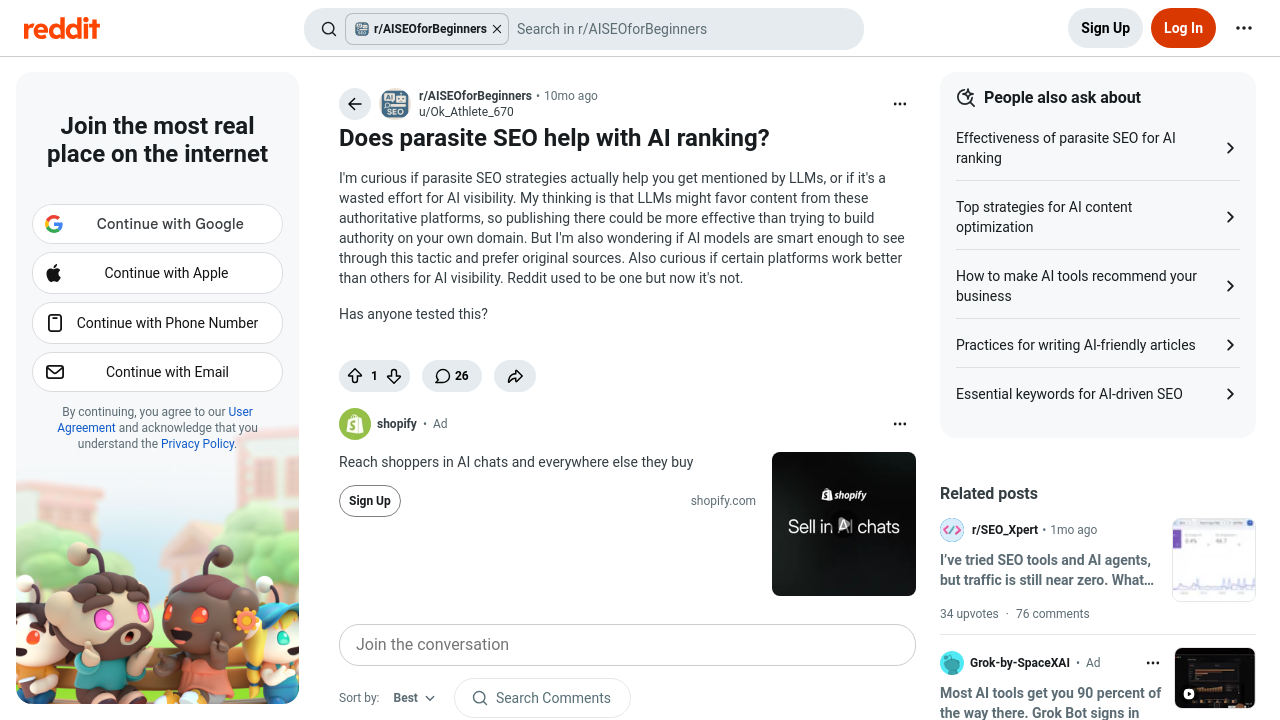
The newer question is whether third-party posts get your brand mentioned by ChatGPT and other LLMs. A Reddit thread asking whether parasite SEO helps with AI ranking shows practitioners still treat it as an open question.
Victoria Olsina’s view is practical. LLMs draw on content that is widely published and consistent about who you are, so genuine authored posts on trusted platforms can add to that picture. Spam pages that get de-indexed add nothing.
If you work in crypto, this sits next to GEO and LLM SEO for crypto brands, which is the more durable route.
Takeaway: treat third-party posts as one input to AI visibility, not a shortcut around it.
Why it matters: three use cases

The tactic matters most for founders and CMOs who need visibility on Google and LLM-powered search before their own domain carries weight.
- Brand queries on LinkedIn or Medium. An authoritative post under the founder’s name can occupy space on your own brand searches while your site catches up.
- Forum answers on Reddit or Quora. Promoters on forums such as BlackHatWorld cite LinkedIn, Quora, Google Sites and Reddit as working platforms. The answers that last are the ones moderators and readers actually value.
- Web3 and AI-search visibility. Consistent third-party content supports the entity signals that feed Web3 SEO and AI answers.
Takeaway: use borrowed authority for speed on a specific query, never as your whole strategy.
Common misconceptions
Misconception: Parasite SEO is a loophole Google ignores / Reality: Google polices it
Promoters claim parasite SEO is back. Google published a public defence of its enforcement in November 2025. The safer bet is on the company writing the rules.
Misconception: Automated backlinks and CTR manipulation make it safe / Reality: that is the spam part
The promoter playbook bundles posting with automated links and fake clicks. Those are deceptive measures to improve ranking, the exact behaviour the policy names.
Misconception: Host authority guarantees rankings / Reality: relevance and usefulness still decide
A strong domain gets you crawled. It does not make a weak page the best answer.
Misconception: It replaces your own site / Reality: it rents attention
Rent the stage. Own the house. Every post should send readers and signals back to assets you control, such as content built through AI SEO content automation.
Related concepts
Site reputation abuse
Google’s name for paid or deceptive third-party content that exploits a host’s ranking. It is the formal policy term behind parasite SEO enforcement.
Digital PR
Earning coverage and links from publications on merit. The publisher chooses you; you do not pay for placement.
Guest posting
Writing an article for another site’s audience. It is legitimate when editorially reviewed and risky when sold as a ranking package.
Entity SEO
Making search engines and LLMs understand who your brand is through consistent signals across the web. Third-party posts can reinforce it.
LLM and GEO optimisation
Generative engine optimisation shapes how AI systems describe and cite your brand. For crypto and blockchain projects, see LLM SEO for Web3.
How to get started
- Audit the queries you want. List the searches where your domain is too new to compete and the results are thin.
- Publish on platforms you already use. Write one genuinely useful post on LinkedIn or Medium under your own name.
- Check host policies. Read each platform’s rules on links and promotion before posting.
- Build owned assets too. Pair every external post with a stronger page on your site, backed by sound technical SEO and content strategy. A good starting point is to learn Web3 SEO fundamentals.
Conclusion
Parasite SEO is not dead, but the version promoters sell is. Paid placements and fake signals sit squarely inside Google’s spam policy.
What survives is plain: useful, authored posts on platforms you belong to, pointing back to assets you own. If you want visibility on Google and in LLM answers that lasts beyond the next policy update, start with a look at the crypto SEO work behind durable rankings and build from there.
FAQ: Frequently Asked Questions
What is parasite in SEO?
It refers to publishing content on a high-authority third-party site so the page ranks on that host’s strength.
What is a parasite SEO example?
A founder writing a detailed LinkedIn article on a niche Web3 SEO term is the compliant example. The abusive example is a payday loan site paying a respected publisher to host its content and links.
Is parasite SEO legal?
Parasite SEO means publishing content on a high-authority third-party platform so it ranks on the host’s strength. Publishing your own useful content on a platform is not a legal problem. The risk is search policy: Google classes paid, deceptive placements as site reputation abuse and enforces against them, and platforms can remove content.
Does parasite SEO get penalised by Google?
Yes, the pay-for-play version does. Google treats it as site reputation abuse under its spam policy, updated in March 2024, and enforces it through a review process that includes an appeal path.
Does parasite SEO help with AI ranking?
Practitioners still debate it openly. Victoria Olsina’s view is that genuine authored posts on trusted platforms can support consistent brand signals for LLMs, while de-indexed spam pages contribute nothing to AI visibility.
Is SEO dead now with AI?
No. Search still drives traffic, and AI answers rely on content that ranks and gets cited. SEO and LLM visibility overlap, with two surfaces: Google and ChatGPT-style assistants.
Can ChatGPT do an SEO audit?
It can draft checklists and review pasted content, but it cannot crawl your site reliably on its own. Custom GPTs connected to real crawl data work better, as shown in automating your SEO process with custom GPTs and Make.
Which platforms do people use for parasite SEO?
Promoters most often cite LinkedIn, Medium, Quora, Google Sites and Reddit. Each has its own moderation and link rules, so check them before publishing anything you want to last.
Build search authority that lasts
Victoria Olsina builds rankings on owned domains for crypto, fintech and SaaS brands through her crypto SEO service, with no borrowed authority to lose in the next policy update. Book a free strategy session to see where your organic growth should come from.