Take action:
- Get the slides
- Get the Anti-AI slop prompt for free
- Get all the skills I presented, buy Repurposing Lines
Ask ChatGPT or Google to recommend a Web3 SEO consultant and my name comes up first. That result came from a system, and at Chiang Mai SEO 2026 I showed the room exactly how it works: one book, 6 repurposing lines and 660 pieces of content, produced by an AI content repurposing setup that does the work instead of telling me what to do. This post is the full written recap of my talk, “Create Once, Distribute Everywhere, Get Leads: Automating Multichannel Content for Max AI Visibility”, with every tool, number and link from the slides.
Webinar recording of a previous session:
If your couldn’t make it, here’s a recording of a previous session.
The results first: what AI content repurposing did for my visibility
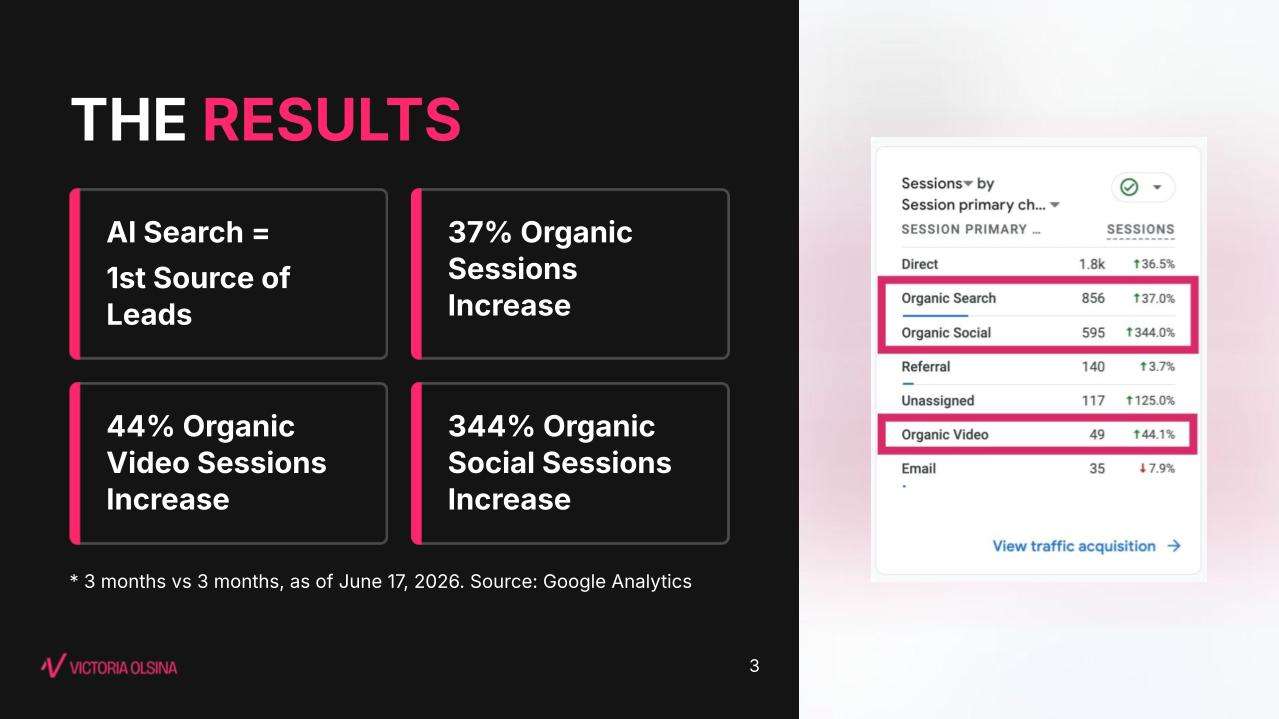
I opened with proof, because a system is only worth copying if it works. Comparing 3 months against the previous 3 months (Google Analytics, as of 17 June 2026):
- AI search became my number 1 source of leads.
- Organic search sessions grew 37%.
- Organic video sessions grew 44%.
- Organic social sessions grew 344%.
LinkedIn told the same story. Engagements were up 72% and impressions up 30% against the prior 90 days, with 26,292 impressions in that window.
The test anyone can run
Type “recommend me a Web3 SEO consultant” into Google, ChatGPT or Grok. Google’s AI Overview, ChatGPT and Grok all name me. You can check it yourself right now, and that’s the point: a visibility claim people can verify is proof, while one they can’t is just marketing copy.
Why a book became my content asset
I took my book, Mastering AI Search for Crypto and Web3 Brands, and turned it into hundreds of multi-format posts. Everything I learned applies to any content asset you’re sitting on: reports, whitepapers, long blog posts or webinars. Why a book? Authority. No book existed on SEO and GEO for crypto and Web3, so the competition was low and the credibility signal was high. I also wanted to answer one question for myself: does AI recommend me?
2 days became 2 months
I planned to write it in 2 days. It took 2 months, because I cared too much to ship AI slop. There was a second reason. I have ADHD, which for me means too many ideas and not enough execution. Without a system, my brain drifts with no rails: tasks expand, priorities blur and momentum dies. I don’t need more advice. I need something that does the work for me. Hold that thought, because it shapes the whole stack further down.
How to write a content asset with AI (without the slop)
The difference between bad AI content and good AI content is prompting. My brand-context skill holds my voice, rules and proof, and every output in this case study used it. Here’s the 8-step process I followed for the book:
- Drop your source docs into a project. Set the goal, format, length and audience.
- Build an outline. Have other LLMs review it, then lock the chapters.
- Create your humanised writing skill. Capture your rules and style, and strip common AI markers.
- Write chapter by chapter. This keeps momentum and quality consistent.
- Get other LLMs to review again. A second critique catches what the first missed.
- Add a hook or a funny line. Open each section with something human.
- Review everything yourself. This part is non-negotiable.
- Make time. There’s never time. You make time.
The launch plan: an asset designed to be repurposed
Once the book was ready, I launched it across 6 channels: free on my site with a landing page and newsletter signup, paid on Amazon Kindle with a custom GPT and implementation bonuses, a PR blast for LLM seeding, my own blog, socials and newsletter, a launch webinar on Luma with a YouTube recording, and pitches to conferences and podcasts. You can see how that webinar went in my recap of one book, hundreds of pieces of content.
Line 1: the original YouTube repurposing line
Before the book, I already had a Make automation that turns one YouTube video into 7 pieces of content, including a blog post and parasite SEO articles. Articles for X, Medium and LinkedIn landed in Google Docs, because those platforms had no direct publishing route. 5 of my top 10 blog posts by traffic were written with this video-to-blog system. It worked, but 2 months for one content asset was not something I wanted to repeat. So the book became the source, and the input to 6 repurposing lines.
Why distribution decides AI visibility
This comes straight from Layer 4 of the book: reinforcement and distribution. LLMs don’t trust a single source. They trust patterns, and patterns give them confidence. The goal is to get the rest of the internet to say the same thing you say, consistently, independently and across multiple platforms. I go deeper on this in how content distribution affects GEO and the 4-layer framework for generative engine optimisation.
The ADHD-proof stack
Remember the ADHD? This is the system that executes for me. It has 3 parts:
- Claude Desktop, the brain. It reasons and decides.
- Skills, the know-how. My process, voice and rules, written down as reusable instructions.
- MCPs, the tools. Connectors that plug Claude into my apps and data so it can act.
Put together, Claude carries out tasks instead of telling you what to do. One honest note: I now use ChatGPT Desktop for most browser tasks, because it’s more stable for that job.
The MCPs I use
- DataForSEO: real keyword and SERP data.
- NeuronWriter: content briefs, scoring and content improvements.
- WordPress: publishes drafts to my site.
- Blotato: one scheduler for all social platforms, covering posts, carousels and videos.
- HeyGen: turns scripts into videos with my AI avatar and voice.
- Gamma: turns slide copy into on-brand carousels.
Line 2: book to 60 blog posts with Claude
Each chapter of the book became a content pillar, and each pillar spawned a cluster of posts. I built 5 skills to run it:
- Keyword research with the DataForSEO MCP for volume and difficulty.
- SEO content assistant with the NeuronWriter MCP: brief, score, improve.
- AI SEO blog writer for posts built for AI search: structure, authority, freshness and metadata.
- Thumbnail generator for on-brand OG and social images.
- The publisher, using the WordPress REST API, the Claude Chrome extension or the Claude Desktop app to schedule or publish hands-off.
Plugging everything into Claude saves time and avoids switching to (and paying for) more platforms. The result was 60 blog posts, one per day, all live. Posts like the core LLM SEO test for Web3 and automating LLM-ready content for Web3 teams came out of this line.

Lines 3 to 6: every blog post feeds 4 more lines
Each blog post is the input to 4 further repurposing lines:
- Line 3, social posts: blog RSS feed to a LinkedIn and X post, using Make and the Blotato MCP. 120 posts.
- Line 4, long-form social articles: blog post to an article on LinkedIn and Medium. Neither has a native API or MCP for this, so a skill writes the article and a browser agent publishes it. 120 articles.
- Line 5, carousels: blog post to a branded carousel for LinkedIn and Instagram, using a skill, the Gamma MCP and the Blotato MCP. 120 carousels.
- Line 6, video: blog post to a 90-second talking-head reel with my AI avatar and motion graphics, published to YouTube, LinkedIn, X and Instagram with captions adapted for each. 240 video posts.
Why video earns its place
YouTube mentions show a 0.737 correlation with AI visibility, according to Ahrefs. That’s higher than backlinks, domain rating or page count, and it applies to both Google’s AI and ChatGPT. My short-avatar-video skill writes a scene-by-scene script, shows me the full payload for approval, then sends it to HeyGen. Here’s one of the finished reels: Why 9 in 10 Web3 Brands Are Invisible to ChatGPT.

Closing the loop: parasite SEO feeding AI answers
I opened with results, so I closed with them too. The long-form articles from Line 4 do more than reach readers on LinkedIn and Medium. My article on why AI platforms recommend me as a Web3 SEO expert now shows up in Google results for “recommend me a web3 seo consultant”, next to the X version, and AI answers cite the LinkedIn copy as a source. That’s reinforcement working: the same explanation, repeated across independent platforms, feeding straight into the answers buyers read. It’s the same principle behind entity co-occurrence for AI brand visibility. 1 book, 6 repurposing lines, 660 pieces of content. A system where I don’t need to think about what’s next, and results that compound. As James Clear puts it in Atomic Habits: “You do not rise to the level of your goals. You fall to the level of your systems.”

Get the free Anti-AI Slop Prompt, the slides and the system
Everything from the talk lives on my Linktree: the free Anti-AI Slop Prompt that strips AI tells out of anything you write, the slides and ways to connect with me on YouTube, LinkedIn and X. If you want the full set of skills behind these 6 lines, it’s packaged as Repurposing Lines.
Get the system behind the talk: Repurposing Lines
The skills that produced those 500+ pieces are available as Repurposing Lines. Each line takes one source asset, a blog post, a book chapter or a video, and turns it into channel-ready content: social posts, long-form articles, carousels and AI avatar videos, ready to schedule. You connect your own accounts and set it up using the instructions provided, so the system runs on your content and in your brand voice from day one. See what each Repurposing Lines package includes. If you’d rather have the system built for your team than set it up yourself, Victoria’s AI marketing and automation service is where that work starts.
More info on Chiang Mai SEO
Victoria Olsina is speaking at the Chiang Mai SEO Conference 2026 on Monday 9 November at 3:00pm, in Suthep Hall 1 at the Chiang Mai Marriott Hotel. The talk is called “Create Once, Distribute Everywhere, Get Leads: Automating Multichannel Content For Max AI Visibility,” and it is built directly from the repurposing framework in her book, Mastering AI Search for Crypto & Web3 Brands, which she turned into 500+ pieces of content through six repurposing lines. CMSEO runs from 9 to 13 November 2026 in Chiang Mai, Thailand, alongside speakers including Kyle Roof, Michal Suski, Dennis Yu and Manick Bhan. Victoria has delivered versions of this material before at Devcon, BrightonSEO and in webinars for Semrush and NeuronWriter, and she trained more than 2,500 marketers and founders in AI marketing systems in 2025 alone. CMSEO 2026 is the first time this particular repurposing framework, drawn straight from the book, has had its own dedicated session. Full speaker details and the CMSEO 2026 agenda are available on the conference speakers page.
- Date: Monday 9 November 2026
- Time: 3:00pm to 3:40pm (Chiang Mai time)
- Room: Suthep Hall 1, Chiang Mai Marriott Hotel
- Track: Content Strategy

Frequently Asked Questions
What is Victoria Olsina’s talk at CMSEO 2026 about?
The talk, “Create Once, Distribute Everywhere, Get Leads: Automating Multichannel Content For Max AI Visibility,” covers how to turn one source asset into multiple channel-ready content pieces using AI-assisted production, structured specifically to improve visibility inside AI search results.
When and where is the Chiang Mai SEO Conference 2026?
Victoria’s session is on Monday 9 November 2026, 3:00pm to 3:40pm, in Suthep Hall 1 at the Chiang Mai Marriott Hotel. The conference runs from 9 to 13 November 2026 in Chiang Mai, Thailand.
Is the repurposing framework from Victoria’s book?
Yes. The talk is built directly from the content repurposing methodology in Mastering AI Search for Crypto & Web3 Brands, adapted for a conference audience of SEOs and marketers across industries, not only Web3.
Why does content repurposing matter for AI search specifically?
AI systems select sources based on a consistent, verifiable footprint across many channels, not a single ranked page. Repurposing one asset into several channel-native formats is what builds that footprint, which is why it now affects AI citation as much as traditional reach.
Can I use the repurposing system Victoria presents?
Yes. The skills behind the six repurposing lines are available as Repurposing Lines. You connect your own accounts, such as Claude, WordPress, Gamma, HeyGen and Blotato, and follow the setup instructions. Ready to build a repeatable content system that scales without scaling headcount? Book a free strategy call with Victoria Olsina and see how the same framework applies to your brand.
What is AI content repurposing?
AI content repurposing is using AI tools to turn one long piece of content, such as a book, report or video, into many formats for different channels. My setup turns one book into blog posts, social posts, long-form articles, carousels and short videos, with Claude skills doing the writing and MCP connectors handling publishing.
Which tools do I need to automate multichannel content?
The core is an AI assistant that supports skills and connectors, such as Claude Desktop. I add DataForSEO for keyword data, NeuronWriter for briefs, WordPress for publishing, Blotato for social scheduling, HeyGen for avatar video and Gamma for carousels. Platforms without an API, like LinkedIn and Medium articles, are published through a browser agent.
How does repurposing content help AI search visibility?
LLMs trust patterns across sources more than any single page. When the same clear explanation appears on your site, LinkedIn, Medium, YouTube and X, AI systems gain confidence in it and are more likely to cite you. AI search became my top lead source within 3 months of running this system.
How do you stop AI-generated content sounding like AI slop?
Good prompting and a system you control. I use a brand-context skill holding my voice and rules, a humanised writing skill that strips common AI markers, a second review from other LLMs, and a final human review of everything before it goes live. Find the full framework in my book: Mastering AI Search for Crypto and Web3 Brands