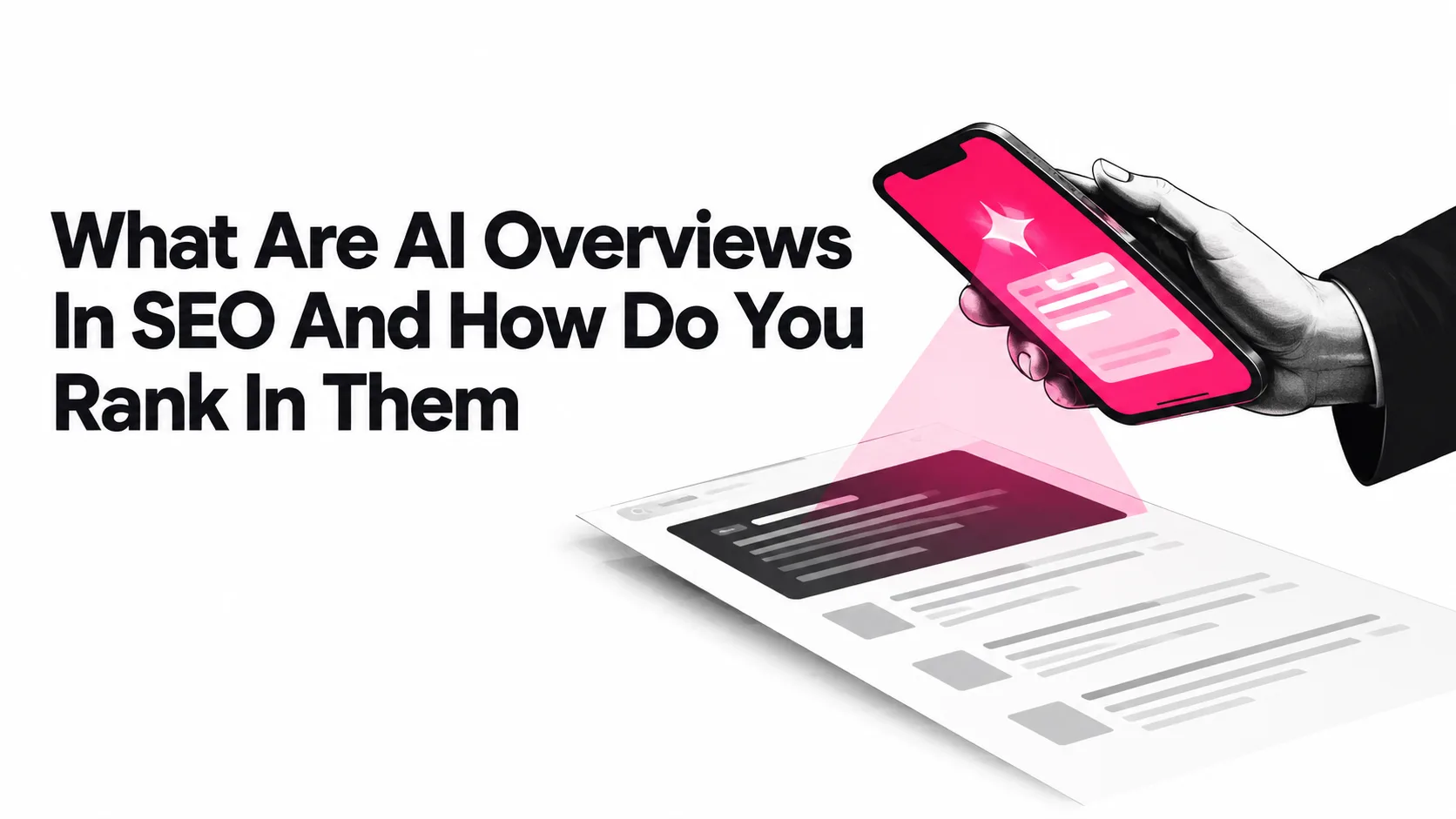
AI Overviews are Google’s AI-generated summaries that appear above organic results for mostly informational queries. You rank in them by being a clearly structured, trustworthy, technically sound source that Google can cite. Victoria Olsina treats them as a citation game, and the fundamentals of search engine optimisation still decide who gets picked.
Definition: what AI Overviews are
Start with what breaks. A searcher asks a question, Google answers it at the top of the page, and your page never gets the click.
They were previously known as Google SGE (Search Generative Experience), according to the IONOS Digital Guide.
The Digital Marketing Institute describes them as Google’s generative AI summaries on results pages. Large language models do the summarising.
Plain language callout
Google reads several pages, writes the answer itself, and links to the pages it trusted.
Takeaway: if your page is not one of those links, the overview is a wall between you and the searcher.
How AI Overviews work and what to fix first
Google now combines traditional search results with generative AI answers. The system analyses the query, identifies related topics, pulls relevant information from across the web and writes a summary with source links.
It does not rely on keywords alone. IONOS notes it weighs meaning, relevance and trustworthiness.
Where they appear
AI Overviews typically sit at the top of the results. Semrush notes they sometimes appear below sponsored results and even below unpaid results.
Their example query is “how to lose weight”. Search it and Google writes the answer before you see a single blue link.
They appear mainly for informational searches. They are much less common for navigational or transactional queries, according to IONOS.
Semrush also reports that Google has widened the availability of AI Overviews beyond its initial experiment in Search Labs.
Tactic checklist table
This is the table the vendor explainers should have included. Each tactic is framed by what fails without it.
| Tactic | What breaks without it | Source |
|---|---|---|
| Clear structure | Google cannot lift a clean answer, so it lifts a competitor’s | IONOS best practices |
| FAQ sections | Question-shaped queries find no matching answer block on your page | IONOS best practices |
| Reliable sources | Your claims look unverified next to cited competitors | IONOS best practices |
| Multimedia | Pages read thin against richer sources on the same topic | IONOS best practices |
| Performance tracking | You lose clicks and never see where or why | IONOS best practices |
| Solid technical SEO | Pages that crawl or render badly never enter the candidate pool | IONOS best practices |
| Know the placement | You misread rank one as top of page when the overview sits above it | Semrush |
| Match query type | You chase overviews on transactional terms where they rarely show | IONOS |
Worked example
Take “how to lose weight”.
A page that opens with a two-sentence direct answer, then a numbered method, then an FAQ block, hands Google a ready-made citation. Same topic. Different outcome.
Takeaway: fix structure and technical health before you write another word of content.
Why AI Overviews matter for traffic and visibility

The failure case first. IONOS states organic click-through rates tend to fall when AI Overviews appear.
Semrush cites a Pew Research Centre report: users clicked traditional result links 8% of the time with an AI Overview present, versus 15% without one.
You also get limited control over how your content is displayed. IONOS lists that, plus the risk of inaccurate information, as core disadvantages.
The upside is narrower but real. Well-structured, trustworthy content can still gain visibility as a cited source.
- Web3 and crypto brands. Buyers ask explanatory questions before they touch a token or protocol. Being the cited source is trust you cannot buy, which is why crypto SEO now has to account for AI answers.
- SaaS. Comparison and “how does X work” queries are informational.
- FinTech. Accuracy is non-negotiable. A misquoted summary costs more here, so clear, sourced pages matter, as in Victoria Olsina’s banking and financial services SEO case study.
Founders and CMOs Victoria Olsina talks to want growth from Google, ChatGPT and other LLM search surfaces at once. Victoria Olsina’s piece on Web3 marketing tactics to rank everywhere covers that wider picture.
Takeaway: measure success as citations plus clicks, not clicks alone.
Common misconceptions
Misconception: AI Overviews replace SEO
Reality: solid technical SEO and clear structure still drive citation. IONOS lists both as best practices. The overview draws from pages Google already trusts.
Misconception: they appear for every query
Reality: they appear mostly for informational queries. Google shows them when it decides a summarised answer helps. Semrush data shows the mix is widening, so check your own terms.
Misconception: AI content is automatically penalised
Reality: the question is quality, not authorship. Inaccurate, thin or unhelpful pages fail whoever wrote them. AI content systems need a human edit, and the edit is where the value lives. See Victoria Olsina’s take on automating SEO content creation with AI and Make.
Misconception: you can control the display
Reality: control is limited. Google decides what to summarise and highlight. You control the source material, so make it unambiguous.
Takeaway: write pages that survive being summarised by a machine.
Related concepts
Google SGE
Search Generative Experience was the Search Labs experiment that became AI Overviews.
Generative engine optimisation (GEO)
GEO is the practice of shaping content so generative systems cite it. Victoria Olsina offers LLM and GEO optimisation, and LLM SEO for Web3 is where she applies it.
LLM SEO
LLM SEO targets visibility inside large language model answers such as ChatGPT. Agents are changing how that content gets produced, which Victoria Olsina covers in AI agents in Web3 content SEO.
Featured snippets
A featured snippet quotes one page verbatim. An AI Overview writes a new answer from several pages.
Zero-click search
A zero-click search ends on the results page. Semrush notes AI Overviews can push more searches this way.
Takeaway: these terms overlap, but the goal is the same: be the source machines quote.
How to get started today

Four actions. None needs a new budget line.
- Restructure your top informational pages. Put a one or two sentence direct answer under each H2. Victoria Olsina’s Learn Web3 SEO page is a good primer on structuring for search.
- Add FAQ sections. Use the real questions your buyers ask. Answer each in under 40 words.
- Fix technical SEO. Crawlability, rendering and speed come first. Technical SEO is a core part of what Victoria Olsina sells, because nothing else works without it.
- Track performance in Google Search Console. Watch impressions against clicks on informational pages. Rising impressions with falling clicks is the overview signature.
If you need tooling, start with Victoria Olsina’s list of AI SEO tools.
Takeaway: publishing more is easy. Publishing something Google can cite is the actual job.
Conclusion

AI Overviews take clicks. They also hand citations to the sources Google trusts most.
Structure your answers, fix your technical foundations and track the gap between impressions and clicks. Then read Victoria Olsina’s guide to automating SEO content with the NeuronWriter API and build pages Google wants to quote.
FAQ: Frequently Asked Questions
Can I use AI content for SEO?
Yes. AI-assisted content can perform if it is accurate, well structured and genuinely useful. Victoria Olsina’s position is that the human edit, fact-checking and clear answers decide results, not which tool drafted the text.
Does Google penalise AI-written content?
Not simply for being AI-written. Pages fail when they are inaccurate, thin or unhelpful. Focus on quality, reliable sources and clear structure, and judge every page by whether it actually answers the question.
How does AI work in Google?
Google uses large language models to read a query, identify related topics and pull information from multiple web pages. It then writes a short summary with source links and shows it above the organic results.
What is search optimisation in AI?
It is the work of making content easy for AI systems to understand and cite. That means direct answers, FAQ sections, reliable sources, multimedia, sound technical SEO and ongoing tracking of how pages perform.
Do AI Overviews reduce clicks?
Yes, organic click-through rates tend to fall. Semrush cites Pew Research Centre data showing users clicked traditional links 8% of the time with an overview present, versus 15% without one.
Which queries trigger AI Overviews?
Mostly informational queries, where a summarised explanation helps the searcher. They are much less common for navigational or transactional searches, though Semrush reports the share of other query types is growing.
Get your brand cited in AI search
Victoria Olsina’s AI SEO and GEO service helps crypto, fintech and AI brands get ranked on Google and cited by ChatGPT, Perplexity and Google AI Overviews. Book a free strategy session to see where your brand stands in AI search today.