It also means writing content AI search can select: fresh, authoritative, structured and semantically clear.
This guide is for founders who want results in Google and in LLM answers. Skill level: intermediate. If content is your bottleneck, start with Victoria Olsina’s guide to using AI for content marketing.
What you’ll need

- An LLM chat tool such as ChatGPT for research and drafting.
- Google Search Console access for your domain.
- A crawler such as Screaming Frog for technical checks.
- A keyword tool for volume and difficulty data.
- An editor with protected time to fact-check every draft.
AI does the fast work. Every row below has a failure case, so every row has a check.
| Task | What AI does | What breaks if unchecked | Verification check |
|---|---|---|---|
| Keyword research | Suggests terms, clusters and intent | Terms with no fit for your product | Confirm volume and fit in your keyword tool |
| Content drafting | Produces outlines and first drafts | Generic copy, invented figures | Line-by-line fact check against sources |
| On-page optimisation | Proposes titles, headings, meta copy | Titles that miss the query intent | Compare against the current top results |
| Link building | Finds prospects and internal link options | Irrelevant or low-quality links | Manual review of every target page |
| AI answer visibility | Restructures sections into answer units | Vague sections no assistant can quote | Each heading answers one question in its first lines |
AI tools now automate parts of keyword research, content optimisation and link building. Takeaway: nothing in this table ships without a human signing off its check column.
Before you start

Here is what breaks first: a team bulk-rewrites pages with AI and rankings drop with no baseline to compare. Export current queries, clicks and top pages from Search Console before you change anything.
Then write down what AI never publishes unreviewed: claims, figures, and any finance or YMYL copy.
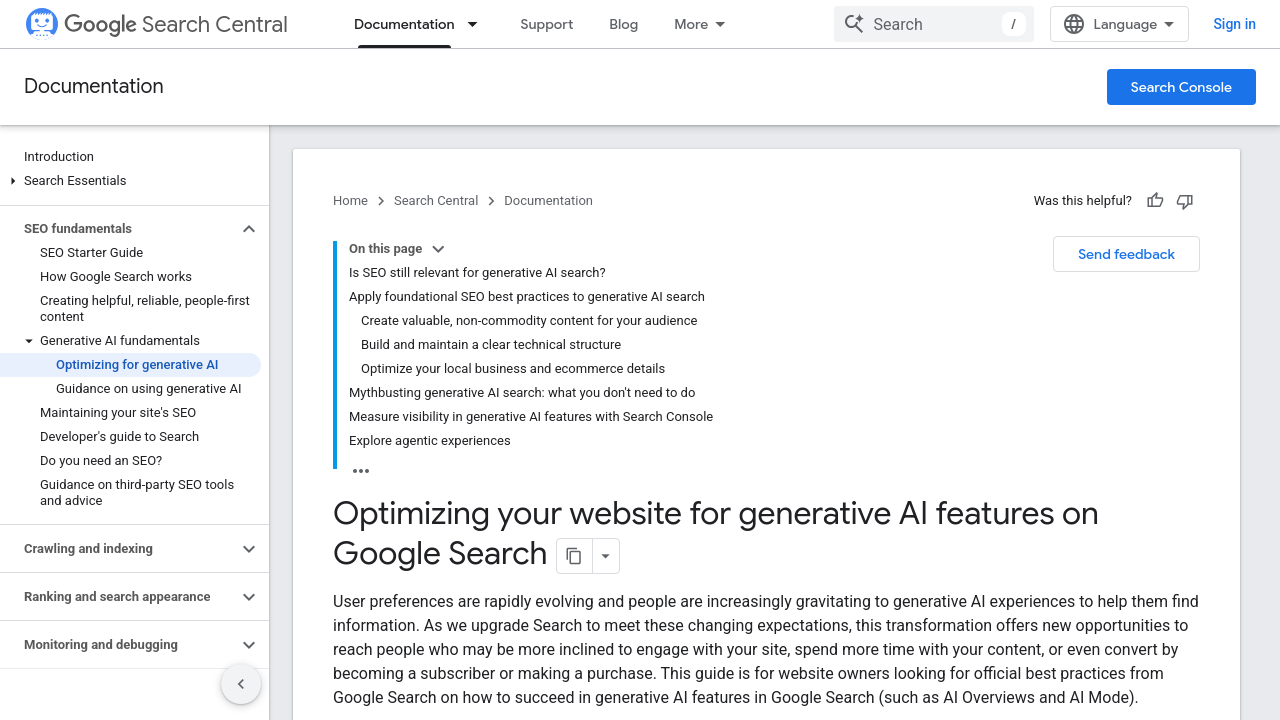
Google’s own guidance is blunt: visibility in its generative AI features rests on foundational SEO. Takeaway: baseline first, rules second, prompts third.
Step-by-step: use AI for SEO
1. Define the search intent per page
Write one sentence per page stating who searches, what they want and what they do next. Ask the LLM to classify intent, then correct it yourself.
Verification: the top five Google results for the term match the format you plan to publish.
2. Run AI-assisted keyword and topic research
Prompt the LLM to list keywords and subtopics for your product, with reasons. An AI tool never knows your business as well as you do, so vet every suggestion.
Verification: every kept keyword has confirmed volume in your keyword tool and a clear link to something you sell.
3. Analyse the top results for gaps
Paste the headings of the top posts into the LLM and ask what they all miss. Practitioners describe this exact loop: find topics, analyse top posts, then optimise.
Verification: you can name one section your page will have that no ranking page offers.
4. Draft with a structured prompt, then edit hard
Give the model the intent sentence, the outline, the audience and the sources it may use. Then cut every generic line and add first-hand detail only you can supply. Drafting is the easy part. Editing is the job.
Verification: every number in the draft traces to a named source, and no paragraph could sit on a competitor’s site unchanged.
5. Optimise titles, headings and internal links
Ask AI for five title options and a heading outline, then pick and rewrite.
Verification: the title contains the main term, each H2 covers one subtopic, and every new page has at least two relevant internal links pointing in.
6. Structure content for AI answers
Treat each heading as an answer unit. Put the direct answer in the first sentence under it, then the detail.
Microsoft Advertising notes that assistants like Copilot parse content into smaller pieces and assemble answers from several sources. Takeaway: a section that only makes sense in context rarely gets quoted.
Verification: read any H2 section in isolation; it should still answer its heading.
7. Check facts, schema and technical health
Crawl the site with Screaming Frog. Fix broken links, duplicate titles and missing metadata, then validate any schema markup you add.
Crawlability, metadata, internal linking and backlinks remain essential for discoverability. If you are moving platforms, follow Victoria Olsina’s checklist on website migration SEO best practices first.
Verification: the crawl returns no critical errors and Search Console shows the page indexed.
8. Measure and refine
Compare clicks and queries against your baseline after a few weeks. Track AI referral traffic in analytics as its own segment.
Refresh pages that slip, since freshness is one of the qualities AI search rewards.
Verification: each refreshed page shows a dated change log and a before-and-after metric.
Where AI search changes the work
AI SEO covers Google’s AI Overviews and answers from ChatGPT, Gemini and Perplexity. You will also see it called GEO or AEO.
The shift is simple. Ranking gets you found. Selection gets you quoted.
Microsoft Advertising reports that AI referrals to top websites rose 357% year on year in June 2025. That traffic goes to content that is fresh, authoritative, structured and semantically clear.
The fundamentals do not change. Google states that its generative features run on the same core ranking and quality systems. For more, read getting found in AI search and see LLM SEO.
For Web3 teams, see Victoria Olsina’s Web3 SEO case study. Takeaway: optimise for Google and LLMs with one content system, not two.
Troubleshooting

Symptom: pages read generic
Cause: the prompt had no product detail, opinion or data.
Fix: add first-hand detail, real examples and a clear point of view before publishing.
Symptom: facts are wrong
Cause: the model filled gaps with plausible guesses.
Fix: verify every figure against a named source, and delete anything you cannot trace.
Symptom: traffic does not move
Cause: the page format does not match search intent.
Fix: re-check intent against the current top results and rebuild the outline.
Symptom: not cited in AI answers
Cause: sections are vague, buried or thin on authority.
Fix: improve structure with answer-first headings, update stale pages and earn mentions from credible sites.
Conclusion
The workflow is eight steps: intent, research, gap analysis, drafting, on-page work, answer structure, technical checks and measurement. Each step has a check, and each check stops a failure from shipping.
AI speeds up the work. You still own the judgement. Next, read Victoria Olsina’s AI marketing strategy for founders to plan where this workflow fits in your growth stack.
FAQ: Frequently Asked Questions
What is SEO for AI?
SEO for AI is the practice of making content visible in AI-driven results such as Google’s AI Overviews, ChatGPT, Gemini and Perplexity. It builds on classic SEO and adds answer-first structure and clear, current, authoritative content.
Does Google use artificial intelligence?
Yes. Google uses machine learning to inform its ranking algorithms, and it now shows AI Overviews in search results. Marketers cannot control those systems directly, but understanding them leads to better-informed SEO decisions and content choices.
Is SEO paid or free?
Organic rankings are free; Google does not sell them. The work behind them is not. You pay in time, tools, writers or specialist help. The cost depends on site size, competition and how much content you need.
Can AI be used for digital marketing?
Yes. AI supports keyword research, content drafting, ad copy, analytics and automation across digital marketing. It works best as a speed layer, with humans owning strategy, positioning, fact checks and the final call on what gets published.
Which AI tools should a founder start with?
Start small: one LLM chat tool for research and drafts, Google Search Console for data, a crawler for technical checks and a keyword tool. Add specialised AI SEO tools only once this core workflow runs reliably.
Get your brand cited in AI search
Victoria Olsina’s AI SEO and GEO service helps crypto, fintech and AI brands get ranked on Google and cited by ChatGPT, Perplexity and Google AI Overviews. Book a free strategy session to see where your brand stands in AI search today.